- Top Pick: SABRENT USB 3.0 to 2.5in SATA Adapter Cable for SSD & HDD, UASP (EC-SSHD)
- Best Value: SDD Hard Drive Caddy Case,Universal 9.5mm SATA to SATA 2nd SSD HDD Hard Drive Caddy Adapter Tray Case for DELL HP Lenovo ThinkPad ACER Gateway ASUS Sony Samsung MSI Laptop
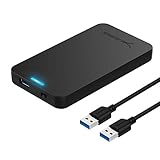
- Premium Choice: SABRENT 2.5in SATA to USB 3.0 Tool-Free SSD/HDD Enclosure (EC-UASP)
What’s the real difference
An HDD stores data on spinning magnetic platters, read by a moving arm with a head on the end of it. That mechanical setup is why hard drives are slow and why they eventually fail from wear. An SSD has no moving parts. It stores data in flash memory chips and reads/writes electrically, which is why it’s faster and more durable in day-to-day use. That’s the whole story mechanically, and it explains almost every practical difference below.
Speed, in numbers you’ll actually notice
A 7200 RPM HDD does sequential reads around 150-200 MB/s. A SATA SSD does 500-550 MB/s. An NVMe SSD on a PCIe 3.0 or 4.0 slot does 2,000-7,000+ MB/s depending on generation. Sequential speed matters for copying large files, but the number that actually changes how a PC feels day to day is random read/write performance and latency. HDDs have seek times of 8-12ms per operation because the head has to physically move. SSDs measure latency in microseconds. That gap is why a Windows boot that takes 40-60 seconds on an HDD takes 10-15 seconds on an SSD, and why a game with lots of small texture streaming (open-world titles especially) has noticeably less pop-in and stutter on an SSD.
As an Amazon Associate we earn from qualifying purchases at no extra cost to you.




| Metric | HDD (7200 RPM) | SATA SSD | NVMe SSD |
|---|---|---|---|
| Sequential read/write | 150-200 MB/s | 500-550 MB/s | 2,000-7,500 MB/s |
| Random access latency | 8-12 ms | ~0.1 ms | ~0.02-0.05 ms |
| Typical boot time (OS drive) | 40-60 sec | 10-15 sec | 8-12 sec |
| Cost per TB (2024-25 street price) | $18-25 | $45-60 | $55-90 |
| Rated endurance | Not TBW-rated; MTBF ~1M hours | 150-600 TBW per TB | 150-600 TBW per TB |
How each one actually dies
HDDs fail mechanically and often gradually: you’ll hear clicking, grinding, or whining before total failure, and tools like CrystalDiskInfo can flag rising reallocated sector counts well in advance. They’re also vulnerable to physical shock — drop a running laptop with an HDD and you can get a head crash that scratches the platter, which is unrecoverable without a cleanroom. Heat and vibration from other drives in the same enclosure shorten their life too.
SSDs fail differently. Flash memory has a finite number of write cycles per cell, measured in TBW (terabytes written). A typical 1TB consumer SSD is rated for 300-600 TBW, which for a normal desktop user (maybe 20-40GB written per day) works out to decades. You will not wear one out doing normal computing. The more common SSD failure is controller or firmware failure, which tends to be sudden and total — one day the drive just doesn’t show up. There’s no slow warning sign like HDD clicking. This is why backups matter more with SSDs, not less, even though they’re more reliable overall.
When the cheap option is genuinely fine
I’m not going to pretend HDDs are obsolete, because they’re not. If you need 4TB, 8TB, or more for a media library, Plex server, security camera NVR, or backup target, an HDD at $18-25 per TB is simply the right tool. A 4TB SSD still costs 2.5-3x more per terabyte than a 4TB HDD, and for sequential bulk storage — movies, backups, archives — you will never notice the speed difference, because you’re not doing random small reads on that data. For that use case, browsing a internal hard drive in the 4-8TB range is the economically sane move, especially in a NAS or secondary bay where speed isn’t the bottleneck anyway.
Where HDDs don’t make sense anymore: as a boot drive, as a drive for a game library you actually play (load times, texture streaming), or in a laptop (shock risk, battery drain from spin-up, and heat). There’s no good argument left for an HDD as your primary drive in 2024.
What to actually buy
For a boot drive and your actively-played games, get an NVMe SSD if your motherboard has an M.2 slot — nearly every board since 2017 does. Prices have come down enough that a 1TB NVMe drive and a 1TB SATA SSD are often within $10-15 of each other, so there’s little reason to choose SATA unless you’re filling an older system that only has SATA ports or you’ve run out of M.2 slots. Shopping for an NVMe SSD in the 1-2TB range covers most people’s OS plus a reasonable game library without needing to juggle installs.
If you’re upgrading an old laptop or budget desktop that’s still on a hard drive, a basic SATA SSD swap is the single biggest felt-speed upgrade you can buy for under $60, bigger than a CPU or RAM upgrade in most cases, because it removes the mechanical bottleneck entirely.
The practical setup for most people
If you need both speed and capacity, don’t pick one drive type — run both. NVMe or SATA SSD for Windows, your applications, and the games or projects you’re actively using, and a 4TB+ HDD for everything you’re storing but not actively hammering with random reads: media, finished projects, backups, downloads. This is cheaper than an all-SSD setup of equivalent total capacity and gives you SSD-level responsiveness where it’s actually felt. Most prebuilt and custom PCs in this price range are configured exactly this way for a reason — it’s not a compromise, it’s just matching the drive to the job.