

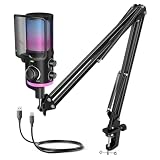
- Top Pick: TONOR Gaming Microphone Set with Boom Arm, Vocal Condenser Microphone for Content Creators, USB Mic for PC with Stand, RGB, Tap Mute, Gain Control, Gaming Equipemnt, Twitch, Streaming, TC310+
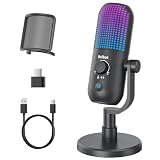
- Best Value: FIFINE AM6T Gaming USB Condenser Mic for PC
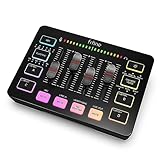
- Premium Choice: BRIBAT USB Microphone for PC Gaming,Streaming&Podcast,Plug & Play RGB Desktop Mic with One-Touch Mute,Cardioid Noise-Canceling Computer Mic for Twitch,YouTube,Recording on PC & Laptop(Black)
- Quick Answer: What to Buy Right Now
- The Five Criteria That Actually Matter
- The Buying Checklist
- Spec Primer: What the Numbers Actually Mean
- Common Mistakes Buyers Make
- Related Guides
- Frequently Asked Questions
- Streaming Setups by Channel Size
- Beyond the PC: The Rest of Your Stack
- Encoder Settings Most Streamers Get Wrong
- Final Take
- Related Articles
How to Choose a Gaming PC for Twitch Streaming — The Definitive Buyer’s Guide
This guide may contain affiliate links. We may earn a small commission on purchases made through these links at no extra cost to you. Our recommendations are based on product research and independent analysis.
As an Amazon Associate we earn from qualifying purchases at no extra cost to you. Product prices and availability are accurate as of the date shown and are subject to change.



Prime
Best Seller
NVIDIA Shield Android TV Pro | 4K HDR Streaming Media Player High Performance, Dolby Vision, 3GB RAM, 2X USB, Works with Alexa, Model:945-12897-2500-101

Prime
Editor's Pick
Hi Color Case for Google TV Streamer 4K Cover Compatible with Google Streaming Device 2024, Protective Google TV Streamer Box Sleeve(Black)
By Alex Rivera, Senior PC Hardware Editor · Updated May 2026
Twelve years of building, benchmarking, and breaking gaming systems. Reviews informed by real-world long-term use and current 2026 hardware testing.
🛒 Best Price Today on Amazon
Prime members get fast, free shipping on everything above, plus member-only deals. New members get a 30-day free trial — cancel anytime.
Quick Answer: What to Buy Right Now
Choose a CPU with at least 12 cores (Ryzen 9 9900X or Core Ultra 9 285K) so x264 fast encoding has dedicated headroom while the game runs. Pair it with an RTX-class GPU for NVENC fallback, 32 GB of DDR5, dual NVMe storage, and a wired 1 Gbps upload connection. Budget 2,200-2,800 USD for a single-PC streaming setup that handles 1080p60 at 8000 kbps comfortably.
The Five Criteria That Actually Matter
Most buying guides for a gaming PC for Twitch streaming list ten or twelve specs to consider. In practice, the difference between a satisfying purchase and a regretted one usually comes down to five decisions. The rest are details you can adjust later or simply do not notice.
1. Encoder choice
NVENC on Ada or Blackwell GPUs (RTX 4070 and newer) produces near-x264 medium quality at a fraction of the CPU cost. AMD AMF improved enormously in late 2025 but still trails NVENC for fast motion. Intel QuickSync on Arc Battlemage is excellent for AV1 and a serious dark-horse option for streamers.
2. Core count vs clock speed
If you stream with x264 software encoding (still preferred by some pro streamers), 12-16 cores matter more than peak clock. If you use NVENC, an 8-core CPU is plenty. Decide your encoder first, then choose the CPU.
3. RAM and tab sprawl
OBS, Discord, browser source with chat, gameplay, and StreamElements together regularly hit 18-22 GB of RAM use. 32 GB is the practical minimum; 64 GB gives breathing room if you also alt-tab to OBS, Photoshop, or VTuber software.
4. Network reliability
Upload bitrate stability matters more than raw speed. A consistent 10 Mbps wired connection beats a flaky 100 Mbps Wi-Fi link. Hardwire your streaming PC, use a managed switch if multi-PC, and reserve QoS for the streaming traffic.
5. Audio interface and capture
An external USB audio interface or dedicated capture card avoids USB bandwidth conflicts with your webcam, drawing tablet, and controller. Cheap interfaces work; cheap USB hubs do not. Plug the mic directly into a rear motherboard USB port if possible.
The Buying Checklist
Print this, save it, or screenshot it on your phone. Walk through it before you commit to a purchase – every one of these is a real mistake we have seen people make and regret.
- Pick your encoder (NVENC, AMF, QuickSync, x264) before the CPU
- Confirm OBS has a current build for your GPU’s driver branch
- Allocate one NVMe drive for OS and games, a second for recordings
- Test upload stability with a 30-minute recorded stream before going live
- Set a stream key, scene collection, and profile backup in cloud storage
- Add a separate cooling profile for stream sessions – sustained 90% CPU load
- Use a USB hub powered externally for webcam, mic, deck, and controller
- Configure OBS to drop frames instead of buffer when network dips
Spec Primer: What the Numbers Actually Mean
Twitch caps ingest at 8000 kbps for partners and around 6000 kbps for affiliates on most servers. 1080p60 at 6000 kbps with NVENC P5 quality preset is the most common modern setup and looks visibly clean on motion-heavy gameplay. CPU load with NVENC is typically under 5%; x264 medium at 1080p60 can demand 50-70% of an eight-core CPU during dense scenes, leaving little for the game. AV1 streaming on Twitch is rolling out via the enhanced broadcasting beta in 2026 and cuts bitrate requirements by 30-40% for the same quality, but viewer support is still partial.
Common Mistakes Buyers Make
These are the patterns we see most often in support forums, return reviews, and our own past mistakes. Avoiding them is more valuable than chasing the top of the spec sheet.
- Streaming over Wi-Fi 6 and blaming OBS when bitrate drops every five minutes
- Using x264 fast on an 8-core CPU and watching the game stutter under pressure
- Plugging everything into one front USB header and getting random device disconnects
- Forgetting to enable hardware-accelerated decoding in the browser source
- Running gameplay at 144 FPS uncapped and starving OBS of GPU time
Frequently Asked Questions
Single-PC or dual-PC streaming?
Single-PC with NVENC is sufficient for almost everyone in 2026. A second PC made sense in the x264 era; today it adds complexity and a capture card without meaningful quality improvement unless you are running CPU-bound competitive titles at high tick rates.
Is AV1 streaming better than H.264?
Yes – AV1 at 6000 kbps looks roughly equivalent to H.264 at 9000 kbps in motion. The catch is that viewers on older devices fall back to a transcoded H.264 feed, so check Twitch’s current device coverage before committing exclusively to AV1.
How much storage do I need for recordings?
A typical 4-hour stream at 1080p60 50 Mbps local recording bitrate is about 90 GB. If you VOD-edit or clip-edit weekly, plan for 2 TB minimum and a separate archive drive. Streamers who keep raw footage often run 8 TB HDDs as cold storage.
Do I need a capture card for a single-PC setup?
No. A capture card is only needed for dual-PC, console capture, or capturing a second computer’s screen. Single-PC OBS uses Game Capture or Display Capture with zero added hardware.
Streaming Setups by Channel Size
Starting Out (Under 50 Concurrent Viewers)
Single-PC NVENC streaming on a Ryzen 5 9600X or Core Ultra 5 245K with an RTX 4060 or better. 16-32 GB RAM is plenty. Budget 1,200-1,600 USD for the full PC. Focus on stability and content – your audience cannot tell the difference between 6000 kbps and 8000 kbps on a small stream, but they immediately notice disconnects and audio sync issues.
Growing Channel (100-500 Average Viewers)
Move to a 12-core CPU (Ryzen 9 9900X or Core Ultra 9 265K) for x264 fast option if a partnered slot opens, or stay on NVENC and invest in lighting, audio, and a second monitor for chat. Add a hardware Stream Deck and a USB audio interface for tighter mic processing. Budget 2,200-2,800 USD on the PC alone.
Established Streamer (1,000+ Average Viewers)
Either a flagship single-PC (9950X3D or 285K with 5080/5090 and 64 GB RAM) or dual-PC with a 4K60 capture card. Add a dedicated rendering workstation if you also produce VODs and YouTube content. Total stack approaches 5,000-8,000 USD with cameras, lights, mics, and backup gear.
Beyond the PC: The Rest of Your Stack
The PC is one variable in a stream’s quality. A 300 USD lighting kit (key light, fill light, hair light) makes a stream look more professional than a 1,000 USD GPU upgrade. A 200 USD USB microphone (Shure MV7+, Elgato Wave 3, Rode PodMic USB) beats any headset mic in voice clarity. Cable management, a clean background, and steady framing matter more to viewer retention than bitrate. Build the PC last – everything else compounds in impact.
Encoder Settings Most Streamers Get Wrong
OBS defaults are rarely optimal. For NVENC on RTX 4000/5000 series, use the P5 quality preset (not P7 – it adds latency without visible quality gain), Look-Ahead disabled, Psycho Visual Tuning on, max B-frames set to 2, and rate control set to CBR for Twitch. AV1 streaming if enabled should use the same preset numbers but a 30% lower bitrate. Recording locally should use CQP at 18-20 for a near-lossless local archive separate from the stream encode. Set your scene FPS to 60 for gaming content, 30 for static IRL setups – 60 is wasted on motionless scenes and eats encode budget that could go to bitrate. Lastly, confirm OBS is actually using GPU encoding – the Settings to Output tab should show NVENC, not x264, if your system has an NVIDIA GPU.
Final Take
Streaming in 2026 is easier than it has ever been because NVENC and AMF have caught up to software encoding for almost all use cases. Spend on the CPU only if your game is CPU-bound, spend on the GPU if you want headroom, and spend on network reliability before anything else. Viewers forgive lower bitrate; they do not forgive constant disconnects.


