As an Amazon Associate we earn from qualifying purchases
A surge protector is the cheapest insurance in a desk or gaming setup, but the budget end of the market is also where vague labeling is most common. Plain power strips with no surge components at all sit next to genuinely certified protectors, and the boxes do not always make the difference obvious. The good news is that established brands publish the figures that matter — joule rating, clamping voltage, safety listing, outlet layout and warranty terms — so a value pick can be chosen on specifications rather than guesswork. This guide compares four verified models for a PC desk, console corner or home office, and explains how to read the ratings before the individual picks.
How to Choose a Budget Surge Protector
Joule rating. This is the amount of surge energy the protector’s metal oxide varistors can absorb over their working life. Higher is better as a rough endurance guide, and the rating is cumulative — a protector that has absorbed years of small spikes may have little capacity left, which is why a protection-status LED matters. Treat the joule figure as the manufacturer’s published specification, not as a promise about any single event.
Clamping voltage and UL 1449. Clamping voltage is the level at which the protector starts diverting excess voltage; lower is generally better. The more useful figure on a datasheet is the UL 1449 let-through rating (also called the suppressed voltage rating): the voltage the standard’s test allows through to connected equipment. Look for a protector that is listed to UL 1449 by a recognized testing laboratory — UL itself, or ETL, which tests to the same standard — rather than one that merely says “surge protection” with no listing behind it.
Outlets and spacing. Count what your setup actually plugs in, then look at spacing. Power bricks and wall adapters cover neighboring sockets on tightly packed strips, so transformer-spaced outlets or a two-row layout preserve usable capacity. Sliding safety covers on unused outlets are a useful extra in homes with children.
USB charging. Built-in USB ports remove phone and headset chargers from the AC row. Check whether the output is shared across ports and whether a USB-C port supports Power Delivery for faster charging of larger phones and handhelds.
Cord and form factor. A corded strip suits a desk that sits away from the wall; a longer cord with a flat or right-angle plug fits behind furniture. A wall tap plugs directly into the receptacle, adds no cable clutter, and works well for a console or charging corner, but it cannot reach a desk positioned away from the outlet.
Warranty and equipment policy. Several established brands back their protectors with a long or lifetime limited warranty and a connected-equipment policy that covers gear damaged while properly connected, subject to the maker’s terms and registration conditions. Read those terms rather than treating the policy headline as a guarantee.
If your setup grows beyond this tier, the step-up options in our guide to surge protectors built for gaming PC setups cover higher-capacity models; the four protectors below are the strongest verified choices in the value segment.
At a Glance
| Model | Outlets | Maker-stated joule rating | USB | Cord / form | Listing stated by maker |
|---|---|---|---|---|---|
| Eaton Tripp Lite TLP808B | 8 (3 transformer-spaced) | 1,440 joules | None | 8 ft cord, right-angle plug | UL 1449, UL 1363 |
| Belkin 6-Outlet with USB-C (SRA008) | 6 | 1,680 joules | USB-C PD + USB-A | Corded strip, wall-mountable | ETL listed |
| Amazon Basics 6-Outlet | 6 (1 transformer outlet) | 790 joules | None | 6 ft cord | Not stated in listing |
| APC SurgeArrest Essential P6WU2 | 6 | 1,080 joules | 2 USB ports | Wall tap, no cord | UL 1449 rating on datasheet |
Eaton Tripp Lite TLP808B — Most Outlets and the Fullest Datasheet
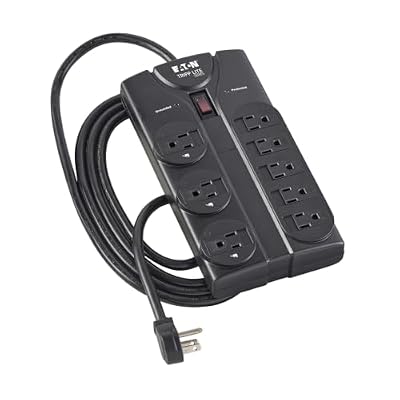
The TLP808B is the pick for a full desk: a PC, two monitors, speakers, a console and chargers quickly fill eight outlets, and three of them are widely spaced so bulky transformers do not block their neighbors. Tripp Lite’s datasheet is the most complete in this group. It rates suppression at 1,440 joules with a clamping voltage of 150V RMS and UL 1449 let-through ratings of 330V line-to-ground and 400V line-to-neutral and neutral-to-ground, with EMI/RFI filtering up to 40 dB. The strip is listed to UL 1449 and UL 1363.
Practical details are well covered: an 8-foot, 14-gauge cord with a space-saving right-angle plug, a lighted switch with an integrated 15-amp resettable circuit breaker, sliding safety covers, diagnostic LEDs for grounding and protection status, keyhole slots for wall or desk mounting, and automatic shutoff that cuts power if the protection circuit is compromised. Tripp Lite backs it with a lifetime limited warranty and its Ultimate Lifetime Insurance connected-equipment policy in the US, Canada and Puerto Rico, under the policy’s terms. There are no USB ports, so phones still need their own chargers.
- View on Amazon: https://www.amazon.com/dp/B014JWEELK
Belkin 6-Outlet Surge Protector with USB-C and USB-A (SRA008) — Best with USB Charging

Belkin’s six-outlet strip carries the highest maker-stated joule rating in this group at 1,680 joules, and it is the only pick here with modern USB charging built in: a USB-C port with Power Delivery alongside a USB-A port, which Belkin describes as delivering fast charging for compatible phones and handhelds while the AC outlets run the desk itself. That removes two charging bricks from the outlet row entirely.
The unit is ETL listed, wall-mountable, and fitted with an LED indicator and overvoltage protection, with an electrical rating of 15 amps and 125 volts. Six outlets suit a single-monitor desk — PC, display, speakers, a lamp and a console — better than a multi-screen battlestation, and Belkin does not publish a UL 1449 let-through figure in its listing the way Tripp Lite does, so buyers who prioritize documented clamping performance over USB convenience should weigh the TLP808B above it. For a tidy home-office desk where charging matters daily, this is the most convenient option in the segment.
- View on Amazon: https://www.amazon.com/dp/B0CCYKVVRH
Amazon Basics 6-Outlet Surge Protector — The Simple, Low-Cost Strip

Amazon’s own Basics strip is the straightforward choice for a small setup or a secondary location — a guest room PC, a printer station, a router shelf. Its listing states 790 joules of three-line surge protection, six outlets including one transformer outlet, a red LED that indicates active protection, and a 15-amp circuit breaker, on a 6-foot, 14-gauge cord. The electrical rating is 15 amps, 125 volts, 1,875 watts.
The trade-offs match the segment: the joule rating is the lowest here, there are no USB ports, and the listing does not name a UL 1449 let-through rating, so this is basic protection for lower-value, everyday electronics rather than the strip to put in front of an expensive gaming rig. Within that honest role — real surge components, a protection indicator and a breaker at the bottom of the value tier — it does its job, and its compact body is easy to mount or tuck behind a desk.
- View on Amazon: https://www.amazon.com/dp/B00TP1C1UC
APC SurgeArrest Essential 6-Outlet Wall Tap with USB (P6WU2) — Best Where a Cord Will Not Work

APC’s wall tap turns one duplex receptacle into six surge-protected outlets — three on each side — plus two USB charging ports sharing 2.4 amps, with no cord at all. It suits a TV and console corner, a bedside charging point or a kitchen counter where a corded strip would be clutter. APC’s datasheet rates it at 1,080 joules with a UL 1449 suppressed voltage rating of 400V, and front LEDs report protection status and building wiring faults, a diagnostic touch the basic strips here do not offer.
APC backs the SurgeArrest Essential line with a lifetime warranty and a lifetime equipment protection policy under its terms. The limits are physical: everything must sit within reach of the wall outlet, the side-facing outlets can crowd each other with large bricks, and there is no cord to route power up to desk height. Where the gear already lives at the wall, it is the neatest solution in this group.
- View on Amazon: https://www.amazon.com/dp/B0046BGUWG
Who Should Choose What
- Full gaming or multi-monitor desk: the Tripp Lite TLP808B — the most outlets, transformer spacing, the longest cord and the most completely documented protection ratings.
- Home-office desk with daily phone charging: the Belkin SRA008 — the highest stated joule rating here plus USB-C Power Delivery built in.
- Small or secondary setup on the tightest budget: the Amazon Basics strip — basic, honestly specified protection for everyday electronics.
- Console corner or charging point at the wall: the APC P6WU2 — six outlets and USB charging with no cord to manage, plus wiring-fault indication.
Whichever model you choose, replace any surge protector whose protection LED has gone out, never daisy-chain protectors or plug one into another strip, and keep the total load within the 15-amp rating every model here shares.
FAQ
How many joules does a gaming PC actually need?
There is no official threshold. The joule rating is the manufacturer’s statement of how much surge energy the unit can absorb across its life, so a higher figure generally means more headroom before the protection wears out. For a valuable PC, prioritize a listed protector with a documented UL 1449 let-through rating and a protection-status LED, and treat the joule count as a secondary comparison.
Is a power strip the same as a surge protector?
No. A plain power strip only adds outlets and may include nothing more than a switch or breaker. A surge protector contains components that divert excess voltage and should carry a joule rating and a safety listing such as UL 1449 or an ETL listing to that standard. If neither figure appears on the packaging, assume it is a strip, not a protector.
Do surge protectors wear out?
Yes. The absorbing components degrade with every surge they handle, including small ones you never notice. A protection-status LED is the practical indicator: when it goes out, the unit may still pass power but no longer protects, and it should be replaced.
Wall tap or corded strip — which is better for a desk?
A corded strip is better for most desks because the outlets reach the equipment and a flat plug keeps furniture close to the wall. A wall tap is better where everything already sits at the receptacle — a console under a TV, for example — and where a loose cord would be a trip hazard or visual clutter.
Does a surge protector guard against blackouts?
No. A surge protector only addresses voltage spikes; it has no battery and provides no run time during an outage. Protecting a PC against blackouts and brownouts as well requires an uninterruptible power supply sized for the system.