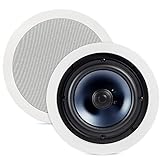
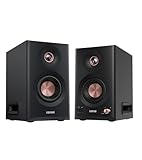
- Top Pick: PreSonus Eris 3.5 Powered Studio Monitors, Pair — 3.5” Active Near | -Field Desktop Speakers for Music Production, Gaming, Movies & Hi-Fi | 50W, Woven-Composite Woofer, Silk-Dome Tweeter, Black
- Best Value: (2) JBL 305P MkII 5" 2-Way Active Powered Studio Reference Monitors Speakers
- Premium Choice: PreSonus Eris E4.5-2-Way 4.5" Near Field Studio Monitor (Pair) | 4.5" Active Near-Field Desktop Speakers for Music Production, Gaming, Movies & Hi-Fi,Woven-Composite Woofer,Silk-Dome Tweeter
Studio monitor speakers exist to tell you the truth about a mix, which is a different job from making music sound pleasant. A consumer speaker often flatters the bass and sparkles the treble; a studio monitor aims to stay out of the way so you can hear a vocal that is too loud or a kick drum that needs a notch. Choosing the best studio monitor speakers for a desk therefore comes down to woofer size, input types, and how much room you have to place them properly.
This guide is for bedroom producers, podcasters, video editors, and gamers who want a more honest sound than laptop speakers deliver. The 2026 listings below were narrowed to real near-field monitors, and two consumer computer speaker sets from the original brief were left out because they are built for casual listening rather than critical mixing. Every verdict comes from facts stated in the product titles: driver size, tweeter type, power output, connections, and what comes in the box.
Quick Picks
As an Amazon Associate we earn from qualifying purchases at no extra cost to you.




| Product | Best for | Key spec from the title |
|---|---|---|
| PreSonus Eris 3.5 | Small desks and tight rooms | 3.5″ woofer, 50W, silk-dome tweeter, pair |
| JBL 305P MkII | Reference-minded mixers | 5″ 2-way active powered monitors |
| PreSonus Eris E4.5 | Balanced near-field setup | 4.5″ woofer, silk-dome tweeter, pair |
| M-Audio BX4 | Beginners who want software included | 4.5″ wired monitors, software suite |
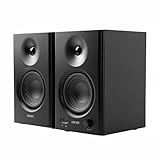
| Edifier MR4 | Compact studio and multimedia use | 4″ woofer, 1″ silk dome tweeter, Hi-Res Audio |
| Edifier MR4.5 | Flexible connections | 80W RMS, Bluetooth 6.0 LDAC, XLR/TRS/RCA/AUX |
| Edifier MR5 | Larger rooms and room correction | 110W RMS, 3-way active, room compensation |
| M-Audio BX3 | Very small spaces | 3.5″ wired monitors, software suite |
How to Choose
Woofer size and room size
Woofer diameter sets how much low end a monitor can deliver. A 3.5-inch driver, as in the Eris 3.5 and BX3, suits a small desk and a listener sitting close. Four to 4.5 inches covers most bedrooms and home offices, and a 5-inch design like the JBL 305P MkII reaches lower but needs more space between the speakers and the wall. If you mix bass-heavy music, plan for a subwoofer or headphones to cross-check. Also consider how far you sit from the speakers: the closer you are, the less woofer you need, and the more important it becomes to keep both cabinets at ear height and forming an equal-sided triangle with your head.
Inputs and connectivity
Look at the back panel connections in each title. XLR and TRS inputs, listed on the Edifier MR4.5 and MR5, are balanced connections that cut noise on longer cable runs from an audio interface. RCA and AUX inputs suit a laptop, console, or turntable. Bluetooth appears on the two larger Edifiers, which is handy for casual listening but should never be your reference path for mixing.
Power output and what it really means
Wattage figures such as 50W, 80W RMS, and 110W RMS describe amplifier output, not loudness in your room. For desk distances under about a meter, even modest power is plenty, and headroom matters more than raw output. Pay attention to whether the title says RMS, because a power number with no qualifier tells you less. Two-way and three-way designs also change how drivers split the frequency range. A bi-amped design, like the one named on the MR4.5, gives each driver its own amplifier, which is a sensible feature to look for when you plan to listen at moderate volume for long sessions.
Where entry-level models cut corners
Budget monitors usually trim cabinet quality, input variety, and tweeter refinement. The wired BX3 and BX4 prioritize simplicity, while the Eris line adds woven-composite woofers and silk-dome tweeters. Ignore bundled-software claims if you already own a digital audio workstation, and set aside buzzwords like Hi-Res until you have the interface and files to take advantage of them. Placement affects results more than most spec lines, so budget a little time for angling the speakers, keeping them off the desk surface if possible, and leaving breathing room behind the cabinets before you judge them.
The 8 Best Options
PreSonus Eris 3.5
The Eris 3.5 is a pair of 3.5-inch active near-field desktop speakers for music production, gaming, movies, and hi-fi. The title lists 50W of power, a woven-composite woofer, and a silk-dome tweeter.
- Strength: A silk-dome tweeter is stated, which points to smoother high frequencies.
- Strength: Compact enough for crowded desks.
- Trade-off: A 3.5-inch woofer limits low-end extension.
Skip it if your music is heavy on sub-bass and you have space for something larger. It makes the most sense for a producer working at arm’s length on a narrow desk, where a large cabinet would crowd the keyboard and the monitor screen.
JBL 305P MkII
The 305P MkII is a 5-inch 2-way active reference monitor, and the listing notes two units, so you receive a pair. It is the largest woofer among the true studio models here, aimed at people who want a more traditional monitoring setup.
- Strength: The 5-inch driver offers the most low-end potential on the list.
- Strength: Active and powered design means no separate amplifier is required.
- Trade-off: The title lists few connection details, so check the inputs against your interface.
Skip it if your desk is shallow and the speakers must sit close to a wall. Plan on stands or a deep desk so the cabinets can sit away from the rear wall, and angle them toward your ears for the clearest stereo image.
PreSonus Eris E4.5
This 4.5-inch pair of active near-field speakers targets music production, gaming, movies, and hi-fi, with a woven-composite woofer and silk-dome tweeter. It splits the difference between the smaller Eris 3.5 and the 5-inch JBL.
- Strength: 4.5 inches balances bass and desk footprint.
- Strength: The title names the same woofer and tweeter materials as the smaller sibling.
- Trade-off: No wattage is stated in the title.
Skip it if you need wireless or detailed power specifications up front. Buyers who want to compare it carefully against the Eris 3.5 should look at the product page for input types and power details, since the title is brief.
M-Audio BX4
The BX4 is a pair of 4.5-inch wired studio monitors for recording, mixing, and multimedia, and the title says a music production software suite is included. That extra makes it attractive to someone starting from nothing.
- Strength: Software suite included helps first-time producers get started.
- Strength: Wired design keeps the signal path simple.
- Trade-off: The title offers no tweeter or wattage details.
Skip it if you already own production software and want clearer specs. Check the listing for the full contents of the software bundle, since the title mentions it but does not name the programs.
Edifier MR4
The Edifier MR4 is a 4-inch active near-field speaker with a 1-inch silk dome tweeter and a 4-inch composite woofer. The title also mentions Hi-Res Audio and bookshelf use, so it doubles as a media speaker.
- Strength: A silk dome tweeter and composite woofer are both stated.
- Strength: Hi-Res Audio is listed for higher-quality files.
- Trade-off: A 4-inch woofer limits bass depth.
Skip it if you need a wider range of professional inputs. It is better matched to a desktop where one pair of speakers serves both music creation and everyday playback from a computer.
Edifier MR4.5
The MR4.5 is a bi-amped studio monitor with an 80W RMS figure, a 4.5-inch woofer, and a 1-inch silk tweeter. Its title lists Bluetooth 6.0 with LDAC, plus XLR, TRS, RCA, and AUX inputs, covering both pro and consumer gear.
- Strength: XLR and TRS inputs support balanced connections.
- Strength: Bluetooth LDAC is available for casual listening.
- Trade-off: More features may mean a bulkier cabinet footprint than the entry models.
Skip it if you only need a simple wired pair. Anyone who cares most about a clean, minimal signal path may prefer to leave Bluetooth unused and send audio from an interface over a balanced cable.
Edifier MR5
The MR5 is a 2.0 studio monitor with a 3-way active design and a 110W RMS figure. The title mentions Hi-Res Audio, Bluetooth 6.0, room compensation, and XLR, TRS, and RCA inputs for home studios and music.
- Strength: Room compensation is listed, which helps with placement problems.
- Strength: The 110W RMS figure is the highest in the group.
- Trade-off: Larger and more complex than the compact models.
Skip it if your desk is small or your needs are modest. A bedroom studio that is only a few steps across may not benefit from a larger three-way cabinet, and the extra size can crowd a compact workspace.
M-Audio BX3
The BX3 is the smallest wired pair here, with 3.5-inch drivers aimed at recording, mixing, and multimedia. Like the BX4, the title says production software is included.
- Strength: Small size fits tight spaces.
- Strength: Software suite included for beginners.
- Trade-off: Limited bass compared with larger models.
Skip it if you want a bigger low end for room-filling playback. Because it is so similar to the BX4 on paper, the choice between them mostly comes down to desk space and how much bass your music needs.
Which One Fits Your Situation
You work in a small bedroom or dorm
The Eris 3.5 or the M-Audio BX3 keeps the footprint low. Both use 3.5-inch drivers suited to close listening.
You record with an audio interface
The Edifier MR4.5 or MR5 give you XLR and TRS inputs for balanced connections from an interface. The MR5 adds room compensation for untreated rooms, while the MR4.5 keeps the footprint smaller; pick by how much desk depth you can spare.
You want the most traditional studio monitor
The JBL 305P MkII, with its 5-inch 2-way design, is the closest to a conventional reference monitor on the list.
You are new to production and want an easy start
The M-Audio BX4 includes a software suite, so you can start recording without separate purchases. Pair it with an entry-level audio interface and a pair of closed-back headphones, and you have a complete basic monitoring chain for learning how mixes translate between devices.
Common Mistakes
- Placing speakers in a corner or against a wall, which inflates bass.
- Treating Bluetooth as a mixing connection when a wired path is cleaner.
- Choosing watts over woofer size and room fit.
- Skipping speaker stands or isolation pads, which lets desk vibrations blur the sound.
- Judging a mix on one pair of speakers without cross-checking on headphones.
Related guides
- Combination Smoke And Carbon Monoxide Detectors
- Aio Liquid Coolers For High Performance Gaming
- How To Lower Input Delay In Competitive Shooters
Frequently Asked Questions
Are studio monitors good for gaming and movies?
Many are marketed for exactly that, including the Eris models, since the clear sound reveals detail in games and films. They sound neutral, which some listeners find less exciting. If you want a livelier, more flattering sound for casual playback, a consumer speaker may feel more fun even though a monitor shows more detail.
Do I need a subwoofer?
Not necessarily. Smaller monitors reach limited low frequencies, so producers who work on bass-heavy music often add a subwoofer or check mixes on headphones.
What is the difference between active and passive monitors?
Active monitors have a built-in amplifier, so they plug into power and a signal source. Passive speakers need a separate amplifier.
What does near-field mean?
Near-field monitors are designed for listening from a short distance, typically at a desk. They reduce the influence of room acoustics compared with speakers meant for larger spaces.