- Top Pick: Klipsch Reference R-40PM (Pair) of Powered Bookshelf Speakers – Black | 90-Degree x 90-Degree Tractrix Horn – Linear Travel Suspension – Sleek, Modern Appearance
- Best Value: Saiyin Powered Bluetooth Bookshelf Speakers | 40W*2, 4 Inch Woofer, Bluetooth/Optical/Auxiliary/RCAInputs,Sub Out, TV/Turntable/Record Player/PC/Computer
- Premium Choice: Saiyin Powered Bluetooth Bookshelf Speakers | 30W*2, 3.75 Inches Woofer, Bluetooth/Optical/Auxiliary/RCA Inputs, TV/Turntable/Record Player/Computer/PC
Powered bookshelf speakers solve a very specific problem: you want real stereo sound from a desk, a TV stand, or a record-player shelf without buying a separate amplifier, running thick speaker wire, or finding space for a receiver. The amplifier lives inside one of the cabinets, and you connect your source directly. That convenience is why they have become the default upgrade for anyone tired of laptop speakers or a thin TV soundbar.
The real decision is how you plan to connect and where the speakers will sit. A desktop near-field pair, a living-room pair fed by a TV over HDMI ARC, and a turntable setup with a subwoofer output call for different features, and in 2026 the listings range from compact 2.75-inch woofers to a 5.25-inch three-way design. Everything below is judged only on the details printed in each listing, so confirm inputs and dimensions before buying.
Quick Picks
As an Amazon Associate we earn from qualifying purchases at no extra cost to you.





| Product | Best for | Key spec from the listing |
|---|---|---|
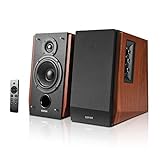
| Klipsch R-40PM | Hi-fi sound with a horn tweeter | Powered pair, 90×90 Tractrix horn |
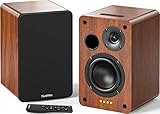
| Saiyin 40W x2 | Turntable and TV setups | 4-inch woofer, Bluetooth, optical, RCA, sub out |
| Saiyin 30W x2 | Small desks and bedrooms | 3.75-inch woofer, Bluetooth, optical, RCA |
| Klipsch R-51PM | Bluetooth listening with a hi-fi brand | Powered Bluetooth speaker |
| ULTIMEA BS-3 | TV and app-tuned setups | 3-way, HDMI ARC, 5.25-inch woofer, 70W RMS |
| RIOWOIS 40W | Compact desks with TV connectivity | 2.75-inch woofer, TV-ARC, Bluetooth 5.3 |
| Edifier R1700BTs | Entry studio-monitor sound | 66W RMS, Bluetooth, subwoofer line out |
| Edifier R1280T | Wired desktop listening | 42W RMS near-field monitors |
| Edifier MR4.5 | Music production and editing | Bi-amped, 80W RMS, XLR/TRS/RCA inputs, LDAC |
How to Choose
Inputs decide how useful they are on day one
List every source you want to connect before you look at watts, and count how many you will use at once. A TV needs optical or HDMI ARC; a turntable with a built-in phono stage needs RCA; a laptop or phone is easiest over Bluetooth or a 3.5mm cable; a studio interface wants balanced XLR or TRS. A pair that lacks your main input forces an adapter, and that adapter is often the weak point in the chain.
Read the power number carefully
RMS watts describe continuous output, while a bare “40W” can mean different things between brands. Compare like with like. For a desk at arm’s length, around 40 RMS watts is plenty. For a living room, look for 60 to 80 RMS watts and a woofer of four inches or larger. Bigger numbers matter less than whether the drivers and the cabinet can use them cleanly.
Woofer size and tweeter design shape the sound
A 2.75-inch woofer fits a crowded desk but gives up low bass. A 4 to 5.25-inch woofer fills a medium room with more body. Tweeter design counts too: silk domes tend to sound smooth, and a horn-loaded tweeter such as the Tractrix horn named on the Klipsch listing is designed to control dispersion. If you want deep bass, look for a subwoofer output.
Where budget models cut corners
Entry pairs often skip balanced inputs, offer fewer connections, and use plastic or thin-walled cabinets. Check that the listing names a remote or app control if you plan to sit across the room, and note which speaker carries the amplifier, because the cable between the two cabinets limits placement. Also decide whether you need a remote, since reaching behind a cabinet for every volume change gets old quickly.
The 9 Best Options
Klipsch Reference R-40PM
Sold as a powered pair, with a 90-degree by 90-degree Tractrix horn and Linear Travel Suspension, in black. It is for listeners who care about clean, controlled sound and a modern look, and who would rather buy a matched pair with the amplifier already built in than assemble separate components. The horn design is aimed at keeping the sound consistent across the room, so it suits shelves where you do not always sit in the exact center.
- Horn-loaded tweeter design named in the title.
- Sleek modern appearance suits living-room shelves.
- Trade-off: the title lists no wattage or input details, so check them first.
Skip it if you need a spec sheet in the headline.
Saiyin 40W x2
A powered Bluetooth pair with 40W per channel and 4-inch woofers, plus Bluetooth, optical, auxiliary, and RCA inputs and a subwoofer output. It is built for TV, turntable, record player, and PC use, which makes it a flexible pick for a family room where one pair has to serve several sources. The mix of digital and analog inputs means you can leave a turntable connected and still switch to the TV with a source button.
- Wide input list covers TV, vinyl, and computer.
- Subwoofer output leaves room to add bass.
- Trade-off: the title offers no tweeter or cabinet detail.
Skip it if you want HDMI ARC.
Saiyin 30W x2
The smaller sibling: 30W per channel with 3.75-inch woofers and the same Bluetooth, optical, auxiliary, and RCA inputs. It suits a bedroom, dorm, or a small desk beside a record player. Because the listing names the same family of inputs as its larger sibling, you can start small and still use every connection you need.
- Compact woofer fits tight spaces.
- Same core input mix as the larger Saiyin.
- Trade-off: no subwoofer output is listed.
Skip it if the room is large or you want to add a subwoofer.
Klipsch R-51PM
A powered Bluetooth speaker pair in black. The title is brief, so it appeals to buyers who already trust the brand and want wireless streaming with hi-fi roots. A buyer comparing it with the R-40PM should read the product page closely, since the two listings differ in how much they disclose.
- Bluetooth streaming is stated.
- Established speaker brand.
- Trade-off: the listing supplies no power, driver, or input details.
Skip it if you want numbers on the page before you commit.
ULTIMEA BS-3
A large three-way powered pair with smart app control, 70W RMS, a 5.25-inch woofer, and a long list of inputs: HDMI ARC, sub out, optical, USB, RCA, and Bluetooth 6.0. App EQ lets you tune the sound. This is the most feature-rich pair in the group, and the HDMI ARC input in particular makes it behave like a soundbar replacement with real stereo separation.
- HDMI ARC connects neatly to a TV.
- App EQ and subwoofer output add flexibility.
- Trade-off: three-way cabinets are larger than desktop pairs.
Skip it if desk space is tight.
RIOWOIS 40W
A compact 40W pair with 2.75-inch woofers and a silk dome horn tweeter. It supports TV-ARC and optical, plus AUX and Bluetooth 5.3, and is listed as compatible with a Fire TV remote, which means the television remote can often handle volume without a second controller. It is aimed at small rooms and shelves where a bulky pair would crowd everything else.
- TV-ARC support on a small footprint.
- Bluetooth 5.3 and AUX cover everyday sources.
- Trade-off: the 2.75-inch woofer limits low bass.
Skip it if you want room-filling bass without a subwoofer.
Edifier R1700BTs
Active Bluetooth bookshelf speakers described as near-field studio monitors, listed at 66W RMS with a subwoofer line out. They fit desk listening, music, and movies, and the combination of Bluetooth and a sub out makes them a sound starting point for a system you plan to expand later.
- 66W RMS output is stated.
- Subwoofer line out allows future bass.
- Trade-off: the title does not list HDMI or app control.
Skip it if you want a TV connection through ARC.
Edifier R1280T
Wired active near-field monitors at 42W RMS, in black. The listing has no Bluetooth mention, which suits people who want a simple wired pair for a desk or a media shelf. Wired designs avoid pairing steps entirely, so they appeal to anyone who connects a computer or console and never wants to think about the connection again.
- Straightforward powered design.
- 42W RMS is enough for desktop distances.
- Trade-off: Bluetooth is not mentioned in the title.
Skip it if you want wireless streaming.
Edifier MR4.5
A bi-amped studio monitor with 80W RMS, a 4.5-inch woofer, a 1-inch silk tweeter, hi-res audio, Bluetooth 6.0 with LDAC, and XLR, TRS, RCA, and AUX inputs. It targets music production, video editing, and home audio. The LDAC support means compatible phones and tablets can stream at a higher quality tier, while the balanced connections suit audio interfaces and mixers.
- Balanced XLR and TRS inputs suit production work.
- Bi-amped design and LDAC support are both named.
- Trade-off: studio-style tuning may be less casual than a lifestyle pair.
Skip it if you only need basic TV audio.
Which One Fits Your Situation
You are building a turntable corner
The Saiyin 40W x2 pairs RCA input with a subwoofer output, which suits a record player and leaves room for a sub later.
You want a TV upgrade with one cable
The ULTIMEA BS-3 offers HDMI ARC and app EQ, so the TV remote and the speakers work as one system. Three-way cabinets also give a living room more body than a desktop pair.
You make music or edit video
The Edifier MR4.5 brings balanced inputs and bi-amped drivers, which is what a production desk needs. Pair them with an audio interface and the XLR or TRS inputs keep the signal path clean.
You have a small desk and a short budget
The RIOWOIS 40W or the Saiyin 30W x2 fits tight spaces while still offering TV or turntable inputs. The Saiyin gives you the record-player connection, and the RIOWOIS gives you TV-ARC.
Common Mistakes
- Buying on wattage alone without checking which inputs the pair offers.
- Skipping a subwoofer output when you know you will want more bass later.
- Putting near-field monitors across a large room where they were never designed to fill the space, instead of placing them close to the listening seat.
- Forgetting that one speaker holds the amplifier and the cable between them limits layout.
- Assuming Bluetooth is included on every active pair, when the Edifier R1280T listing makes no such claim.
Frequently Asked Questions
What does powered mean?
The amplifier is built into one of the speakers, so you connect a source directly without a separate receiver or speaker wire runs to a rack. Passive speakers need an external amplifier.
Can I connect these to a TV?
Many can, via optical or HDMI ARC where listed. Check your TV’s output first, since not every TV offers both. If it only has a headphone jack, an auxiliary cable still works but loses remote-volume control.
Do I need a subwoofer?
Not for desk listening. If you want deep bass in a living room, pick a pair with a sub out, such as the Saiyin 40W, ULTIMEA BS-3, or Edifier R1700BTs.
Are studio monitors good for home use?
Yes, for close listening. Their tuning tends toward accuracy rather than extra bass, so some people add a subwoofer. Sit roughly an arm’s length or two away, with the tweeters near ear height, for the most precise image.