Our Short List of 3

- Amazon: https://www.amazon.com/dp/B07C54DPBD

- Amazon: https://www.amazon.com/dp/B00DCYMVB2

- Amazon: https://www.amazon.com/dp/B0C88Y9TY5
All 3 Picks at a Glance
| Product | Specs | Action |
|---|---|---|
| JBL 308P MkII 8-Inch Studio Monitor Speakers, Pair |
| Check price on Amazon |
| Yamaha HS8 8-Inch Powered Studio Monitor, Black |
| Check price on Amazon |
| PreSonus Eris Studio 8 8-Inch 2-Way Active Studio Monitors |
| Check price on Amazon |
An 8-inch monitor is the largest size that still works on a desk. The best 8-inch powered studio monitors for desktop mixing deliver deep bass without a subwoofer, a flat and honest frequency response, and enough output to fill a small room, all from a single cabinet per side with a built-in amplifier.
The 8-inch woofer is the key difference from smaller monitors. It moves more air at low frequencies, so bass guitar, kick drums, and synth low end are easier to judge. A well-designed 8-inch monitor still keeps the midrange clear, because the tweeter and waveguide handle the highs while the woofer focuses on the lows.
This guide covers three 8-inch powered studio monitors that suit desktop mixing. Each one is a two-way active design with balanced inputs and acoustic tuning controls.
What to Look For
Woofer and tweeter: An 8-inch woofer pairs with a 1-inch tweeter in most designs. Check the woofer material, such as woven composite or polypropylene, because it affects stiffness and bass control.
Amplifier power: Active monitors use separate amplifiers for the woofer and tweeter, known as bi-amplification. Total power of 100 watts or more per monitor gives headroom for dynamic mixes, while higher power helps in larger rooms.
Frequency response: Look for the low-frequency limit and the response range. A monitor that reaches down to 35 Hz or 38 Hz reveals more low end than one that stops at 45 Hz, which matters when mixing bass without a subwoofer.
Inputs: Balanced XLR and TRS inputs are standard for studio use, because they reject interference from nearby computers and power supplies. An unbalanced RCA input is useful for a second source.
Acoustic tuning: Rear-panel controls for high-frequency trim, low-frequency cutoff, and acoustic space help a monitor adapt to a desk against a wall or in a corner. Boundary controls that reduce bass buildup near a wall are especially useful on a desktop.
Size and placement: An 8-inch monitor is larger and heavier than a 5-inch model, so measure the desk depth and the distance to the wall. Nearfield monitors work best at arm’s length, with the tweeters at ear height.
The Best 8-Inch Powered Studio Monitors for Desktop Mixing
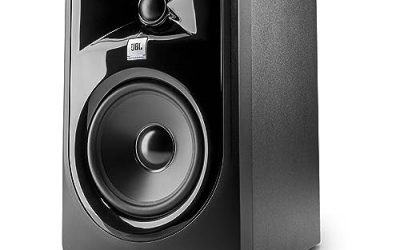
JBL 308P MkII 8-Inch Studio Monitor Speakers, Pair
- Amazon: https://www.amazon.com/dp/B07C54DPBD
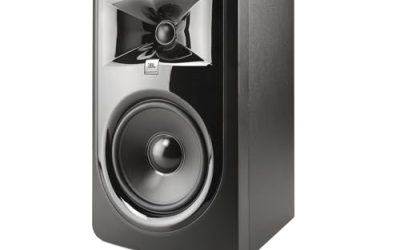
The JBL 308P MkII is an 8-inch two-way powered studio monitor sold as a pair, with an 8-inch woofer and a 1-inch tweeter mounted in JBL’s Image Control Waveguide. The waveguide shapes sound dispersion so the stereo image stays stable across a wider listening area. The monitor uses 112 watts of Class D amplification, with 56 watts for the woofer and 56 watts for the tweeter.
Frequency response runs from 37 Hz to 24 kHz, giving deep bass extension for an 8-inch nearfield monitor. Inputs include balanced XLR and balanced 6.35 mm TRS, and rear-panel controls include a volume control, a boundary EQ switch, and a high-frequency trim switch. The boundary EQ compensates for bass buildup near a wall.
This monitor suits a desktop mixer who wants a matched pair with deep bass and a wide, stable stereo image. The pair listing covers both speakers in one purchase, and the waveguide helps the mix translate from different positions. One consideration is that each cabinet is large for a small desk, so buyers should measure depth and height before ordering, and plan for stands or isolation pads to bring the tweeters to ear height.
Yamaha HS8 8-Inch Powered Studio Monitor, Black
- Amazon: https://www.amazon.com/dp/B00DCYMVB2
The Yamaha HS8 is an 8-inch powered studio monitor with an 8-inch cone woofer and a 1-inch dome tweeter, built as a two-way bass-reflex design. It uses 120 watts of bi-amplified power, with 75 watts for the woofer and 45 watts for the tweeter, and its frequency response runs from 38 Hz to 30 kHz.
Inputs include balanced XLR and balanced 6.35 mm TRS, and the rear panel carries a level control, a room control switch, and a high trim switch. Room control cuts low frequencies to compensate for bass buildup near a wall. The HS8 is sold as a single monitor, so a stereo pair needs two units.
This monitor suits a mixer who wants a flat, honest reference that reveals problems in a mix rather than flattering them. The HS series is known for a neutral midrange that makes vocal and instrument balances easy to judge. One consideration is that the HS8 is sold singly, so buyers should order two for stereo, and its rear bass-reflex port needs some clearance from the wall.
PreSonus Eris Studio 8 8-Inch 2-Way Active Studio Monitors
- Amazon: https://www.amazon.com/dp/B0C88Y9TY5
The PreSonus Eris Studio 8 is an 8-inch two-way active studio monitor with an 8-inch woven composite woofer and a 1-inch silk dome tweeter. It uses 140 watts of Class AB bi-amplification, with 75 watts for the woofer and 65 watts for the tweeter, and its frequency response runs from 35 Hz to 20 kHz.
The tweeter sits in an EBM waveguide that shapes dispersion for a wide listening area, and the front panel carries a power switch and a volume control. Inputs include balanced XLR, balanced TRS, and unbalanced RCA, giving three ways to connect a mixer, an interface, or a consumer device. Rear-panel acoustic tuning controls cover midrange, high-frequency, low cutoff, and acoustic space.
This monitor suits a desktop mixer who wants flexible inputs and detailed room tuning in one cabinet. The front port and acoustic space control make it easier to place on a desk against a wall, and the RCA input is handy for a second source. One consideration is that the Eris Studio 8 is a larger cabinet than many 8-inch monitors, so buyers should check desk depth.
Comparison
| Product | Woofer and Tweeter | Amplifier Power | Frequency Response | Inputs | Best For |
|---|---|---|---|---|---|
| JBL 308P MkII | 8-inch woofer, 1-inch tweeter | 112W Class D | 37 Hz to 24 kHz | XLR, TRS | Matched pair, wide stereo image |
| Yamaha HS8 | 8-inch cone woofer, 1-inch dome tweeter | 120W bi-amp | 38 Hz to 30 kHz | XLR, TRS | Flat, honest reference |
| PreSonus Eris Studio 8 | 8-inch woven composite woofer, 1-inch silk dome tweeter | 140W Class AB | 35 Hz to 20 kHz | XLR, TRS, RCA | Flexible inputs, room tuning |
FAQ
Do I need a pair of studio monitors for mixing?
Yes, for stereo mixing. A single monitor can check mono compatibility, but stereo width, panning, and phase need two matched monitors placed symmetrically. The JBL 308P MkII in this guide is sold as a pair, while the Yamaha HS8 and PreSonus Eris Studio 8 are commonly bought as two single units.
Can 8-inch monitors work on a desk without a subwoofer?
Yes, in most home studios. An 8-inch monitor reaches down to 35 Hz to 38 Hz, which covers bass guitar, kick drums, and most synth low end. A subwoofer adds extension below that range, but it also adds room and placement complexity that many desktop setups do not need.
How far from the wall should an 8-inch monitor sit?
Rear-ported monitors such as the Yamaha HS8 need clearance behind the cabinet for the port to work properly, while front-ported models such as the PreSonus Eris Studio 8 tolerate closer wall placement. In either case, use the rear-panel room control or acoustic space switch to reduce bass buildup when a monitor sits near a wall.
Conclusion
For desktop mixing, an 8-inch powered monitor gives the low-end extension that smaller monitors miss, without the size and cost of a larger main monitor. The JBL 308P MkII covers a pair in one purchase with a wide stereo image, the Yamaha HS8 is a flat reference for judging balances, and the PreSonus Eris Studio 8 adds flexible inputs and detailed room tuning. Measure the desk and place the tweeters at ear height.
Disclosure: As an Amazon Associate, we earn from qualifying purchases.