- Top Pick: Android TV Box 4K Ultra HD, 4GB+32GB High Speed Memory,USB 2.0/3.0
- Best Value: Xiaomi TV Box S 3rd Gen – 4K UHD, Google TV, 32GB Memory, Dolby Vision & Atmos, WiFi 6, HDMI 2.1, Fast Streaming, Compact and Powerful
- Premium Choice: Android TV Stick 4K 2026, 2GB 16GB | Android 14, Quad-core RK3518 CPU, 4K HDR10+, WiFi 6 2.4G/5G Dual-Band, USB 3.0, Bluetooth 5.4, Voice Remote
🛒 Best Price Today on Amazon
Prime members get fast, free shipping on everything above, plus member-only deals. New members get a 30-day free trial — cancel anytime.
- Top Streaming Cpus Picks for 2026
- Best Streaming CPUs at a Glance
- 1. AMD Ryzen 7 5700X 8-Core, 16-Thread Unlocked Desktop Processor
- 2. AMD Ryzen 7 5800X 8-Core, 16-Thread Unlocked Desktop Processor
- 3. AMD Ryzen 7 5700G 8-Core, 16-Thread Desktop Processor with Radeon Graphics
- 4. AMD Ryzen 5 5600X 6-Core, 12-Thread Unlocked Desktop Processor
- 5. AMD Ryzen 5 5500 6-Core, 12-Thread Unlocked Desktop Processor
- 6. AMD Ryzen 3 3200G 4-Core Desktop Processor with Radeon Graphics
- How to Choose a Streaming CPU
- Frequently Asked Questions
- Related Guides
- Related Articles
Top Streaming Cpus Picks for 2026
Here are our current top streaming cpus picks, compared on real Amazon owner reviews, price, and features. Live prices update below.
As an Amazon Associate we earn from qualifying purchases at no extra cost to you.





Streaming while you game is one of the most demanding things you can ask of a PC, because the processor has to run the game and encode the broadcast at the same time. That dual workload is exactly why core and thread count matter so much for a streaming CPU: extra cores give the encoder room to work without stealing frames from your game. If you lean on software (x264) encoding rather than handing the job to your GPU, those threads become the single biggest factor in a smooth, stutter-free stream. This guide rounds up the best streaming CPUs in 2026, focused on AMD Ryzen chips that pair strong gaming performance with the multi-threaded muscle that live encoding rewards.
Our picks were chosen on what genuinely drives a good game-and-encode experience: core and thread count for parallel workloads, per-core speed for the game itself, and value for the streamer on a budget. We have included a deliberate price spread — from around $48 up to around $248 — because the best streaming CPU is the one that fits your encoding approach and your wallet. The list leads with the higher core-count chips best suited to software encoding, then covers capable all-rounders and budget entries, including two APUs with integrated Radeon graphics for streamers building without a discrete card yet. Below is an at-a-glance comparison of all six, then a closer look at each and a buyer’s guide built around cores, threads and your encoding workflow.
Best Streaming CPUs at a Glance
| Processor | Best For | Standout Spec | Approx Price |
|---|---|---|---|
| AMD Ryzen 7 5700X | Software-encode streaming value | 8 cores / 16 threads, no iGPU | around $248 |
| AMD Ryzen 7 5800X | High-headroom game + encode | 8 cores / 16 threads, unlocked | around $210 |
| AMD Ryzen 7 5700G | Streaming without a GPU | 8 cores / 16 threads, Radeon iGPU | around $208 |
| AMD Ryzen 5 5600X | Entry game-and-encode | 6 cores / 12 threads, unlocked | around $180 |
| AMD Ryzen 5 5500 | Budget multi-thread starter | 6 cores / 12 threads, low cost | around $84 |
| AMD Ryzen 3 3200G | Cheapest iGPU starter | 4 cores, Radeon Vega graphics | around $48 |
1. AMD Ryzen 7 5700X 8-Core, 16-Thread Unlocked Desktop Processor

As an Amazon Associate we earn from qualifying purchases. Product prices and availability are accurate as of the date/time indicated.
The AMD Ryzen 7 5700X leads this list because it hits the streaming sweet spot: eight cores and sixteen threads of Zen 3 performance at a sensible price. Those sixteen threads are precisely what a software-encoded stream feeds on — the game gets the cores it needs while x264 encoding runs in parallel on the rest, keeping both your frame rate and your broadcast smooth. At around $248 it is the most expensive chip here, and for serious streamers it is money well spent.
This is the pick for the streamer who wants to encode in software for the best broadcast quality and refuses to compromise on in-game performance. The 5700X runs a little more efficiently than the 5800X while delivering essentially the same eight-core, sixteen-thread layout, so it stays cooler and easier to feed. It is unlocked for tuning, drops into the mature AM4 platform, and pairs naturally with a discrete GPU. If your priority is a dependable game-and-encode workhorse that handles a high-bitrate x264 stream without dropping frames, the 5700X is the standout starting point.
Pros: Eight cores and sixteen threads ideal for software encoding, efficient, unlocked, AM4 value.
Cons: No integrated graphics, so a discrete GPU is required; priciest chip here.
2. AMD Ryzen 7 5800X 8-Core, 16-Thread Unlocked Desktop Processor


As an Amazon Associate we earn from qualifying purchases. Product prices and availability are accurate as of the date/time indicated.
The AMD Ryzen 7 5800X is the high-headroom game-and-encode pick. It shares the 5700X’s eight-core, sixteen-thread Zen 3 configuration but pushes clocks higher out of the box, giving it extra per-core speed for the game while keeping all those threads available for the encoder. At around $210 it often undercuts the 5700X on price, which makes it a compelling option for streamers who want maximum performance.
This is the chip for the streamer who wants the headroom of a high-clocked eight-core processor for both gaming and software encoding. The higher boost speeds help the game side feel snappy, the sixteen threads keep an x264 stream stable, and being unlocked means there is room to tune cooling and clocks. It runs warmer than the 5700X and benefits from a capable cooler, but if you want the punchier of these two flagship eight-core AM4 parts for a demanding game-and-encode setup, the 5800X delivers it.

Pros: Eight cores, sixteen threads, higher boost clocks, unlocked, strong for simultaneous game and encode.
Cons: Runs hotter than the 5700X and wants a good cooler; no integrated graphics.
3. AMD Ryzen 7 5700G 8-Core, 16-Thread Desktop Processor with Radeon Graphics

AMD Ryzen™ 7 5700G 8-Core, 16-Thread Desktop Processor with Radeon™ Graphics


As an Amazon Associate we earn from qualifying purchases. Product prices and availability are accurate as of the date/time indicated.
The AMD Ryzen 7 5700G is the pick for streaming without a discrete graphics card. It is an APU that combines eight cores and sixteen threads with built-in Radeon graphics, so it can run a game and encode a stream on a single chip while you save for or skip a dedicated GPU. At around $208 it brings that eight-core, sixteen-thread streaming muscle to a more self-contained build.
This is the chip for the streamer building on a budget who has not added a discrete card yet, or who streams lighter titles that the integrated Radeon graphics can handle. The sixteen threads still give software encoding plenty of room, so your broadcast stays smooth, while the iGPU drives the display and lighter games. Keep expectations realistic on graphics — integrated Radeon is fine for esports and older titles, not demanding AAA — but as an all-in-one streaming starting point that can grow with a GPU later, the 5700G is a smart, flexible choice.
Pros: Eight cores and sixteen threads plus integrated Radeon graphics, no discrete GPU required to start.
Cons: Integrated graphics suit esports and lighter games, not demanding AAA titles.
4. AMD Ryzen 5 5600X 6-Core, 12-Thread Unlocked Desktop Processor

AMD Ryzen 5 5600X 6-core, 12-thread unlocked desktop processor with Wraith Stealth cooler

As an Amazon Associate we earn from qualifying purchases. Product prices and availability are accurate as of the date/time indicated.
The AMD Ryzen 5 5600X is the entry game-and-encode pick. It steps down to six cores and twelve threads but keeps Zen 3’s strong per-core speed and an unlocked multiplier, and it ships with a Wraith Stealth cooler. At around $180 it is a popular, well-balanced processor for a streamer who is starting out or leaning more on GPU (NVENC) encoding than pure software x264.
This is the chip for the streamer whose game performance matters most and who is comfortable using GPU-assisted encoding to lighten the CPU’s load. Twelve threads handle a moderate software stream and multitasking comfortably, the strong single-thread speed keeps games running well, and the bundled cooler trims the build cost. It has fewer threads than the eight-core chips above, so a very high-bitrate x264 broadcast will push it harder, but for entry-level streaming alongside great gaming, the 5600X is an easy recommendation.

Pros: Six cores, twelve threads, excellent gaming speed, unlocked, includes a cooler, well priced.
Cons: Fewer threads than the eight-core picks; heavy x264 software encoding will tax it.
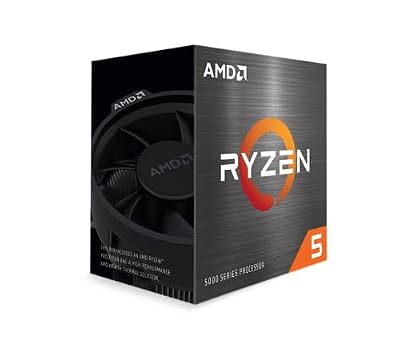
5. AMD Ryzen 5 5500 6-Core, 12-Thread Unlocked Desktop Processor

AMD Ryzen 5 5500 6-Core, 12-Thread Unlocked Desktop Processor with Wraith Stealth Cooler


As an Amazon Associate we earn from qualifying purchases. Product prices and availability are accurate as of the date/time indicated.
The AMD Ryzen 5 5500 is the budget multi-thread starter. It offers six cores and twelve threads with a Wraith Stealth cooler at a remarkably low price, making twelve-thread parallelism affordable for a first streaming PC. At around $84 it is one of the cheapest ways to get a true six-core, twelve-thread processor for game-and-encode duty.
This is the chip for the new streamer on a tight budget who wants more threads than a basic dual- or quad-core part for a smoother broadcast. The twelve threads give the encoder room to work, the included cooler keeps the total outlay down, and the AM4 platform leaves an upgrade path open later. Its memory and cache setup are more modest than the 5600X, so it is a notch behind in raw gaming and heavy encoding, but as an inexpensive entry point into multi-threaded streaming, the 5500 punches well above its cost.
Pros: Six cores, twelve threads at a very low price, bundled cooler, solid budget streaming starter.
Cons: More modest cache and memory support than the 5600X; no integrated graphics.
6. AMD Ryzen 3 3200G 4-Core Desktop Processor with Radeon Graphics
As an Amazon Associate we earn from qualifying purchases. Product prices and availability are accurate as of the date/time indicated.
Rounding out the list is the AMD Ryzen 3 3200G, the cheapest iGPU starter here. It is a quad-core APU with integrated Radeon Vega graphics at around $48, and we are honest about where it fits: with four cores it has the fewest threads on this list, so it is best seen as a budget entry point for very light streaming or a starter build, not a high-bitrate software-encoding machine.
This is the chip for someone assembling the most affordable possible PC who wants to dip a toe into streaming lighter games without buying a graphics card. The integrated Radeon Vega graphics drive a display and casual titles, and the low price keeps a first build accessible. For demanding game-and-encode work, though, the four cores are a real limitation — software x264 streaming will struggle, and leaning on GPU encoding is not an option without a discrete card. Treat the 3200G as an entry ticket and an upgrade path, and it does that job well for the money.

Pros: Very cheap, integrated Radeon Vega graphics, no GPU needed for a basic starter build.
Cons: Only four cores, so it is weak for software encoding and demanding game-and-encode loads.
How to Choose a Streaming CPU
Choosing a streaming CPU starts with how you intend to encode, because that decides how many threads you actually need. If you stream with software (x264) encoding for the best image quality, the CPU does the heavy lifting and core and thread count is king — which is why the eight-core, sixteen-thread chips here, the 5700X, 5800X and 5700G, lead the list. If you offload encoding to your GPU with NVENC or AMD’s equivalent, the CPU’s burden drops sharply and a strong six-core, twelve-thread chip like the 5600X becomes plenty.
Cores and threads, then, are the headline spec, but per-core speed still matters for the game itself. A streaming PC is running two jobs at once, so you want enough threads to keep the encoder fed and enough single-thread speed to keep frame rates high. The eight-core parts give the most encoding headroom for high-bitrate software streams, the 5800X adds extra clock speed on top, and the 5600X balances fewer threads with excellent gaming speed for a more entry-level setup.
Integrated graphics are the next decision and depend on whether you already own a GPU. If you have a discrete card, a CPU without an iGPU like the 5700X, 5800X, 5600X or 5500 makes sense and puts every transistor toward CPU performance. If you are building without a graphics card for now, an APU such as the 5700G or the budget 3200G lets you run a display and lighter games on integrated Radeon graphics — just keep expectations realistic, since integrated graphics suit esports and older titles rather than demanding AAA gaming.
Finally, match the chip to your budget and remember the platform around it. All six processors here use AMD’s mature AM4 socket, which keeps motherboard and memory costs reasonable and is a friendly place for a first build. Set your encoding approach, pick the thread count that suits it, decide whether you need integrated graphics, and choose the CPU on this list that lands on your budget. For serious software-encoded streaming, more threads win; for GPU-assisted streaming, a fast six-core chip is all most people need.
Frequently Asked Questions
How many cores do I need for streaming and gaming at the same time?
It depends on how you encode. For software (x264) encoding, where the CPU handles the broadcast, more cores and threads are better — the eight-core, sixteen-thread chips here like the 5700X and 5800X give the encoder room to work without stealing frames from your game. If you offload encoding to your GPU, a strong six-core, twelve-thread CPU such as the 5600X is plenty.
Is software (x264) or GPU (NVENC) encoding better for my CPU choice?
Software x264 encoding can produce excellent quality but leans heavily on CPU threads, so it favours the higher core-count chips on this list. GPU encoding offloads that work to your graphics card, freeing the processor, which lets a fewer-threaded CPU keep up. Decide your encoding method first, then pick the core count that matches it.
Can I stream without a dedicated graphics card?
Yes, with an APU. The Ryzen 7 5700G and the budget Ryzen 3 3200G include integrated Radeon graphics, so they can drive a display and lighter games while you stream, no discrete card required. The 5700G’s eight cores make it genuinely capable for software encoding; the four-core 3200G is better suited to very light streaming and a starter build.
Is the four-core Ryzen 3 3200G good enough for streaming?
Honestly, it is an entry-level option rather than a streaming workhorse. With only four cores it has the least encoding headroom on this list, so software x264 streaming will struggle and there is no discrete GPU to offload to. It is a fine cheap starter for very light streaming or a first PC, but if streaming is a priority, the six- and eight-core chips are far better suited.
Related Guides
- Best Gaming CPUs
- Best CPU Coolers
- Best GPUs for Streaming
- Best RAM for Gaming
- Best Motherboards
- Best Streaming Microphones
Affiliate Disclosure: As an Amazon Associate, we earn from qualifying purchases. If you click a link and make a purchase, we may earn a small commission at no extra cost to you. Prices and availability are accurate as of publication and may change.