The Radeon RX 7900 XTX is a 355W graphics card that is less forgiving of a weak power supply than most GPUs. Picking the right PSU for it comes down to three things: enough wattage to clear AMD’s published minimum with room to spare, enough native 8-pin PCIe connectors for your specific card model, and the build quality to handle the brief power excursions a flagship card produces under load. Get any of those wrong and the symptoms are ugly — shutdowns mid-game, or a system that refuses to boot with the card installed.
As an Amazon Associate we earn from qualifying purchases.
The five units below are all fully modular, all carry 80 PLUS Gold or equivalent Cybenetics Gold certification, and all are backed by 10-year warranties. Three are 850W units for standard builds; two are 1000W units for overclocked cards and power-hungry CPUs.
What the RX 7900 XTX actually needs from a PSU
AMD’s official specifications for the RX 7900 XTX list a typical board power of 355W and a minimum PSU recommendation of 800W, with more than 65A available on the 12V output. AMD also states (in its GD-223 guidance) that the 800W figure assumes a system built around a Ryzen 9 5900X plus typical components. Treat 800W as the floor, not the target: a quality 850W unit is the sensible minimum buy, and 1000W makes sense with a high-draw CPU or a factory-overclocked card.
Connectors matter just as much. AMD’s reference design uses two 8-pin PCIe power connectors, but many board-partner models use three — Sapphire’s NITRO+ RX 7900 XTX, for example, takes three 8-pin connectors and repeats the 800W minimum in its documentation. Before ordering any PSU, check the connector count on your exact card. If you are still deciding which card to buy, our RX 7900 XTX graphics card guide walks through the partner models and their differences. Where a PSU provides enough separate PCIe cables, run one cable per connector rather than using both plugs on a single split cable.
Finally, transients. High-end GPUs draw brief power excursions well above their rated board power — long enough to trip a marginal PSU. The ATX 3.0 and ATX 3.1 standards exist partly to certify against this: compliant supplies absorb excursions of up to 200% of rated power for very short intervals. The 7900 XTX does not require an ATX 3.x supply, but that certified headroom is genuinely useful with this card.
Manufacturer specs vs measured results
Throughout this guide, wattage, connector counts, dimensions, and warranty terms are manufacturer-published specifications. Efficiency and noise figures are different: 80 PLUS and Cybenetics are independent lab programmes that measure a sample unit against a published standard. Where a specific measured figure is quoted — such as the Cybenetics report averages for the Corsair RM1000x — it is labelled as a lab-measured result, not a manufacturer claim.
1. Corsair RM850x (2024) — best overall for most builds
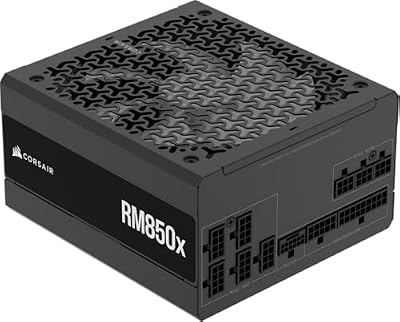
The refreshed RM850x is the default recommendation for a single-GPU RX 7900 XTX system. It clears AMD’s 800W floor, meets the current ATX 3.1 standard, and its three separate PCIe 6+2 cables cover both two-connector and three-connector cards without split-cable compromises. The Cybenetics programme certifies it at Gold efficiency with an A noise rating — a published lab certification, not a marketing badge.
Specs (manufacturer-published unless noted):
- Output: 850W continuous; +12V rail rated at 70.8A
- Standard: ATX 3.1, PCIe 5.1 ready
- Efficiency: Cybenetics Gold certified; 80 PLUS Gold
- PCIe connectors: 3x 6+2-pin on three separate cables; 1x 12V-2×6 cable
- CPU connectors: 2x EPS 4+4-pin
- Modularity: fully modular, Corsair Type 4 embossed cables
- Fan: 140mm fluid-dynamic bearing, Zero RPM mode at low loads
- Dimensions: 160 x 150 x 86 mm
- Warranty: 10 years
See the Corsair RM850x (2024) on Amazon
2. MSI MPG A850G PCIE5 — best 850W for three-connector cards

If your 7900 XTX is a three-connector partner model, the MPG A850G is the 850W unit with the most cabling flexibility. MSI’s own datasheet lists six PCIe 6+2-pin connectors — double what most 850W rivals provide — plus a 600W 16-pin PCIe 5.0 cable. The platform launched as an ATX 3.0 design and MSI now lists it as ATX 3.1 ready, with a specified power excursion capability of 1700W (200% of rated power for 100 microseconds). A 0% RPM fan mode keeps it silent below 40% load.
Specs (manufacturer-published):
- Output: 850W; +12V rail rated at 70.8A
- Standard: ATX 3.0 design, ATX 3.1 ready (MSI); PCIe 5.1 support
- Efficiency: 80 PLUS Gold (up to 90%)
- PCIe connectors: 6x 6+2-pin; 1x 16-pin PCIe 5.0 (600W)
- CPU connectors: 2x EPS 4+4-pin
- Modularity: fully modular, flat cables
- Fan: 135mm fluid-dynamic bearing, 0% RPM mode
- Dimensions: 150 x 150 x 86 mm
- Warranty: 10 years
See the MSI MPG A850G PCIE5 on Amazon
3. Seasonic FOCUS GX-850 — best for compact cases

The FOCUS GX-850 is the veteran of this list: a proven 850W platform in an unusually short 140mm-deep chassis — the easiest fit in compact ATX cases where longer supplies foul against drive cages. It provides four PCIe 6+2 connectors, so both card variants are covered. Be aware of what it is not: this earlier SSR-850FX generation predates the ATX 3.x standards, so it carries no certified excursion rating and no 12V-2×6 cable — irrelevant for the 7900 XTX itself, but worth knowing if you plan to keep the PSU through a future GPU upgrade. Seasonic also sells a newer ATX 3.1 FOCUS GX under a similar name, so check the model code (SSR-850FX) when comparing listings.
Specs (manufacturer-published):
- Output: 850W; +12V rail rated at 70A
- Standard: ATX 12V (pre-ATX 3.0 platform)
- Efficiency: 80 PLUS Gold
- PCIe connectors: 4x 6+2-pin
- CPU connectors: 2x EPS (8-pin and 4+4-pin)
- Modularity: fully modular
- Fan: 120mm, Premium Hybrid Fan Control with fanless mode
- Dimensions: 150 x 140 x 86 mm (140mm depth)
- Warranty: 10 years
See the Seasonic FOCUS GX-850 on Amazon
4. be quiet! Pure Power 12 M 1000W — best quiet 1000W option

Stepping up to 1000W buys headroom for an overclocked three-connector card alongside a high-draw CPU, and a fan that barely turns at gaming loads. The Pure Power 12 M is built around a silence-optimised 120mm fan and an LLC + SR + DC/DC topology. be quiet! quotes efficiency of up to 93.1% — a manufacturer figure measured at 230V input and 50% load; the certification that applies everywhere is 80 PLUS Gold. Four PCIe 6+2 connectors plus a 600W 12VHPWR cable cover both card generations.
Specs (manufacturer-published):
- Output: 1000W continuous, 1050W peak
- Standard: ATX 3.0, PCIe 5.1 compatible
- Efficiency: 80 PLUS Gold (up to 93.1% at 230V, manufacturer figure)
- PCIe connectors: 4x 6+2-pin; 1x 12VHPWR (600W)
- Rails: two 12V rails
- Modularity: fully modular
- Fan: 120mm silence-optimised be quiet! fan, rifle bearing
- Dimensions: 160 x 150 x 86 mm
- Warranty: 10 years
See the be quiet! Pure Power 12 M 1000W on Amazon
5. Corsair RM1000x (2024) — best measured results and maximum headroom

The RM1000x is the pick for a flagship build you do not want to think about again: a three-connector XTX, a 16-core CPU, and overclocking on both. It matches the RM850x feature for feature at 1000W, with four separate PCIe 6+2 cables. It also has the strongest independently measured numbers here: in the Cybenetics lab report for this model (report CR10002396), average efficiency measured 89.0% at 115V and 91.1% at 230V — inside the Cybenetics Platinum band even though Corsair sells and certifies the unit as Gold — and average noise measured about 24.8 dBA, earning the Cybenetics A rating. Those are lab-measured results from the published certification report.
Specs (manufacturer-published unless noted):
- Output: 1000W; +12V rail rated at 83.3A
- Standard: ATX 3.1, PCIe 5.1 ready
- Efficiency: Cybenetics Gold certified (measured results in the lab report, above)
- PCIe connectors: 4x 6+2-pin on four separate cables; 1x 12V-2×6 cable (600W)
- CPU connectors: 2x EPS 4+4-pin
- Modularity: fully modular, Corsair Type 4 embossed cables
- Fan: 140mm fluid-dynamic bearing, Zero RPM mode at low loads
- Warranty: 10 years
See the Corsair RM1000x (2024) on Amazon
Comparison table
| PSU | Wattage | Standard | Efficiency certification | PCIe 6+2 connectors | 12V-2×6 / 12VHPWR | Warranty |
|---|---|---|---|---|---|---|
| Corsair RM850x (2024) | 850W | ATX 3.1 | Cybenetics Gold, 80 PLUS Gold | 3 (separate cables) | Yes | 10 years |
| MSI MPG A850G PCIE5 | 850W | ATX 3.0 / 3.1 ready | 80 PLUS Gold | 6 | Yes (16-pin, 600W) | 10 years |
| Seasonic FOCUS GX-850 | 850W | ATX 12V | 80 PLUS Gold | 4 | No | 10 years |
| be quiet! Pure Power 12 M 1000W | 1000W | ATX 3.0 | 80 PLUS Gold | 4 | Yes (600W) | 10 years |
| Corsair RM1000x (2024) | 1000W | ATX 3.1 | Cybenetics Gold, 80 PLUS Gold | 4 (separate cables) | Yes | 10 years |
Verdict: which PSU should you buy?
For a typical RX 7900 XTX gaming PC — reference-style two-connector card, mainstream or X3D CPU, no heavy overclocking — the Corsair RM850x (2024) is the buy: current standard, certified efficiency and noise, and exactly the cable set the card needs. If your card is a three-connector partner model and you want to stay at 850W, the MSI MPG A850G PCIE5 offers the most connector headroom in this class. For a compact case, the Seasonic FOCUS GX-850 trades its older platform for a 140mm depth. For a quieter system with real headroom, the be quiet! Pure Power 12 M 1000W is the noise-first 1000W choice; the Corsair RM1000x (2024) is the maximum-headroom option, with lab-measured efficiency to justify it in a flagship build.
Whichever you choose, do not drop below AMD’s 800W published minimum for this card, and do not reuse cables from a different modular PSU — modular cables are not interchangeable between models, even from the same brand.
FAQ
Is an 850W PSU enough for the RX 7900 XTX?
Yes. AMD’s minimum is 800W for a system built around a Ryzen 9 5900X, so a quality 850W unit covers the card plus a typical gaming CPU. Step up to 1000W with a high-draw flagship CPU, a factory-overclocked three-connector model, or overclocking plans.
Does the RX 7900 XTX need an ATX 3.0 or ATX 3.1 power supply?
No. The card uses standard 8-pin PCIe connectors, not the 12V-2×6 plug. An ATX 3.x supply is still a sensible buy because the standard certifies tolerance for short power excursions, but a quality older unit meeting the wattage and connector requirements will run the card.
How many 8-pin connectors does the RX 7900 XTX need?
The AMD reference design needs two; many board-partner cards — Sapphire’s NITRO+ is one example — need three. Check your exact model’s specification before buying a PSU, and where possible give each connector its own cable rather than using both plugs on one split cable.
Can I keep my current 750W PSU?
It falls below AMD’s published 800W minimum for this card, so it sits outside the manufacturer’s guidance. A PSU upgrade is the safer path — and every unit in this guide adds a fresh 10-year warranty to the build.
Product and ASIN Reference
| Product | ASIN |
|---|---|
| Corsair RM850x (2024) 850W | B0FLFGG1CC |
| MSI MPG A850G PCIE5 850W | B0B4345YV7 |
| Seasonic FOCUS GX-850 850W | B07WVMDZMZ |
| be quiet! Pure Power 12 M 1000W | B0BVYCXQY4 |
| Corsair RM1000x (2024) 1000W | B0D9C3P46P |