The A6700 has a single UHS-II SD slot, so one card carries every photo and clip you shoot, and the real decision is how much write speed your record settings actually demand. Paying for a V90 card only pays off if you use the all-intra XAVC S-I codec or lean on long RAW bursts; the 4K 120p mode most owners bought the camera for records at bitrates a good V60 card already covers. Buy past your settings and you overspend, buy under them and the camera refuses the mode or stalls mid-burst.
This guide serves three groups: hybrid shooters who record 4K 120p video, stills photographers who fire long bursts at 11 frames per second, and travellers who need one dependable card to last a full day. Every pick below was chosen from the product names and specifications printed on its Amazon product page, including the exact model code, so you can match the listing against the card in your hand before it ships.
Quick Picks
As an Amazon Associate we earn from qualifying purchases.
| Product | Best for | Key spec from title |
|---|---|---|
| SanDisk Extreme PRO SDXC UHS-II 128GB | All-intra video and the fastest buffer clearing | UHS-II V90, up to 300MB/s read and write |
| Sony TOUGH SF-G 128GB | Shooting in rain, dust and rough travel conditions | V90, max read 300MB/s, max write 299MB/s |
| Lexar Professional 2000x 128GB | V90 performance with fast offloads after a shoot | UHS-II V90, up to 300MB/s read |
| Lexar Professional SILVER PRO 128GB | 4K 120p in XAVC HS without paying the V90 premium | UHS-II V60, up to 280MB/s read |
| ProGrade Digital SDXC UHS-II V60 256GB | Long recording days where capacity matters most | UHS-II V60, 250MB/s read, 130MB/s write |
How to Choose
V60 vs V90: Match the Rating to Your Record Settings
The V-rating is a guaranteed minimum sustained write speed, and it decides which of the A6700’s codecs you may use. Sony reserves the all-intra XAVC S-I codec for V90 media, because its bitrates climb far beyond what a V60 card promises to sustain. The XAVC HS 4K 120p mode tops out at 200 Mbps, roughly 25 MB/s, which sits comfortably inside a V60 card’s 60 MB/s floor. Check the record setting you actually plan to use, then buy the rating that unlocks it instead of defaulting to the most expensive card on the shelf.
Capacity for Video File Sizes
Capacity planning starts with bitrate arithmetic. At the 200 Mbps ceiling of XAVC HS 4K, an hour of footage consumes about 90GB, so a 128GB card holds roughly 85 minutes. Switch to all-intra XAVC S-I at up to 600 Mbps and the same hour needs about 270GB, which turns a 256GB card into a single-hour medium. Stills shooters face gentler maths, since even long RAW bursts rarely fill 128GB in a day. Decide whether your card is a video tank or a photo wallet, because the A6700’s single slot offers no second card to overflow onto.
Read Speed and the Offload Half of the Day
Write speed wins the shoot, but read speed decides how the evening goes. A 128GB card filled with 4K footage takes over twenty minutes to copy through an old UHS-I reader, and under eight through a UHS-II reader working near the 300 MB/s these cards advertise. Our broader roundup of the best SD cards for Sony cameras shows the same pattern across the range: the card is only half the chain. Budget for a UHS-II reader if you do not already own one, or the fastest card here will feel ordinary at the desk.
Brand Reliability and Counterfeit Risk
A failed card in a single-slot camera means lost work, so the brand behind the listing matters as much as its speed class. Established makers publish sustained-write figures, serialise their cards and honour warranty replacements; ProGrade even laser-etches each card’s serial number to make fakes easier to spot. The risk concentrates in marketplace listings with unfamiliar seller names and prices far below the field. Buy from Amazon itself or the manufacturer’s own storefront, register the card if the maker offers it, and run one full-format test shoot at home before trusting it with paid work.
The 5 Best Options
SanDisk Extreme PRO SDXC UHS-II 128GB
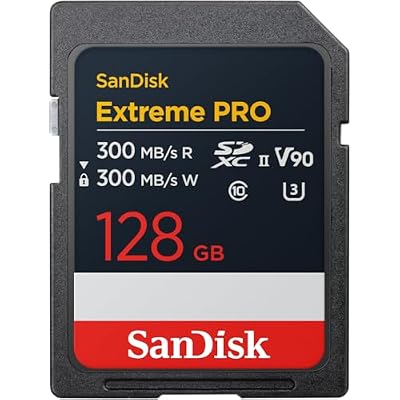
This is the card for A6700 owners who refuse to think about media limits. Its V90 rating unlocks the all-intra XAVC S-I codec, and the listing’s headline write figure matches its read figure, which is rare even among UHS-II flagships and shows up as the shortest buffer-clearing pauses after a burst. The 128GB capacity suits hybrid days that mix stills with shorter 4K clips rather than hour-long recordings. SanDisk also rates the card IP68 against water and dust and backs it with a lifetime warranty, which fits a camera that often works outdoors without a cage or cover.
Specs
- Card type: SDXC, UHS-II bus
- Capacity: 128GB
- Video speed class: V90 (U3, Class 10)
- Read speed: up to 300 MB/s
- Write speed: up to 300 MB/s
- Minimum sustained write speed: 90 MB/s
- Durability: IP68 water and dust resistant, drop tested to 6 metres
- Warranty: lifetime
- Model: SDSDXDM-128G-GN4IN
Best for: Shooters who record XAVC S-I or fire long RAW bursts and want one card that never becomes the bottleneck.
Watch out for: Confirm the model code SDSDXDM on the listing before ordering, because the older SDSDXDK generation of this card peaks at a lower write speed.
ASIN: B0DLWTWM4R
Sony TOUGH SF-G 128GB
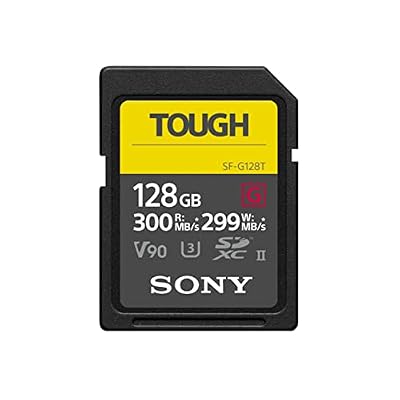
Sony builds this card as a single moulded piece with no separate casing seams, and rates it for drops, bending, water and dust that would retire an ordinary card. That construction suits A6700 owners who hike, shoot winter sports or work events where the camera bag takes knocks. Performance matches the class leaders, with the fastest rated write speed in this guide, so 4K 120p and all-intra recording are both on the table. Choosing the camera maker’s own media also removes any doubt about compatibility warnings, since Sony validates the SF-G line against its own bodies and publishes the pairing.
Specs
- Card type: SDXC, UHS-II bus
- Capacity: 128GB
- Video speed class: V90 (U3, Class 10)
- Read speed: up to 300 MB/s
- Write speed: up to 299 MB/s
- Special features: drop proof, dust proof, water proof one-piece TOUGH design
- Model: SF-G128T/T1
Best for: Outdoor and travel shooters who treat durability as a feature, not an accessory.
Watch out for: The TOUGH body has no write-protect switch, so guard against accidental formatting in the camera menu instead.
ASIN: B07H9GDFRW
Lexar Professional 2000x 128GB

Lexar’s long-running 2000x line gives the A6700 the full V90 feature set, including all-intra recording and fast burst clearing, and it has been the default recommendation in UHS-II cameras for years. Its rated write speed sits a step below the two leaders above, yet still far beyond anything the A6700 can demand outside XAVC S-I. Where it earns its place is the working photographer’s routine: maximum read speed matches the best here, so a full card empties quickly at the computer. Photographers who already own Lexar media for a second body will also appreciate staying inside one card family.
Specs
- Card type: SDXC, UHS-II bus
- Capacity: 128GB
- Video speed class: V90 (U3, Class 10)
- Read speed: up to 300 MB/s
- Write speed: up to 260 MB/s
- Minimum sustained write speed: 90 MB/s
- Model: LSD2000128G-BNNNU
- Warranty: limited lifetime
Best for: Stills-led hybrid shooters who want V90 headroom and quick card offloads.
Watch out for: Check whether the listing is the card alone, because some 2000x listings bundle a USB reader and others do not.
ASIN: B08GGFCZPW
Lexar Professional SILVER PRO 128GB

The SILVER PRO is the sensible answer for owners who bought the A6700 for 4K 120p and stills rather than all-intra work. Its V60 rating guarantees 60 MB/s sustained writes, more than double the top bitrate of the XAVC HS codec, and its read speed nearly matches the V90 cards, so offloads stay quick. The trade is explicit: the camera will not offer XAVC S-I recording with this card inserted. For travel shooters who record in HS or XAVC S and shoot bursts in JPEG or compressed RAW, that limitation rarely surfaces, and the saving against V90 media is real money toward a second card.
Specs
- Card type: SDXC, UHS-II bus
- Capacity: 128GB
- Video speed class: V60 (U3, Class 10)
- Read speed: up to 280 MB/s
- Write speed: up to 160 MB/s
- Model: LSDSIPR128G-BNNNU
Best for: 4K 120p shooters using XAVC HS who would rather own two good cards than one flagship.
Watch out for: Do not buy it as your only card if you plan to try all-intra recording, because the A6700 blocks XAVC S-I on V60 media.
ASIN: B0CCSZ3D8M
ProGrade Digital SDXC UHS-II V60 256GB

ProGrade aims this card at the opposite problem from the flagships: running out of space. Doubling capacity to 256GB while holding a V60 rating makes it the pick for wedding videographers, event shooters and anyone recording long 4K sessions away from a laptop. Its peak write speed is the lowest in this guide, which lengthens buffer clearing after very long bursts, but the sustained floor still clears every XAVC HS and XAVC S mode the A6700 offers. ProGrade also enables its Refresh Pro health monitoring on this card and laser-etches the serial number, two small defences against the wear and counterfeits that plague working media.
Specs
- Card type: SDXC, UHS-II bus
- Capacity: 256GB
- Video speed class: V60 (U3, Class 10)
- Read speed: up to 250 MB/s
- Write speed: up to 130 MB/s
- Minimum sustained write speed: 60 MB/s
- Warranty: 3 years
- Extras: Refresh Pro enabled, laser-etched serial number
- Model: ProGrade Digital SDXC UHS-II V60 250R
Best for: Video shooters who measure a day in hours of footage and cannot swap cards mid-event.
Watch out for: Older ProGrade V60 stock with a 200 MB/s read rating still circulates, so confirm the 250R version in the listing title.
ASIN: B07TDNQX6L
Which One Fits Your Situation
You Record All-Intra Video or Shoot Action Bursts
Pick the SanDisk Extreme PRO or the Sony SF-G. XAVC S-I is locked to V90 media in the A6700, and both cards pair that rating with the highest write ceilings here, so bursts clear quickly and the codec menu stays fully open. Between them, choose SanDisk for the warranty and Sony for the tougher shell.
You Mainly Shoot 4K 120p and Stills
Take the Lexar SILVER PRO and put the saving toward a second identical card. XAVC HS at 120p never approaches the V60 floor, stills bursts clear acceptably, and owning a matched spare matters more in a single-slot camera than a rating you will never engage. Two cards also halve the damage if one fails.
You Record Long Events Away From a Computer
The ProGrade 256GB V60 is built for your day. Weddings, conferences and stage shows punish small cards, and 256GB holds close to three hours of 4K XAVC HS footage. Its slower peak write only shows after extreme stills bursts, which event video work rarely involves, while the capacity removes mid-ceremony card swaps entirely.
You Shoot Outdoors in Bad Weather
Choose the Sony TOUGH SF-G. Its one-piece body shrugs off rain, dust and the drops that happen with gloves on, and it keeps full V90 speed for any mode the day demands. Pair it with the camera’s weather sealing and you can keep working through conditions that send ordinary media back into the bag.
Common Mistakes
- Buying a fast UHS-I card because the read speed looks similar, then finding XAVC S-I missing from the menu and bursts clearing at a crawl.
- Judging cards by headline read speed instead of the V-rating, which is the only figure that guarantees sustained write performance.
- Carrying one large card in a single-slot camera with no spare, so a failure or a full card ends the shoot.
- Ordering from unknown marketplace sellers at outlier prices, where counterfeit SD cards with faked capacities are a documented problem.
- Using a microSD card in an adapter, which adds a failure point and can throttle the UHS-II contacts the A6700 relies on.
Frequently Asked Questions
Does the Sony A6700 actually need a V90 card?
Only for one feature: the all-intra XAVC S-I codec, which Sony restricts to V90 media. Every other mode, including 4K 120p in XAVC HS and 4K 60p in XAVC S, records within a V60 card’s guaranteed sustained write speed. Buy V90 if you want the full menu open, not because standard recording demands it.
How much 4K 120p footage fits on a 128GB card?
At the 200 Mbps top bitrate of XAVC HS 4K, footage consumes about 90GB per hour, so a 128GB card holds roughly 85 minutes. Lower the bitrate in the record settings and the same card stretches further. All-intra recording is far hungrier, using about 270GB per hour at its highest 4K setting.
Can I use a CFexpress Type A card in the A6700?
No. Unlike Sony’s full-frame bodies with combined slots, the A6700 accepts SD cards only, in a single UHS-II slot. CFexpress Type A media physically does not fit, and there is no second slot for backup recording. That single-slot design is exactly why card reliability and carrying a spare matter so much with this camera.
Will an older UHS-I card work at all?
Yes, the slot is backward compatible, and a UHS-I card records stills and lower-bitrate video without complaint. The penalties are slower buffer clearing after bursts, UHS-I offload speeds at the computer, and no access to the record modes that require UHS-II sustained writes. Treat one as an emergency spare rather than your main card.