In an older home, the first question is not which app you prefer. It is whether the outlet on the wall can take a smart plug at all, and whether the plug can carry the load safely once it is in. Every smart plug sold today is a three-prong grounded device, so an ungrounded two-prong outlet rules one out until an electrician upgrades it. Thick plaster, lathe and brick then decide whether the Wi-Fi signal even reaches the room, and a 1,500-watt space heater will expose any plug whose continuous rating was written for lamps.
This guide is for owners and renters of pre-war and post-war houses who want timers, voice control and energy figures without rewiring the place. The five picks were chosen from the names and specifications on their Amazon product pages, and they split deliberately: hub-free Wi-Fi models for most rooms, one Alexa-only plug for simple setups, and one hub-based Z-Wave switch for heavy appliances in rooms where Wi-Fi gives up.
Quick Picks
As an Amazon Associate we earn from qualifying purchases.
| Product | Best for | Key spec from title |
|---|---|---|
| Kasa Smart Plug Mini EP25 (4-Pack) | Most older homes wanting one plug that suits every platform | 15A, Apple HomeKit supported, energy monitoring class mini plug |
| Tapo Smart Plug P115 (4-Pack) | Tight duplex outlets and automatic shut-off protection | 15A/1800W max, ETL certified, 2.4G Wi-Fi only |
| Amazon Smart Plug | Alexa households that want no extra app or account | 15A max output, 2.4 GHz only, indoor use |
| Emporia Smart Plug | Watching what a fridge or dehumidifier really costs to run | Energy monitoring, 10A continuous with 15A peak |
| Zooz ZEN15 Power Switch | Window AC units and sump pumps in rooms Wi-Fi barely reaches | Z-Wave Plus, 15A/1800W, overload protection |
How to Choose
Grounding and Load Rating Come First
Walk the house with a plug-in outlet tester before you order anything. A smart plug needs a grounded three-prong outlet: the ground pin is part of its safety design, and a cheater adapter that lifts the ground is not a workaround, it is the hazard people warn about. Ungrounded outlets need an electrician, who can often fit a GFCI-protected replacement and label it correctly. Then match the load. Ratings come in two flavours, continuous and peak, and they are not interchangeable. A 1,500-watt heater draws about 12.5 amps continuously, which overwhelms a plug rated at 10 amps continuous no matter what its short peak figure says.
Wi-Fi Reach Through Plaster, Lathe and Brick
Nearly every Wi-Fi plug here speaks 2.4 GHz only, and in an old house that is a feature. The longer wavelength pushes through plaster-and-lathe walls, brick chimneys and foil-backed insulation better than 5 GHz, which is why plug makers stay on the slower band. Stand at the outlet with your phone on the 2.4 GHz network and check the signal honestly; one bar at the socket means dropouts at the plug. A mesh node in the hallway fixes most dead rooms. Where no node can help, a hub-based mesh plug such as the Z-Wave pick below repeats its own signal from device to device instead of relying on the router.
Hub-Free Wi-Fi or a Hub-Based Mesh
Hub-free Wi-Fi plugs are the easy default: they join your router, pair with an app, and need nothing else in a closet. Their schedules usually live on the plug itself, so timers keep running through an internet outage, although app and voice control stop until the connection returns. A hub system such as Z-Wave costs more up front and asks you to own a SmartThings, Hubitat or similar controller, but automations run locally, every mains-powered device extends the mesh, and the plugs keep working in the far bedroom that Wi-Fi never reached. Pick per house, not per gadget.
Size, Shape and the Second Socket
Older homes rarely have spare outlets, so a plug that swallows both sockets of a duplex is a real cost. Mini plugs around an inch and a half tall stack two to a duplex, one above the other, and leave the second socket free for a charger or a lamp. Taller bodies can crowd the neighbouring socket or foul on the outlet’s centre screw, and anything behind a dresser needs a short depth or a corded design. Measure the gap between the outlet and the furniture, check which way the outlet faces, and only then compare apps and voice assistants.
The 5 Best Options
Kasa Smart Plug Mini EP25 (4-Pack)
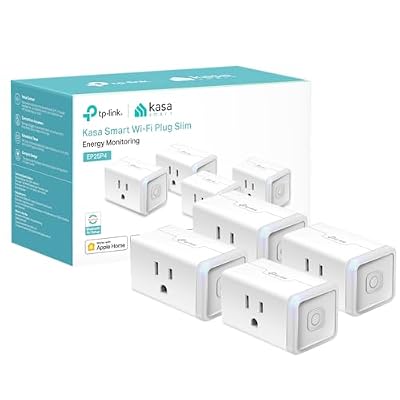
The EP25 is the safest first buy for a mixed household because it refuses to lock you into one platform: it works with Apple HomeKit, Alexa, Google Assistant and SmartThings from the same small body, and it reports real-time and historical energy use in the Kasa app. The 15-amp rating covers lamps, fans, coffee makers and most dehumidifiers, the mini shell stacks two high in a duplex, and UL certification matters in a house whose wiring you did not install. Buy the four-pack and standardise every timer in the house on one app.
Specs
- Model: EP25 (this listing is the EP25P4 four-pack)
- Max load: 15A / 1800W
- Connectivity: 2.4 GHz Wi-Fi only, no hub required
- Platforms: Apple HomeKit, Alexa, Google Assistant, SmartThings
- Energy monitoring: real-time and history in the Kasa Smart app
- Certification: UL certified
- Dimensions: 2.62 x 1.57 x 1.5 in
- Control: app control, scheduling, timer and Away mode
Best for: a first set of plugs for lamps, fans and small appliances across several rooms of an older home.
Watch out for: energy figures appear in the Kasa app rather than Apple Home, and HomeKit control away from home needs a HomePod, HomePod mini or Apple TV acting as the home hub.
ASIN: B0B14C719T
Tapo Smart Plug P115 (4-Pack)

Choose the P115 when the outlets themselves are the constraint. It is one of the smallest metering plugs sold, so two genuinely share a duplex, and the Tapo app adds two safety tricks the Kasa lacks: a charge guard that cuts power when a battery device reaches a set level, and a power-protection mode that switches the plug off if draw passes a threshold you choose. That second feature suits old circuits you would rather not push. It matches the EP25 on load rating and energy history, but speaks to Alexa, Google and SmartThings only, with no Apple support.
Specs
- Model: Tapo P115 (this listing is the four-pack)
- Max load: 15A / 1800W general use and resistive, 1/6 HP motor
- Connectivity: 2.4 GHz Wi-Fi only, no hub required
- Platforms: Alexa, Google Assistant, SmartThings
- Energy monitoring: real-time and historical use in the Tapo app
- Safety: charge guard, power-protection auto shut-off, flame-retardant V-0 housing
- Certification: ETL certified
- Dimensions: 60 x 38 x 40 mm
Best for: crowded duplex outlets, charging corners, and loads you want cut automatically past a set wattage.
Watch out for: there is no Apple HomeKit support, so iPhone households should take the Kasa EP25 instead.
ASIN: B0D7FZ97T5
Amazon Smart Plug

Amazon’s own plug is the pick for a house that already runs on Alexa and wants nothing else to manage. Setup happens inside the Alexa app, there is no third-party account to create, and routines, schedules and voice control all live in one place. The body is rated to the same 15-amp ceiling as the Kasa and Tapo picks, so it handles the usual lamps, fans and coffee makers, and its compact shape is designed to leave the second outlet free. What you give up is breadth: it talks to Alexa alone, offers no energy monitoring, and will not join a Google or Apple setup later.
Specs
- Max output: 15A max
- Input: 120V AC, 60Hz
- Connectivity: 2.4 GHz Wi-Fi only (802.11 b/g/n), no hub required
- Platforms: Alexa only; does not support other voice assistants or smart hubs
- Size: 3.2 x 1.5 x 2.2 in (80 x 38 x 57 mm)
- Use: indoor use only
- Control: schedules and routines in the Alexa app
Best for: an Alexa-only household adding timers to lamps and fans with the least possible setup.
Watch out for: with no energy monitoring and no second platform, it is a dead end if you later want usage figures or Apple or Google control.
ASIN: B089DR29T6
Emporia Smart Plug

The Emporia plug exists for one job: showing you, in detail, what a connected appliance uses. Its app graphs power draw down to the second, tracks cost over days and months, and pairs with Emporia’s whole-home monitors if you later fit one, which makes it the natural choice for interrogating a basement dehumidifier, a chest freezer or an ageing fridge in a house where every circuit is suspect. Scheduling and Alexa and Google control are present, but read the rating before you place it: continuous load is capped at 10 amps, with 15 amps allowed only as a peak for an hour a day.
Specs
- Max load: 10A maximum continuous load, 15A peak for up to one hour per day
- Connectivity: 2.4 GHz Wi-Fi only, no hub required
- Platforms: Alexa, Google Assistant
- Energy monitoring: real-time power and usage history in the Emporia app
- Certification: ETL certified
- Dimensions: 1.97 x 3.31 x 1.5 in
- Control: app scheduling and timers
Best for: monitoring a fridge, freezer or dehumidifier and proving what it costs to run each month.
Watch out for: the 10-amp continuous ceiling rules out most space heaters and many window AC units, whatever the 15-amp peak figure suggests.
ASIN: B0CLVTKYQ9
Zooz ZEN15 Power Switch

The ZEN15 is built for the appliance end of the problem. It is a Z-Wave Plus switch on a short cord with a flat angled plug, rated for the full 15 amps and 1800 watts, with overload protection and energy reports covering watts, amps, volts and kilowatt-hours. Zooz designed it around motor inrush, so window AC units, sump pumps, dehumidifiers and fridges that trip lesser plugs are its home territory, and because it runs on a mesh rather than Wi-Fi, it keeps working in the back room or basement corner your router cannot reach. It also repeats the Z-Wave signal for nearby devices.
Specs
- Model: ZEN15 Power Switch
- Protocol: Z-Wave Plus (908.42 MHz), Z-Wave hub required
- Max load: 15A / 1800W
- Energy monitoring: wattage, amperage, voltage and kWh reports
- Protection: built-in overload protection, ETL certified
- Design: short cord with flat angled plug, built-in Z-Wave signal repeater
- Dimensions: 20 x 2.6 x 1.1 in (with cord)
- Use: indoor use only
Best for: a window AC unit, sump pump or dehumidifier in a room where Wi-Fi is weak but a hub mesh can reach.
Watch out for: it needs a Z-Wave hub such as SmartThings or Hubitat, sold separately, and Zooz states plainly not to use it with electric heaters.
ASIN: B07578W7KY
Which One Fits Your Situation
Lamps and Fans on Timers, and No Smart Home Yet
Start with the Kasa EP25 four-pack. One app runs every timer, the plugs work with whichever voice assistant you adopt later, and the energy screen quickly shows which lamp or fan is worth automating at all. If Apple gear is absent and the outlets are cramped, the Tapo P115 set does the same job in a smaller body.
A Window AC or Dehumidifier in a Far Back Room
Take the Zooz ZEN15, provided you are willing to run a hub. Motor inrush is exactly what it is rated for, and the Z-Wave mesh hops from device to device through walls that stop Wi-Fi. If the room’s 2.4 GHz signal tests strong, the EP25 is the cheaper route, but confirm the appliance’s running amps against the plug’s continuous rating first.
A Gaming Desk or Office Corner on One Outlet
Use a metering plug, either the Tapo P115 or the Kasa EP25, and let its app show what the whole desk draws before you schedule anything. The Tapo’s power-protection shut-off is the safer pick on an old circuit. For load maths and safety checks specific to a PC setup, read our notes on smart plugs for gaming PC power management before plugging in a full rig.
An Alexa Household That Values Simple Over Flexible
Buy the Amazon Smart Plug and stop shopping. It sets up inside the Alexa app in minutes, runs schedules and routines without a second account, and handles ordinary lamps and fans at the same 15-amp ceiling as the rest of this list. Accept its limits knowingly: no energy figures, and no path into Google or Apple control later.
Common Mistakes
- Plugging a smart plug into an ungrounded two-prong outlet through a cheater adapter, which defeats the ground pin the plug’s safety design depends on.
- Running a 1,500-watt space heater on a plug rated at 10 amps continuous, or on any plug whose maker tells you not to connect heaters at all.
- Blaming the plug when setup fails on a combined network: these plugs join 2.4 GHz only, so give that band its own name or temporarily split the bands during pairing.
- Forcing a tall plug into the top socket and losing the bottom one, instead of choosing a mini body or a corded switch that drops the bulk below the outlet.
- Ordering a Z-Wave or other hub-based plug without owning the hub it needs, then discovering the app alone cannot adopt it.
Frequently Asked Questions
Can I use a smart plug on an ungrounded two-prong outlet?
No. Every plug in this guide is a three-prong grounded device, and the ground connection is part of how it protects you and the appliance. A plug-in adapter that accepts three prongs without a real ground path does not make the outlet safe. Ask an electrician about a GFCI-protected grounded replacement instead, which is the standard fix in older homes.
Can a smart plug run a space heater or a window air conditioner?
Only within its continuous rating and the maker’s own rules. A typical 1,500-watt heater pulls about 12.5 amps nonstop, which excludes 10-amp-continuous plugs, and several makers prohibit heaters outright, Zooz among them. Window AC units are easier: choose a plug with an explicit motor rating and headroom for compressor inrush, such as the ZEN15, and check the nameplate amps first.
Will a smart plug work in a room where my Wi-Fi is weak?
Sometimes. Plugs use 2.4 GHz, which crosses plaster and brick better than the 5 GHz band your phone prefers, so test at the socket before assuming failure. If the signal still drops, move a mesh node closer or switch that one outlet to a hub-based mesh plug, whose signal repeats from device to device rather than depending on a single router.
Do smart plugs keep their schedules when the internet goes down?
Usually, yes. Most Wi-Fi plugs store schedules on the device itself, so lamps keep their timers through an outage, while phone and voice control pause until the connection returns. Hub-based systems go further and keep local automations running as well. What no plug can do is follow a schedule that only exists in a cloud routine, so put critical timers on the plug.