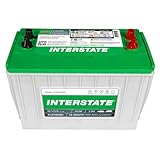
- Top Pick: Interstate Batteries Marine/RV Battery 12V 70Ah 750CCA Group 24 AGM
- Best Value: Interstate Batteries Marine/RV Battery 12V 100Ah 925CCA 1110CA Group 31 AGM (31-AGM5)
- Premium Choice: OPTIMA® Batteries D34M BLUETOP® Dual Purpose Boat and RV Sealed AGM Battery | High Performance Deep Cycle and Starting Battery, 750 CCA, Dual Terminal, Maintenance Free, Versatile Mounting
Picking a boat battery starts with an uncomfortable question: what is it actually going to do? An engine start needs a burst of cold cranking amps. A trolling motor, fish finder, or cabin lights need steady amp-hours over many hours. Some batteries try to cover both jobs, and others commit to one. Getting that split wrong is how weekend anglers end up stranded at the ramp with a battery that turned over fine at the dock and then faded on the water.
This guide sorts ten marine-ready listings by what their titles say: chemistry, capacity in amp-hours, cranking figures, group size, and intended use. Seven are sealed AGM designs, and three are lithium iron phosphate packs aimed at deep-cycle work. In 2026 the practical question is less about brand loyalty and more about group size, cranking need, and whether your charger and charging system can handle the chemistry you choose.
Quick Picks
As an Amazon Associate we earn from qualifying purchases at no extra cost to you.




| Product | Best for | Key spec from the title |
|---|---|---|
| Interstate 70Ah Group 24 AGM | Mid-size boat dual use | 12V 70Ah, 750CCA, Group 24 |
| Interstate 100Ah Group 31 AGM (31-AGM5) | Larger house or start bank | 12V 100Ah, 925CCA, Group 31 |
| Optima D34M BlueTop | Boat and RV dual purpose | 750 CCA, dual terminal, maintenance free |
| Interstate 100Ah Group 31M AGM | Marine-labeled Group 31 | 12V 100Ah, 925CCA, Group 31M |
| Newport 50Ah Deep Cycle AGM | Kayaks and small boats | 12V 50Ah, trolling motors |
| 12V 100Ah LiFePO4 Group 31 (15000 cycles) | Deep-cycle lithium | 100A BMS, 15000 deep cycles |
| UPLUS Group 24M AGM | Electronics and engine starts | 12V 79AH, 550CCA, Group 24M |
| 12V 100Ah LiFePO4 Group 31 (Smart BMS) | Cold-weather lithium use | 1280Wh, low-temp protection |
| CHITOLI 100Ah LiFePO4 | Trolling motor banks | 4000-15000 deep cycles, 100A BMS |
| Mighty Max MM-G24M | Spill-proof AGM | 90Ah, 550 CCA, 700 MCA |
How to Choose
Starting, deep-cycle, or dual-purpose
Cranking amps (CCA or MCA) describe the burst used to start an engine. Amp-hours (Ah) describe how long a battery can feed loads such as a trolling motor. Dual-purpose AGMs like the Optima, UPLUS, and Mighty Max list both. The lithium packs here list deep cycles and amp-hours but no cranking figure, so treat them as house or trolling batteries unless the maker says otherwise.
Group size and fit
Group 24 and Group 31 are standard footprints. Measure your battery tray and check hold-down hardware before buying, because a physically wrong battery is a return waiting to happen. Group 24 units suit smaller boats, while Group 31 units offer more capacity if you have the room. A 12V 100Ah listing assumes you can mount a larger case.
AGM versus lithium iron phosphate
Sealed AGM batteries are maintenance free and spill-resistant, which suits rough water. LiFePO4 packs list thousands of deep cycles and a built-in battery management system (BMS), but they need a compatible charger setting. Confirm your alternator and onboard charger can handle lithium. Mixing chemistries in one bank is generally a mistake.
What to ignore
Cycle-life numbers such as 15000 are manufacturer claims under ideal conditions, not a promise for your boat. Budget batteries can cut corners on terminal quality and capacity accuracy, so read the amp-hour and CCA figures in the title rather than the marketing adjectives. Warranty terms and vibration resistance matter more on a boat than on a shelf.
The 10 Best Options
Interstate 70Ah Group 24 AGM
This Interstate unit lists 12V, 70Ah, 750CCA, Group 24, and AGM construction for marine and RV duty. The mix of capacity and cranking figures suits a mid-size boat that needs to start an engine and run electronics. It is a middle-of-the-road pick for owners with a Group 24 tray who want a recognizable brand name and a single battery that can handle both jobs on weekend trips.
- Strength: dual-use specs cover starting and house loads.
- Strength: Group 24 fits common smaller trays.
- Trade-off: 70Ah is modest for long trolling days.
Skip it if you need a Group 31 footprint.
Interstate 100Ah Group 31 AGM (31-AGM5)
The 31-AGM5 lists 12V, 100Ah, 925CCA, and 1110CA in a Group 31 AGM case. It offers more capacity and cranking than the Group 24 sibling and suits larger boats or RV-style house banks that also need engine-starting capability. Owners stepping up from a Group 24 battery gain headroom for added electronics such as a larger display or extra lighting.
- Strength: 100Ah capacity paired with 925CCA.
- Strength: sealed AGM design with marine and RV labeling.
- Trade-off: Group 31 needs a bigger tray and a heavier lift.
Skip it if your battery box is sized for Group 24.
Optima D34M BlueTop
Optima describes the D34M as a sealed AGM dual-purpose boat and RV battery with high-performance deep cycle and starting capability, 750 CCA, a dual terminal, maintenance-free design, and versatile mounting. The mounting note is useful in cramped compartments, where a battery may have to sit on its side or in an awkward bracket, though you should confirm the orientation the maker allows.
- Strength: dual terminal fits both post and stud connections.
- Strength: maintenance free and sealed.
- Trade-off: the title gives no amp-hour figure, so check the full listing.
Skip it if you want capacity stated up front.
Interstate 100Ah Group 31M AGM
The Group 31M version carries nearly the same headline numbers as the 31-AGM5: 12V, 100Ah, and 925CCA, in a marine-labeled AGM. The “M” in the group name signals marine use, so it is the one to look at if the retailer sorts by marine category. Between the two Group 31 Interstates, the listed cranking and capacity numbers are the same, so the choice often follows stock and fit.
- Strength: marine-focused Group 31 with the same capacity figures.
- Strength: AGM sealed construction.
- Trade-off: it lacks the extra 1110CA figure the 31-AGM5 lists.
Skip it if you already picked the 31-AGM5.
Newport 50Ah Deep Cycle AGM
Newport targets trolling motors, kayaks, and small boats with a 12V, 50Ah rechargeable sealed lead acid design. It is a deep-cycle battery rather than a starter, which makes it suited to powering a small motor and electronics on a light craft. A paddler adding a motor to a fishing kayak or a skiff owner running a small trolling motor will recognize the intended use.
- Strength: sized for small-boat and kayak use.
- Strength: deep-cycle AGM suits steady loads.
- Trade-off: no cranking figure is listed, so it is not an engine-start pick.
Skip it if you need to start a larger outboard.
12V 100Ah LiFePO4 Group 31 (15000 cycles)
This lithium iron phosphate pack lists a built-in 100A BMS, 15000 deep cycles, and Group 31 size, aimed at solar, home energy, RV, and marine use. It appeals to owners who want lower weight and long cycle life for house loads and are comfortable with a lithium-ready charging setup. Anglers who run a trolling motor from a dedicated battery, separate from the engine battery, are the clearest match.
- Strength: built-in BMS is stated in the title.
- Strength: very high listed cycle count.
- Trade-off: no cranking figure, so it is not a starter battery.
Skip it if your charger cannot handle lithium.
UPLUS Group 24M AGM
UPLUS lists a BCI Group 24M dual-purpose AGM at 12V, 79AH, and 550CCA, for starting and deep cycle use. The title mentions navigation devices, lights, and engines, so it is positioned for boats that run electronics and need engine starts from the same battery. A single-battery fishing boat with a depth finder and lights is the typical home for a unit like this.
- Strength: both capacity and cranking numbers are in the title.
- Strength: Group 24M fits smaller marine trays.
- Trade-off: 79AH is modest for heavy trolling loads.
Skip it if you run a large trolling motor all day.
12V 100Ah LiFePO4 Group 31 (Smart BMS)
This second lithium listing states a Group 31 case, a 100A smart BMS, 15000+ deep cycles, 1280Wh, and low-temp protection, for RV, marine trolling motor, solar, and off-grid use. The watt-hour figure helps when sizing against a motor or inverter load, and the low-temperature note is a point worth confirming if you fish in cold months.
- Strength: 1280Wh figure helps estimate runtime planning.
- Strength: low-temperature protection is listed.
- Trade-off: no cranking rating appears in the title.
Skip it if the battery must also start an engine.
CHITOLI 100Ah LiFePO4
CHITOLI offers a 12V 100Ah LiFePO4 battery with a built-in 100A BMS, a 4000-15000 deep cycle range, and a 10-year lifetime claim. The title lists RV, trolling motor, camping, marine, solar, and home energy storage as uses, which is a broad net. That breadth suits owners who plan to move one battery between a boat, a camper, and a backyard solar setup.
- Strength: a cycle range rather than a single optimistic figure.
- Strength: aimed at trolling motor banks.
- Trade-off: the lifetime claim is a manufacturer statement, not a guarantee.
Skip it if you want a starting battery.
Mighty Max MM-G24M
Mighty Max lists the MM-G24M as a 12V, 90Ah Group 24M deep-cycle marine AGM with 550 CCA, 700 MCA, and 145 RC. The title calls it dual-purpose, spill-proof, and maintenance free, giving it the most detailed spec line among the AGM entries. The spill-proof design appeals to owners whose battery sits in a tight compartment where leaks would be a headache.
- Strength: 90Ah is the highest capacity among the Group 24 options.
- Strength: CCA, MCA, and reserve capacity are all listed.
- Trade-off: lead-acid weight is higher than the lithium packs.
Skip it if weight is your top concern.
Which One Fits Your Situation
A bass boat with an outboard and electronics
Mighty Max MM-G24M or UPLUS Group 24M cover starting and deep use from one Group 24 battery.
A kayak or small skiff with a trolling motor
Newport 50Ah Deep Cycle AGM matches the stated use and the compact size.
A larger boat with a house bank
Interstate 100Ah Group 31 AGM (31-AGM5) offers 100Ah and 925CCA in one case.
Lithium for a trolling motor
CHITOLI 100Ah LiFePO4 is the one that lists a cycle range and trolling motor use, assuming a lithium-ready charger.
Common Mistakes
- Using a deep-cycle-only battery to start an engine.
- Ignoring group size and buying a case that does not fit the tray.
- Putting a lithium pack on a charger set for lead acid.
- Mixing old and new batteries, or AGM and lithium, in one bank.
- Reading cycle claims as a guarantee instead of a manufacturer figure.
Related guides
- Combination Smoke And Carbon Monoxide Detectors
- Aio Liquid Coolers For High Performance Gaming
- Graphics Cards For Low Wattage Power Supplies
Frequently Asked Questions
What do CCA and MCA mean?
CCA is cold cranking amps, the burst delivered in cold conditions to start an engine. MCA is marine cranking amps, measured at a warmer temperature, so MCA figures are higher for the same battery.
Can I replace AGM with lithium?
Often, but check that your charger, alternator, and wiring support lithium first. Lithium packs here list deep cycles and a BMS, not cranking.
Is dual-purpose good enough for everything?
It is a compromise. Dual-purpose AGMs start engines and run loads, though a dedicated deep-cycle battery usually suits a trolling motor better.
How big a battery do I need?
Match the group size to your tray, then compare the amp-hours to what your motor and electronics draw. When unsure, choose the larger capacity that physically fits.