

- Top Pick: 12.8V 300Ah Self-Heating LiFePO4 Lithium Battery with APP Monitoring | 200A BMS, Rechargeable 3840Wh Energy Battery for Trolling Motor, RV, Marine, Solar, Camping, Backup Power, Off-Grid, etc.
- Best Value: 12.8V 300Ah LiFePO4 Lithium Battery with Smart APP Monitoring | 200A BMS System, Up to 15000+ Cycles Life, Max 4P4S, 3840Wh with Low-Temp Protection for RV Camping, Off-Grid,Backup Power
- Premium Choice: 12V 100Ah LiFePO4 Battery, Group 24 Deep Cycle for RVs & Trolling Motors | 1280Wh Capacity, 100A BMS, Low-Temp Cutoff, Supports 4P4S Expansion, Up to 20.48kWh, for RV, Trolling Motor, Marine & Solar
Swapping a lead-acid house bank for lithium is one of the most common RV upgrades, and the reasoning is simple: a lithium iron phosphate battery delivers nearly all of its stated capacity, holds steady voltage as it drains and weighs far less than the lead-acid bank it replaces. The hard part is choosing among dozens of look-alike 12V packs that all promise thousands of cycles. The real questions are how much energy the coach needs overnight, whether the cabin sits in cold weather, and whether the battery bay can physically hold the case.
This guide compares ten LiFePO4 batteries for motorhomes, trailers and camper vans in 2026, from single 100Ah Group 24 and Group 31 units to large 300Ah, 314Ah and 460Ah packs. Every comparison below sticks to the numbers each listing states, such as capacity in amp-hours and watt-hours, battery management system current limit, expansion limits and cold-weather features, and avoids claims the titles do not support.
Quick Picks
As an Amazon Associate we earn from qualifying purchases at no extra cost to you.




| Product | Best for | Key spec from the title |
|---|---|---|
| VATRER 12.8V 300Ah Self-Heating | Cold-weather camping with app monitoring | 3840Wh, 200A BMS, self-heating |
| MEYULMOL 12.8V 300Ah | Large capacity with low-temp protection | 3840Wh, 200A BMS, 15000+ cycles |
| SUPER EMPOWER 12V 100Ah Group 24 | Replacing a single standard battery | 1280Wh, 100A BMS, Group 24 |
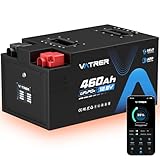
| VATRER 12.8V 460Ah Self-Heating | Full-time motorhome living | 5880Wh usable, 300A BMS |
| VATRER 12V 300Ah Self-Heating | Off-grid weekends with temperature cut-offs | 200A BMS, low/high temp cut-off |
| VEMDIA 12V 100Ah Group 31 | Larger battery trays | Group 31, 1280Wh, 4P4S expansion |
| yeagulch 2 Pack 12.8V 100Ah | Building a bank in one purchase | Two Group 31 units, 100A BMS |
| SUPER EMPOWER 2 Pack Group 24 | Two-battery Group 24 systems | Two 12V 100Ah units, 1280Wh each |
| ECO-WORTHY 12V 314Ah | High capacity with status lights | 4019Wh, Bluetooth, SOC LEDs |
| BUKNUWO 12V 100Ah Bluetooth | Simple single-battery upgrades | Bluetooth, 15000+ cycles |
How to Choose
Capacity in amp-hours and watt-hours
Capacity tells you how long the coach runs between charges. A 100Ah, 12.8V battery stores about 1280Wh, and the listings above state exactly that. To size a bank, add up the watts of your refrigerator, lights, fans, water pump and chargers, multiply each by hours of daily use, and compare the total with the usable watt-hours. Weekend campers often manage on 100Ah to 200Ah, while full-timers and anyone running an inverter for appliances look at 300Ah and up.
BMS current limit and what it allows
The battery management system limits current and protects cells. A 100A BMS supports roughly 1280W of continuous load at 12.8V, a 200A BMS about 2560W and a 300A BMS about 3840W, which is the load figure quoted on the 460Ah pack. If you plan to run a microwave, air conditioner or large inverter, match the BMS current limit to the peak draw, not just the average.
Cold weather and monitoring
Lithium iron phosphate cells should not be charged below freezing, so a battery for winter camping needs either self-heating or a low-temperature cut-off that blocks charging. Several listings mention one or both. App monitoring or Bluetooth lets you read charge and voltage from a phone, while indicator LEDs give a quick glance without opening a compartment. Monitoring is a convenience, not a safety feature on its own.
Size, expansion and where budget models cut corners
Group 24 and Group 31 describe case dimensions, so measure your battery bay before ordering. Expansion claims such as 4P4S mean up to four batteries in parallel and four in series, but only if the manufacturer supports mixing, so keep every unit identical. Budget packs may cut corners on terminal hardware, warranty terms and documentation. Treat headline cycle counts as marketing ceilings rather than promises.
The 10 Best Options
VATRER POWER 12.8V 300Ah Self-Heating
This battery lists 3840Wh, a 200A BMS, app monitoring and self-heating, and names trolling motors, RVs, marine, solar and backup power as uses. It suits campers who want one big battery that can handle cool mornings and be checked from a phone instead of a compartment inspection.
- Self-heating and app monitoring address cold weather and visibility together.
- A 200A BMS supports demanding loads such as a mid-size inverter.
- Trade-off: a 300Ah case is large and heavy to place in tight battery bays.
Skip it if you only need a small bank or have limited compartment space.
MEYULMOL 12.8V 300Ah LiFePO4
The MEYULMOL pack lists 3840Wh, smart app monitoring, a 200A BMS, up to 15000+ cycles, max 4P4S and low-temperature protection. It fits off-grid campers and backup power setups who want large capacity with software visibility, and who may add a second unit later as their needs grow.
- App monitoring and low-temp protection are both listed.
- Expansion up to 4P4S allows future growth without replacing the first battery.
- Trade-off: low-temp protection is not the same as active self-heating.
Skip it if you camp in freezing weather and want built-in heating, or if floor space is tight.
SUPER EMPOWER 12V 100Ah Group 24
This Group 24 battery lists 1280Wh, a 100A BMS, a low-temp cutoff and expansion up to 20.48kWh in 4P4S. It targets RVs and trolling motors where a standard case size matters more than maximum capacity, such as a small camper replacing one tired lead-acid battery.
- The Group 24 size matches many existing battery trays.
- Expansion support allows a larger bank later on.
- Trade-off: 1280Wh covers only light loads when used alone.
Skip it if you plan to run an inverter for large appliances or need app monitoring.
VATRER POWER 12.8V 460Ah Self-Heating
The largest battery here lists 5880Wh of usable energy, a built-in 300A BMS, a 3840W maximum load, self-heating, app monitoring and 5000+ cycles, aimed at RVs and motorhomes. It suits full-time travelers who want a single big house bank rather than several smaller units wired together.
- It has the most stored energy and the highest BMS current limit in the group.
- Self-heating and app monitoring come together in one pack.
- Trade-off: its cycle claim of 5000+ is lower than the 15000+ figures other listings state.
Skip it if you have limited space or modest energy needs that a smaller pack would cover.
VATRER POWER 12V 300AH Deep Cycle (Self-Heating)
This second 300Ah VATRER lists self-heating, app monitoring, low and high temperature cut-offs and a 200A BMS, with RV, camping and off-grid use named. It suits buyers who want temperature protection at both ends of the range, for example campers who park in desert sun one week and mountain frost the next.
- High and low temperature cut-offs are both listed.
- Self-heating helps in cold camps.
- Trade-off: the title gives no watt-hour figure, so you must work it out from voltage and amp-hours.
Skip it if you want listed watt-hours and cycle counts in the title.
VEMDIA 12V 100Ah Group 31
The VEMDIA lists a Group 31 case, a 100A BMS, 1280Wh, 15000+ deep cycles, 4P4S expansion up to 20.48kWh, low-temp cutoff and a lightweight build. It suits RVs and marine setups with a larger tray, and it is the pick for anyone who is moving from a heavy Group 31 lead-acid battery.
- Group 31 fits the bigger trays commonly found in trailers and boats.
- Low-temp cutoff and expansion are both listed.
- Trade-off: no monitoring feature appears in the title.
Skip it if you want app or Bluetooth readouts, or if your tray only fits Group 24.
yeagulch 2 Pack 12.8V 100Ah Group 31
This listing is a two-pack of 100Ah BIC Group 31 batteries with a 100A BMS, 1.28kWh each and 15000+ deep cycles, for RV, marine, camping, off-grid and home energy storage. It suits buyers who want to start a parallel bank in one order and keep both units identical from day one.
- Two matched batteries arrive together.
- Home energy storage use is mentioned alongside RV use.
- Trade-off: no cold-weather or monitoring features are named in the title.
Skip it if winter charging protection is a priority or if one battery already covers your needs.
SUPER EMPOWER 12V 100Ah Group 24 (2 Pack)
The two-pack lists 12V 100Ah Group 24 units with 1280Wh each, a 100A BMS, low-temp cutoff and 4P4S expansion up to 20.48kWh, for RV, boat, trolling motor, marine and solar use. It is the Group 24 route to a two-battery bank, handy for a van with two trays.
- Two batteries arrive matched for a parallel build.
- Low-temp cutoff is listed.
- Trade-off: no app monitoring appears in the title.
Skip it if your tray is built for Group 31 or you would rather have a single large battery.
ECO-WORTHY 12V 314Ah LiFePO4
The ECO-WORTHY lists 314Ah and 4019Wh, Bluetooth, SOC LEDs, low-temperature protection, a 200A BMS and up to 15000 deep cycles, for off-grid, RV, solar and home backup. It suits owners who like a physical charge indicator on the case as well as a phone readout.
- SOC LEDs give an at-a-glance charge reading without opening an app.
- Bluetooth and a high capacity combine in one pack.
- Trade-off: it has low-temperature protection but no self-heating listed.
Skip it if you camp in deep cold, or if you want the extra capacity of a 460Ah pack.
BUKNUWO 12V 100Ah Bluetooth
This 12.8V 100Ah battery lists Bluetooth and 15000+ cycles, for trolling motors, off-grid, boat, RV, marine and solar use. It fits a simple single-battery swap with phone monitoring, and works as a starting point for a camper who may expand later.
- Bluetooth monitoring is included.
- The title names many applications, from boats to solar.
- Trade-off: no BMS current limit or watt-hour figure appears in the title.
Skip it if you need a published BMS current limit before sizing an inverter.
Which One Fits Your Situation
Winter camping in a trailer
The VATRER 300Ah Self-Heating, which lists self-heating, and the 460Ah version are the strongest matches for cold mornings.
Swapping one lead-acid battery in a tight tray
The SUPER EMPOWER Group 24 or VEMDIA Group 31 matches the case size, once you confirm which group your tray holds.
Building a larger bank in one purchase
The yeagulch two-pack (Group 31) or SUPER EMPOWER two-pack (Group 24) gives you matched batteries to wire in parallel.
Full-time living with an inverter
The VATRER 460Ah, with a 300A BMS and 5880Wh usable, is the listing built for heavy loads.
Common Mistakes
- Ordering before measuring the battery bay and confirming Group 24 or Group 31 fit.
- Ignoring the BMS current limit when planning to run an inverter.
- Charging lithium batteries below freezing without a heating or cut-off feature.
- Mixing batteries of different brands or ages in one bank.
- Treating 15000-cycle claims as guarantees and ignoring the warranty terms.
Related guides
- Combination Smoke And Carbon Monoxide Detectors
- Aio Liquid Coolers For High Performance Gaming
- Graphics Cards For Low Wattage Power Supplies
Frequently Asked Questions
How many amp-hours does an RV need?
It depends on loads. Weekend campers often manage on 100Ah to 200Ah, while full-timers with an inverter look at 300Ah or more. Add up daily watt-hours to be sure.
Can I replace lead-acid with lithium directly?
Often yes, but check the charger and converter. Some older units charge lithium poorly, so confirm a lithium-compatible profile.
What is self-heating?
It means the battery warms its cells so charging can proceed in cold conditions. It uses some stored energy to do so.
What does 4P4S mean?
It indicates up to four batteries in parallel and four in series, which raises capacity or voltage. Use identical batteries and follow the maker’s wiring guidance.







