Most gaming headsets share the same recipe: a 50 mm dynamic driver, a basic boom microphone and a wireless dongle. The high end of the market exists for buyers who want more than that recipe — planar magnetic drivers borrowed from audiophile headphones, graphene diaphragms, broadcast-grade condenser microphones, hi-res wired and wireless audio paths, and battery systems built for week-long play rather than nightly charging. This guide compares five headsets that earn the high end label through named hardware, not through branding. Each pick below is judged on the same dimensions: how it connects, what its microphone really is, how far its audio path goes in resolution terms, and what it needs in power and accessories to work at its best.
A headset at this level usually anchors a serious desk setup, so it pairs naturally with the kind of machine covered in our guide to the best high end gaming desktop PC builds — there is little point feeding a planar magnetic headset from a noisy onboard audio jack. As an Amazon Associate we earn from qualifying purchases.
How to judge a high end headset
Four things separate this tier from the mainstream. First, driver technology: planar magnetic drivers use a thin diaphragm driven across its whole surface, which makers spec with very wide frequency response and low distortion, while graphene diaphragms aim for stiffness and speed in a dynamic design. Second, the microphone: the best here use a detachable hypercardioid boom, a studio condenser capsule, or a broadcast-grade omnidirectional design rather than a basic electret. Third, the audio path: look for stated hi-res support such as 24-bit/96 kHz over USB, LDAC over Bluetooth, or a USB DAC mode. Fourth, power: wireless flagships quote battery life from 30 to more than 80 hours, while the wired flagships trade the battery away for an amplifier-friendly analogue connection.
1. Audeze Maxwell — planar magnetic wireless flagship
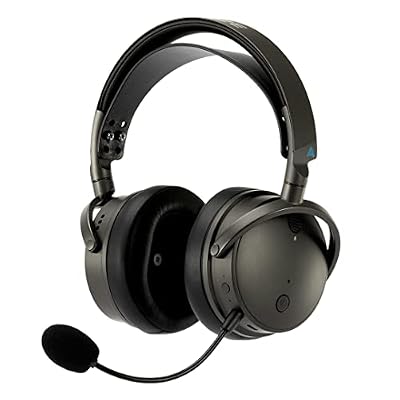
The Maxwell is the reference point for wireless gaming audio because its 90 mm planar magnetic drivers are several times larger than the dynamic drivers in most headsets. Audeze builds them with its Fluxor magnet array, Fazor phase management and ultra-thin Uniforce diaphragms, and specs the headset at a 10 Hz to 50 kHz frequency response with distortion under 0.1 percent. That driver package, not a feature checklist, is what makes it high end.
Connection is the most complete here: an ultra-low-latency wireless link through the included USB-C dongle, Bluetooth 5.3 with multipoint, wired USB-C digital audio, and a 3.5 mm analogue input. The audio path supports hi-res playback up to 24-bit/96 kHz, and the Bluetooth codec list runs to LDAC, LE Audio, LC3 and LC3plus alongside AAC and SBC — the broadest codec support in this guide. The microphone is a detachable hypercardioid boom designed with Shure, backed by AI noise filtering fed by an internal microphone array, so voice chat stays usable with the boom removed. Power comes from an 1,800 mAh lithium-polymer battery rated for more than 80 hours, with fast charging that returns about a quarter of the battery in 20 minutes. The trade-offs are weight — 490 g is heavy — and an active analogue input, so the headset needs battery power even when wired. Choose the Maxwell for one wireless headset covering PC, console and hi-res music, and pick the correct PlayStation or Xbox version, since the two are separate models.
Specs
- Driver: 90 mm planar magnetic, Fluxor array, Fazor waveguides
- Design: Closed-back, over-ear
- Frequency response: 10 Hz – 50 kHz
- Connection: USB-C low-latency wireless dongle, Bluetooth 5.3 (LDAC, LC3, LC3plus, LE Audio, AAC, SBC), USB-C wired, 3.5 mm analogue
- Audio resolution: Up to 24-bit/96 kHz
- Microphone: Detachable hypercardioid boom, AI noise filtration
- Battery: 1,800 mAh lithium-polymer, 80+ hours rated, USB-C fast charge
- Weight: 490 g
- Platforms: PC, Mac, PlayStation or Xbox (version-specific), Switch, mobile
2. Audeze LCD-GX — wired open-back audiophile flagship

If the Maxwell is the wireless ceiling, the LCD-GX is the wired one. It is built on Audeze’s LCD audiophile line, with 106 mm planar magnetic drivers in an open-back magnesium housing, handcrafted in California. The open-back design gives it the widest, most spacious presentation here, at the cost of leaking sound to the room and letting room noise in — this is a headset for a quiet, private setup, not a shared space or a LAN.
There is no wireless, no battery and no DSP: the LCD-GX is purely analogue. It ships with two cables — a braided cable ending in a 6.35 mm plug for a headphone amplifier, and a microphone cable ending in a 3.5 mm TRRS plug for controllers, PCs and consoles. Audeze recommends more than 250 mW of amplifier power, so budget for a decent DAC and amp rather than a motherboard jack. The microphone is a standout for voice work: a detachable boom with a directional, noise-attenuating capsule positioned for broadcast and streaming use, removable when you only want to listen. At 20 ohms and 100 dB/1 mW it is easy to drive to volume, but the 454 g weight and amplifier requirement define its audience. Choose the LCD-GX if sound quality is the single priority, your play space is quiet, and you already own — or plan to buy — proper amplification.
Specs
- Driver: 106 mm planar magnetic, single Fluxor array, Uniforce diaphragm
- Design: Open-back, over-ear, magnesium housing
- Frequency response: 10 Hz – 50 kHz
- Impedance / sensitivity: 20 ohms / 100 dB per 1 mW
- Connection: Wired analogue only — braided cable with 6.35 mm plug, microphone cable with 3.5 mm TRRS plug
- Microphone: Detachable directional boom microphone, noise-attenuating
- Battery: None — passive analogue headset, amplifier recommended (over 250 mW)
- Weight: 454 g
- Platforms: PC, PlayStation, Xbox, Mac, mobile via 3.5 mm
3. Corsair Virtuoso Max — graphene drivers, ANC and dual wireless

Corsair’s flagship takes a different route to the high end: 50 mm drivers whose diaphragms are made entirely of graphene, which Corsair uses for a faster, tighter response than a standard dynamic driver, with a rated 20 Hz to 40 kHz frequency response. Around that driver it stacks the convenience features the Audeze models skip — hybrid active noise cancellation with a transparency mode, Dolby Atmos spatial audio on PC, and Sonarworks SoundID, which builds a personal hearing profile from a short listening test and tunes the headset to your ears.
The Virtuoso Max connects over a 2.4 GHz wireless dongle and Bluetooth at the same time, so game audio and a phone call or music can run simultaneously, with a separate volume wheel for each source. Note the platform limit: this model covers PC, Mac and PlayStation, not Xbox wireless. The microphone is a detachable broadcast-grade omnidirectional boom, with built-in microphones for use when the boom is removed. Battery life is rated up to 65 hours, and a 15-minute charge adds several hours of playback. At around 417 g it is still a substantial headset, and SoundID and EQ live in Corsair’s iCUE software, so console players get a smaller feature set. Choose the Virtuoso Max for flagship convenience — ANC, simultaneous dual wireless and personalised tuning — on PC or PlayStation.
Specs
- Driver: 50 mm graphene dynamic
- Design: Closed-back, over-ear, aluminium frame
- Frequency response: 20 Hz – 40 kHz
- Connection: 2.4 GHz wireless dongle and Bluetooth simultaneously, USB-C charging and data
- Audio features: Dolby Atmos on PC, Sonarworks SoundID via iCUE, hybrid ANC and transparency
- Microphone: Detachable broadcast-grade omnidirectional boom, plus built-in microphones
- Battery: Up to 65 hours rated, fast charge over USB-C
- Weight: About 417 g
- Platforms: PC, Mac, PS5, PS4 (no Xbox wireless on this model)
4. Focal Bathys — hi-fi headphones with a USB DAC mode for gaming

The Bathys is not a gaming-branded headset at all, and that is its appeal: it is a hi-fi wireless headphone from Focal, built around 40 mm aluminium-magnesium M-dome drivers made in France, that happens to cover gaming bases through its wired modes. For desk play, its USB-C connection runs in DAC mode at up to 24-bit/192 kHz — the highest-resolution audio path in this guide — and a 3.5 mm input covers controllers. Bluetooth 5.1 with aptX Adaptive handles wireless listening away from the desk.
Be clear about what it does not have: there is no 2.4 GHz gaming dongle and no boom microphone. Voice chat uses the built-in microphones — fine for calls and casual chat, a step below the boom designs above — and Bluetooth latency makes it a poor fit for competitive shooters. What you get instead is active noise cancellation with silent, soft and transparency modes, a Focal and Naim app with EQ and hearing personalisation, and battery life rated at 30 hours over Bluetooth with ANC, rising to 35 hours on the jack input and 42 hours in USB mode. At 350 g it is the lightest pick here by a wide margin. Choose the Bathys if your headset budget is really a headphone budget — one premium pair for music, travel and single-player gaming, with competitive voice chat handled by a separate microphone.
Specs
- Driver: 40 mm aluminium-magnesium M-dome dynamic, made in France
- Design: Closed-back, over-ear, active noise cancellation
- Frequency response: 15 Hz – 22 kHz
- Connection: Bluetooth 5.1 (aptX Adaptive, AAC, SBC), USB-C DAC mode, 3.5 mm wired
- Audio resolution: Up to 24-bit/192 kHz in USB DAC mode
- Microphone: Built-in microphones only — no boom microphone
- Battery: 30 hours Bluetooth with ANC, 35 hours wired jack, 42 hours USB mode; fast charge adds about 5 hours in 15 minutes
- Weight: 350 g
- Platforms: PC and Mac via USB or Bluetooth, consoles via 3.5 mm controller connection, mobile
5. Audio-Technica ATH-M50xSTS — broadcast microphone for streamers
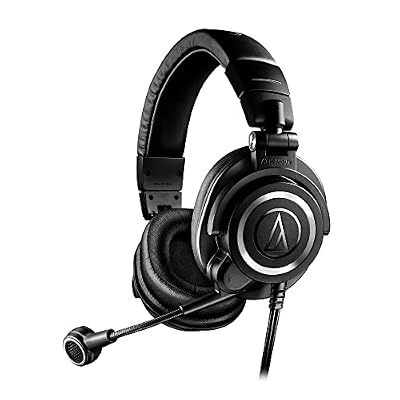
Every other pick here leads with its drivers; the StreamSet leads with its microphone. Audio-Technica took the ATH-M50x studio monitor headphone — 45 mm drivers, a 15 Hz to 28 kHz response and a closed-back design tuned for monitoring — and fitted a boom microphone built from its 20 Series condenser technology, the same capsule family as the AT2020 studio microphone. For streamers and commentators, that condenser boom is the high end feature: it captures a fuller, more detailed voice than the dynamic and electret booms on typical gaming headsets.
This XLR version is wired and deliberately analogue. One supplied 2-metre cable splits into an XLR output for the microphone and a 3.5 mm plug for the headphones, so the microphone feeds an audio interface or mixer — plan on owning one, since that interface powers and converts the condenser capsule. A second 1.2-metre cable with a 3.5 mm TRRS plug covers direct connection to a controller or laptop. There is no battery, no wireless and no software; sidetone, gain and processing all come from your interface, which is the control a streaming setup wants. The earcups fold and the pads are replaceable, following the M50x’s studio-serviceable design. Choose the ATH-M50xSTS if you stream or record commentary and your voice matters more than wireless freedom — and choose the USB version of the StreamSet instead only if you do not own an interface.
Specs
- Driver: 45 mm dynamic, closed-back monitor tuning
- Frequency response: 15 Hz – 28 kHz
- Impedance / sensitivity: 38 ohms / 99 dB
- Connection: Wired — 2.0 m cable with XLR microphone output and 3.5 mm headphone plug; 1.2 m cable with 3.5 mm TRRS plug
- Microphone: Boom-mounted cardioid condenser based on Audio-Technica 20 Series technology, flip to mute
- Battery: None — powered through the connected interface for the microphone
- Required accessory: Audio interface or mixer with an XLR microphone input for the XLR cable
- Weight: About 330 g
- Platforms: PC and consoles via interface or 3.5 mm connection
Which high end headset should you buy?
Start with the microphone and the wire, not the driver. If you stream or commentate, the ATH-M50xSTS is the only pick built around a studio condenser capsule, provided an XLR interface already sits on your desk. If you want wireless freedom with the best driver technology across PC and console, the Audeze Maxwell is the complete package. If your room is quiet and pure sound quality from a proper amplifier is the priority, the LCD-GX sits a level above everything else here. If you want flagship convenience — noise cancellation, simultaneous phone and game audio, personalised tuning — the Virtuoso Max is the mainstream flagship done properly, as long as you do not need Xbox wireless. And if the headset doubles as your travel headphone, the Bathys trades the boom microphone and gaming dongle for hi-fi drivers, a USB DAC mode and the lightest build in the group. Whichever you choose, check platform details before ordering: console-specific versions, interface requirements and amplifier recommendations are where high end headsets most often catch buyers out.