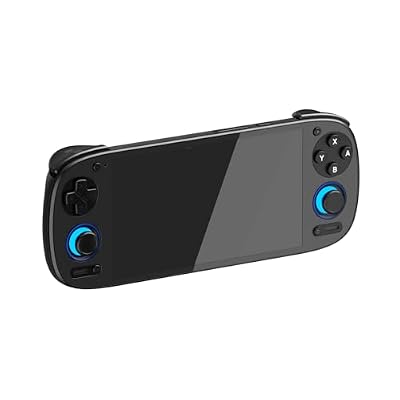
- Top Pick: Lenovo Legion Go 2
- Runner-up: ASUS ROG Xbox Ally
- Also consider: Lenovo Legion Go S
Flight games are the quiet corner of the emulation shelf. The library here stays under the weather: Ace Combat on PSP and PS2, Pilotwings on SNES and Nintendo 64, Sky Odyssey’s island hops on PS2, the After Burner line, and the DOS flight classics that DOSBox carries so well. None of it asks for a fast chip. All of it asks for a stick you can move by a hair without the nose wandering, a trigger that behaves like a throttle, and a screen big enough to pick a runway out of the haze.
As an Amazon Associate, we earn from qualifying purchases.
This is the terrestrial sibling of our space sims roundup: same sky, different air. Everything below runs on dumps from games you own, through PPSSPP, PCSX2 and DOSBox, and the ranking puts stick feel first and screen size second, because in this genre the controller is the review. Power matters only up to the PS2 tier, and the lightest library in the cluster means storage never enters the argument.
This article contains an affiliate link for each product listed, and we may earn a commission if you buy through them.
Quick Answer
For emulated flight games, pick the Legion Go 2: its 8.8-inch screen spots distant runways early, and its Hall-effect sticks hold gentle corrections without drift. The ROG Xbox Ally is the lighter long-cruise pick, the Legion Go S brings the sharpest value screen, and a simple USB hub lets any Windows handheld borrow a real flight stick.
The Shelf: What Counts as a Flight Game Here
The shelf splits into three bands. The arcade band is After Burner and its descendants: short, loud, and happy on almost any hardware. The console band is where the hours live: Ace Combat pairs arcade handling with long campaign missions, Pilotwings turns flight into calm scored exercises, and Sky Odyssey treats the aeroplane as a way to wander. The DOS band is the deep archive, flown through DOSBox with a keyboard beside the stick.
Each band leans on a different control. Arcade flight wants a stick that snaps back to centre cleanly. Console flight wants a stick that can sit two degrees off centre for a full minute. DOS flight wants a throttle axis and enough buttons, which is why the throttle question below matters more here than in any other genre.
Why the Stick Is the Whole Review
A racing game forgives a coarse stick because the car is always being corrected. A flight game does not. Most of a flight is a gentle correction held steady: a whisper of bank to stay on the glide path, a nudge of pitch to hold altitude. A stick with a wide dead zone or a gritty centre turns that into small over-corrections, and the aeroplane porpoises down the approach.
This is where the makers’ published designs separate the field. Lenovo states that the Legion Go 2’s TrueStrike controllers use Hall-effect sticks and triggers, sensing position magnetically rather than through a wearing contact track. ASUS states Hall Effect analog triggers for the ROG Xbox Ally. Where a maker publishes nothing about stick sensing, this guide says so rather than guessing, because drift resistance is a design fact, not a vibe.
The Throttle Question
Flight is the one genre that reads a trigger as a quantity rather than a press. Console flight games map throttle to the analog triggers, so a trigger with long, smooth travel is a throttle you can set and leave; a short, clicky one is a switch pretending. The Legion Go 2’s triggers add an adjustable throw, with short and long travel settings in Lenovo’s materials, which suits a shelf that mixes arcade and simulation.
DOSBox answers the same question from the other direction. Its documentation describes joystick types in its configuration, including FCS and CH modes named for the classic ThrustMaster Flight Control System and CH Flightstick Pro, alongside simpler two-axis and four-axis modes, and its mapper binds real axes to the emulated stick. DOSBox was written when a flight stick was the expected controller, and it still treats yours that way.
Bringing a Real Stick Along
Every Windows handheld here has USB-C, and that opens the genre’s best trick: plug in a desktop flight stick and fly the DOS and PS2 shelves with the control they were drawn around. The handheld becomes screen, computer and battery in one, and the triggers-as-throttle compromise disappears. A hub with pass-through charging keeps the battery fed through the session.
The Picks, Ranked by Stick and Screen
Lenovo Legion Go 2

The biggest screen and the best-documented sticks take the top spot: the 8.8-inch panel gives distant detail room to exist, and the detachable controllers mean a wobbly tray table never reaches the airframe.
Specs:
- Processor: AMD Ryzen Z2, 8 cores and 16 threads, up to 5.1 GHz
- Memory and storage: 32GB LPDDR5X, 2TB SSD, M.2 2280 slot
- Display: 8.8-inch OLED, 1920×1200, 144Hz
- Controls: detachable TrueStrike controllers, Hall-effect sticks and triggers, adjustable trigger throw
- Battery and weight: 74Wh, about 920g with controllers attached
- Ports: two USB4 ports
For flight, the size is the argument and the weight is the tax. Held for a full mission it is the heaviest pick here; propped up or rested on a cushion, it is the closest thing to a cockpit panel in this guide.
ASUS ROG Xbox Ally

The calm-cruise pick. At about 670g it is the lightest Windows handheld in this guide, and a two-hour Sky Odyssey wander is exactly the session that rewards that. ASUS states Hall Effect analog triggers, the half of the control pair this genre leans on for throttle.
Specs:
- Processor: AMD Ryzen Z2 A, 4 cores and 8 threads
- Memory and storage: 16GB LPDDR5X-6400, 512GB SSD, M.2 2280 slot
- Display: 7-inch IPS, 1920×1080, 120Hz, FreeSync Premium
- Controls: Hall Effect analog triggers per ASUS
- Battery and weight: 60Wh, about 670g
- Storage expansion: UHS-II microSD slot
The 7-inch screen is the honest limit: distant runways resolve later than on the Lenovo panels. For the arcade band and Pilotwings, nothing here is missing; for long visual approaches, sit closer and it stops mattering.
See the ROG Xbox Ally on Amazon
Lenovo Legion Go S

The sharp-screen value route. Its 8-inch 1920×1200 panel carries the most pixels per inch in this guide, so a far threshold stays a line instead of a smudge, and the 48-120Hz variable refresh keeps slow panning views smooth.
Specs:
- Processor: AMD Ryzen Z2 Go, 4 cores and 8 threads, up to 4.3 GHz
- Memory and storage: 16GB LPDDR5x-6400, 512GB SSD, M.2 2242 slot
- Display: 8-inch IPS, 1920×1200, 48-120Hz variable refresh
- Operating system: Windows 11 (this configuration)
- Battery and weight: 55.5Wh, about 740g
Lenovo publishes no Hall-effect claim for this model’s sticks, so treat them as conventional and serviceable rather than drift-proof. The chip is the modest one here, which this shelf forgives: PSP, PS2 and DOS flight all sit inside its reach.
Xbox Wireless Controller

The docked and desk pick. When a handheld is plugged into a hub and a real stick is not on the table, a full-size pad with long trigger travel is the most comfortable throttle in the guide, and its layout is the one every emulator here assumes by default.
Specs:
- Connection: Xbox Wireless, Bluetooth and USB-C
- Power: AA batteries, or an optional rechargeable battery pack
- Features: dedicated Share button, hybrid D-pad, textured grips
- Stick sensing: not stated by Microsoft
It adds no screen and no chip, so it ranks below the handhelds it serves. As the second seat in a two-player After Burner session, or the pad you fly with while the handheld charges, it earns its place.
See the Xbox Wireless Controller on Amazon
Anker 341 USB-C Hub (7-in-1)

The enabler. This hub turns the real-stick route from a battery gamble into a setup: one cable to the handheld, power passed through to keep it charged, and USB-A ports waiting for a flight stick, a throttle, or both.
Specs:
- Ports: 7-in-1 layout with USB-A, USB-C, HDMI and card slots
- Charging: USB-C power delivery pass-through, up to 100W input
- Video: HDMI output for a larger screen
- Stick sensing: not stated
Anker’s stated compatibility covers the Windows handheld pattern used here; confirm your exact model on the maker’s list before ordering. With a stick attached through this hub, the ranking above stops mattering, which is the point of including it.
See the Anker 341 hub on Amazon
How to Choose
Start with the band you actually fly. Arcade flight and Pilotwings ask so little that the Legion Go S or the Xbox Ally covers the whole shelf, and the choice becomes screen taste and weight. The PS2 band is the only one that spends chip: Ace Combat’s later entries and Sky Odyssey favour the Legion Go 2’s headroom, though the Go S still flies them at native resolution.
Then decide where your hands will be. If you fly handheld, stick sensing and weight decide, in that order. If you fly at a desk or tray table, the hub-and-stick route outranks every built-in control in this guide, and the handheld choice collapses to screen size alone. Finally, match the battery to the session: the Go 2 carries the largest cell, the Ally the middle one, the Go S the smallest, and a hub session makes the question disappear.
Who Should Skip
Skip this entire shelf if your flight library lives in modern simulators rather than emulated classics; those belong on a desktop with a full HOTAS. Skip the Legion Go 2 if you fly in an airline seat with the device in your hands for hours, where its weight works against the calm it is meant to deliver. Skip the hub route if you only fly the arcade band, since After Burner never asked for a throttle quadrant. And skip emulation for any game you cannot dump from a copy you own; the shelf is deep enough with your own discs and cartridges.
FAQ
Can these handhelds run Ace Combat from the PS2?
Yes, within the normal per-game variance of PCSX2. The Legion Go 2 has the most headroom, the Legion Go S and Xbox Ally handle the series at native resolution, and the PSP entries through PPSSPP are lighter still. Use your own disc dumps, and check the emulator’s compatibility notes for your title.
Do I need a real flight stick for DOS flight games?
No, but DOSBox is ready for one. Its documented joystick modes include FCS and CH settings modelled on classic flight sticks, and its mapper binds real axes to the emulated controls. A built-in stick covers the classics; a USB stick through a hub is a comfort upgrade, not a requirement.
Why does stick drift matter more for flight games?
Because flight is a held correction, not a series of presses. A drifting stick adds a constant unwanted bank or pitch that you fight all session. Hall-effect sensing, where the maker states it, avoids the wearing contact track behind most drift, which is why this guide ranks on published stick design.
Are the triggers really used as a throttle?
In the console band, yes. Ace Combat and its peers read the analog triggers as throttle input, so smooth trigger travel means finer speed control. On the DOS shelf, throttle usually lives on a separate axis, which the hub-and-stick route restores.
Final Verdict
Flight games reward the handheld that disappears: a stick that holds a whisper of bank, a screen that resolves a runway early, and enough battery to forget. That is the Legion Go 2 first, on screen size and documented Hall-effect controls. The ROG Xbox Ally is the pick for long, light, calm sessions, and the Legion Go S is the sharp-screen value route into the same sky. Add the Xbox controller for the desk and the Anker hub when a real stick comes out, and every band of the terrestrial shelf has a comfortable way to fly.