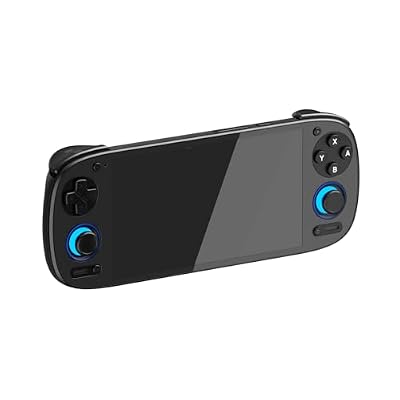
- Top Pick: Miyoo Mini V4
- Runner-up: Anbernic RG28XX
- Also consider: TrimUI Brick
Most retro handheld roundups rank by screen size and emulation ceiling, and both of those push you toward bigger shells. If your hands are on the smaller side, the spec that decides comfort is neither: it is the width of the body, because width sets how far your thumbs travel and how far your index fingers stretch to reach the shoulder buttons. A wide handheld forces a fingertip grip, and a fingertip grip turns into aching hands long before the battery runs out.
This guide is the counterpart to our large-hands roundup, and it is written for adult players with smaller hands, not for children. Every pick below is ranked by three measurements: body width, weight, and shoulder-button reach. The five devices run from a 65 mm wide micro vertical up to an 81 mm wide model that marks the practical ceiling for a relaxed grip.
As an Amazon Associate, we earn from qualifying purchases.
Quick Answer
For small hands, start with the Miyoo Mini V4: at 65 mm wide and about 107 g it is the easiest grip on this list. The Anbernic RG28XX is the horizontal option, with close-set shoulders and no sticks to stretch for. The TrimUI Brick and Miyoo Mini Plus add bigger 4:3 screens in narrow vertical shells, and the Anbernic RG35XX Plus is the largest pick still worth considering.
Why Width and Reach Matter More Than Screen Size
A handheld’s width is the distance your hands have to bridge. On a narrow body, your palms support the shell and your thumbs rest on the controls. On a wide body, the same hands hold the device by its edges, your thumbs angle inward, and every press becomes a small reach. That difference is minor in a menu and exhausting in an action game, because it repeats thousands of times per session.
Shoulder buttons are the second pressure point. On vertical handhelds the shoulder buttons sit on the back or the top edge, and their spacing follows the shell. A shell that is 65 to 80 mm wide keeps both pairs of shoulders under your index fingers without shifting your grip. Past roughly 85 mm, smaller hands usually have to roll the device forward to reach the second pair, which breaks your hold on the face buttons at the worst moment.
Weight compounds both problems. A light device can be held loosely, so a slightly awkward reach costs little. A heavy device has to be gripped firmly, so the same reach costs much more over a long session. That is why every pick below stays under 190 g, and why the ranking weighs grams as heavily as millimetres. Screen size still matters for text-heavy games, but a screen you cannot hold comfortably is a poor trade.
The Five Picks, Smallest First
Miyoo Mini V4

The Mini V4 is the narrowest full-featured retro handheld in this roundup: 65 mm wide, 93.5 mm tall and about 107 g. Your thumbs cover the whole face without stretching, and the back shoulder buttons sit exactly where short index fingers land. The trade is screen size, a 2.8-inch panel, and a modest dual-core chip that tops out around PlayStation 1. With OnionOS installed it is also the simplest pick here to live with day to day.
Specs:
– Display: 2.8-inch IPS, 750 x 560
– Dimensions: 93.5 x 65 x 18 mm
– Weight: about 107 g
– Chip: SigmaStar SSD202D, dual-core Cortex-A7 at 1.2 GHz
– RAM: 128 MB
– Battery: 2,000 mAh
– Connectivity: USB-C, no Wi-Fi
– Controls: D-pad, four face buttons, back shoulder buttons, no analog sticks
Anbernic RG28XX

The RG28XX is the horizontal pick, and horizontal shells suit small hands better than their width suggests: at 125 mm across but only 56.5 mm tall, your fingers wrap a short body and the four shoulder buttons sit in a tight row that is easy to cover. There are no analog sticks, which removes the longest thumb reach entirely. The H700 chip is far stronger than the Mini V4’s, handling Nintendo 64 and Dreamcast far more convincingly, but there is no Wi-Fi, so updates and RetroAchievements mean moving files by card.
Specs:
– Display: 2.83-inch IPS, 640 x 480
– Dimensions: 125 x 56.5 x 16.5 mm
– Weight: about 125 g
– Chip: Allwinner H700, quad-core Cortex-A53 at 1.5 GHz
– RAM: 1 GB LPDDR4
– Battery: 3,100 mAh
– Connectivity: USB-C, no Wi-Fi
– Controls: D-pad, four face buttons, four shoulder buttons, no analog sticks
TrimUI Brick

The Brick is the pick when you want a bigger, sharper screen without a wider grip. It is 73.2 mm wide, narrower than the Mini Plus below, yet fits a 3.2-inch 1024 x 768 laminated panel that renders Game Boy Advance and SNES pixel art with unusual clarity. The metal back plate makes it feel dense rather than bulky at 159 g, and the microswitch face buttons need very little travel, which suits shorter thumbs. It has Wi-Fi and Bluetooth, but no analog sticks, so its ceiling is PlayStation 1 and lighter Nintendo 64.
Specs:
– Display: 3.2-inch IPS, fully laminated, 1024 x 768
– Dimensions: 109.9 x 73.2 x 11.8 to 19.9 mm
– Weight: 159 g
– Chip: Allwinner A133P, quad-core Cortex-A53 at 1.8 GHz
– RAM: 1 GB LPDDR3
– Battery: 3,000 mAh
– Connectivity: Wi-Fi, Bluetooth, USB-C
– Controls: D-pad, four face buttons, shoulder buttons, no analog sticks
Miyoo Mini Plus
The Mini Plus is the roomier sibling of the Mini V4: same vertical layout and the same OnionOS experience, stretched to 78.5 mm wide with a 3.5-inch screen. That extra width buys noticeably more readable text in RPGs and strategy games, and the grip stays relaxed because the shell is still narrow and only 162 g. Wi-Fi is built in, which the V4 lacks, so RetroAchievements and wireless file transfers work out of the box. Power matches the V4, so PlayStation 1 is again the realistic ceiling.
Specs:
– Display: 3.5-inch IPS, 640 x 480
– Dimensions: 108.5 x 78.5 x 22.3 mm
– Weight: 162 g
– Chip: quad-core Cortex-A7 at 1.2 GHz
– RAM: 128 MB
– Battery: 3,000 mAh
– Connectivity: Wi-Fi, USB-C
– Controls: D-pad, four face buttons, back shoulder buttons, no analog sticks
Anbernic RG35XX Plus

The RG35XX Plus marks the upper bound of this list at 81 mm wide and 186 g. It earns its place because it pairs that still-manageable shell with the strongest package here: the H700 chip, Wi-Fi and Bluetooth, dual card slots and a mini-HDMI output for a television. If your hands are small but not tiny, this is the most capable pick that does not demand a stretched grip. If the Mini Plus already feels wide in your hands, treat this one as too big and stop at the Brick.
Specs:
– Display: 3.5-inch IPS, 640 x 480
– Dimensions: 117 x 81 x 22 mm
– Weight: 186 g
– Chip: Allwinner H700, quad-core Cortex-A53 at 1.5 GHz
– RAM: 1 GB LPDDR4
– Battery: 3,300 mAh
– Connectivity: Wi-Fi 5, Bluetooth 4.2, mini-HDMI out
– Controls: D-pad, four face buttons, four shoulder buttons, no analog sticks
How to Choose
Measure your current comfort first. If you own any handheld, note whether your index fingers rest on the shoulder buttons or hover short of them; that single observation tells you more than any spec sheet. As a working guide, shells up to about 80 mm wide suit most smaller hands for long sessions, and every extra 10 mm of width costs more comfort than the same weight in grams.
Decide your layout next. Vertical shells keep both hands close together and put the shoulders on the back, which short fingers reach easily; they are the safer default. Horizontal shells spread your hands apart but shorten the body’s height, so they work when the device is light and the shoulders are close-set, as on the RG28XX.
Then match the chip to your library. If your games stop at PlayStation 1, every pick here is fast enough and you can choose purely on fit. If you want Nintendo 64, Dreamcast or PSP, narrow the list to the two H700 models and accept their extra width and weight as the price of that power.
Who Should Skip This List
Skip these picks if your library centres on PSP, GameCube or PlayStation 2. None of the five has analog sticks, and the compact shells that make them comfortable also cap their emulation ceiling well below those systems; a larger Android handheld is the honest answer there.
Skip them, too, if you mostly play docked or on a television, where grip size stops mattering, or if you have average or large hands and find compact verticals cramped: the large-hands roundup covers the wider shells built for you. Finally, if tiny text strains your eyes, the two 2.8-inch screens will frustrate you regardless of fit.
Frequently Asked Questions
Is a vertical or horizontal handheld better for small hands?
Vertical, in most cases. A vertical shell is narrower, keeps your thumbs close to the centre line and puts the shoulder buttons on the back within easy index-finger reach. A horizontal handheld only competes when it is very light with close-set shoulders, which is why the RG28XX is the single horizontal pick here.
What width should I look for in a handheld for small hands?
Treat about 80 mm as the comfort ceiling for long sessions and 65 to 75 mm as the sweet spot. Width matters more than height or thickness, because it sets thumb travel and shoulder reach. Every pick in this guide is 81 mm wide or less, and the top two are under 75 mm.
Are these handhelds suitable for children?
They are chosen for adult players with smaller hands, not as toys for children. The sizing advice transfers, since a child’s hands are smaller still, but these are enthusiast Linux devices with small parts, lithium batteries and setup steps that assume an adult is doing the configuring and supervising play.
Do any of these compact handhelds have analog sticks?
No. Every pick uses a D-pad and face buttons only, which is part of why they stay narrow and light. That limits them to systems designed around digital controls, up to PlayStation 1 comfortably. If your games need twin sticks, you will have to accept a wider shell from a different class of device.
Final Verdict
Fit first, power second: that order decides whether a handheld gets played or shelved. The Miyoo Mini V4 is the safest grip and the easiest recommendation, the RG28XX covers horizontal fans, the TrimUI Brick offers the sharpest screen in a narrow shell, the Miyoo Mini Plus adds reading room and Wi-Fi, and the RG35XX Plus is the capability ceiling at a width small hands can still manage. Pick by the width your fingers can relax around, and the rest follows.