

- Top Pick: Corsair K55 CORE TKL RGB Gaming Keyboard – Tenkeyless, 8-Zone RGB, Quiet Membrane Keys, Spill Resistant, Media Keys, 1000Hz Polling – NA Layout – Black
- Best Value: Logitech G413 TKL SE Mechanical Gaming Keyboard – Black
- Premium Choice: SteelSeries Apex 3 TKL RGB Gaming Keyboard – Tenkeyless Compact Form Factor – 8-Zone RGB Illumination – IP32 Water & Dust Resistant – Whisper Quiet Gaming Switch – Gaming Grade Anti-Ghosting,Black
Affiliate disclosure: As an Amazon Associate we earn from qualifying purchases. This post contains affiliate links — if you buy through them we may earn a small commission at no extra cost to you. This never affects our recommendations.
As an Amazon Associate we earn from qualifying purchases at no extra cost to you. Product prices and availability are accurate as of the date shown and are subject to change.

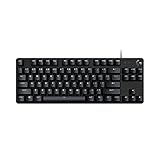


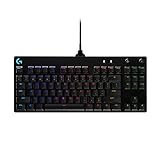
Tenkeyless keyboards have quietly become the go-to layout for serious gamers — and for good reason. By dropping the numpad, a TKL board shrinks your footprint enough to push your mouse pad a full 3–4 inches to the left, giving your mouse arm the room it needs for wide, low-DPI sweeps. The result is better aim, less shoulder strain, and a cleaner desk. Portability is a bonus: TKL boards slide into most laptop bags, making them tournament-viable without needing a dedicated carry case.
In 2026, the wired TKL segment has never been more competitive. Hall Effect switches have gone mainstream, rapid trigger technology is no longer a premium-only feature, and even budget boards now offer QMK/VIA support for deep customization. Whether you are chasing millisecond advantages in ranked play or want a premium daily driver that doubles as a gaming board, there is a wired TKL here for you. We researched the top five picks across actuation feel, build quality, software, and value — here is what we found.
In a hurry? See the top-rated Wired TKL Gaming Keyboard deals available right now:
🛒 Check Wired Tkl Gaming Keyboard Prices on Amazon →🛒 Best Price Today on Amazon
Prime members get fast, free shipping on everything above, plus member-only deals. New members get a 30-day free trial — cancel anytime.
Start 30-Day Prime Free Trial →See Today’s Amazon DealsQuick Comparison Table
| Keyboard | Switch Type | RGB | Hot-Swap |
|---|---|---|---|
| Wooting 60HE+ TKL | Hall Effect (Lekker) | Yes | Yes |
| SteelSeries Apex Pro TKL | OmniPoint 2.0 Magnetic | Yes | No |
| Ducky One 3 TKL | Cherry MX / Kailh (choice) | Yes (south-facing) | No |
| Keychron C3 Pro TKL | Gateron Red/Brown/Blue | No | Yes |
| Redragon K552 Kumara | Outemu Red/Blue | Yes | No |
Our Top Picks
1. Wooting 60HE+ TKL — Best Overall
The Wooting 60HE+ TKL is the keyboard that finally made Hall Effect switches a household name in the competitive gaming community. Unlike traditional mechanical switches that rely on physical metal contacts, the Lekker switches inside the Wooting use magnets to detect key position — meaning there is no contact wear, no debounce noise, and, crucially, the firmware can read exact key depth at any point in the travel.
This enables Rapid Trigger, Wooting’s flagship feature, which resets the actuation point the moment a key starts moving upward rather than waiting for it to reach a fixed reset threshold. In fast-paced games like Counter-Strike 2, Valorant, or any FPS requiring rapid counter-strafes, this translates to inputs that feel instantaneous. You can set actuation sensitivity as fine as 0.1 mm per direction independently for every single key. The board also supports analog input, letting WASD behave like a joystick axis in supported titles — useful for racing games or character movement that benefits from variable speed.
The build is solid polycarbonate with a gasket mount, giving it a slightly bouncy, premium typing feel. The software (Wootility) is one of the cleanest firmware editors on the market, and the board is fully hot-swappable so you can experiment with different Lekker variants or compatible Hall Effect switches in the future. The USB-C cable is braided and detachable.
Pros
- Rapid Trigger down to 0.1 mm — unmatched competitive edge
- Per-key analog actuation customization
- Hot-swappable Hall Effect sockets
- Gasket mount for comfortable extended sessions
- Clean, no-bloat Wootility software
Cons
- Premium price (~$175) narrows the audience
- Hall Effect switches have a slightly different feel than traditional mechanicals — takes adjustment
- No dedicated macro keys or media row without fn-layer
2. SteelSeries Apex Pro TKL — Best Adjustable Actuation
SteelSeries was the first major brand to bring adjustable actuation to the mass market, and the Apex Pro TKL remains the benchmark for that feature in a conventional mechanical package. The OmniPoint 2.0 magnetic switches allow per-key actuation adjustment between 0.1 mm and 4.0 mm directly through the SteelSeries GG software — no soldering, no firmware flashing, just sliders in a GUI.
The real-world benefit for gamers is nuanced but meaningful. Set your movement keys (WASD) to 0.1 mm for the fastest possible input registration, leave your ability keys at 1.5–2.0 mm to avoid accidental activations, and push utility keys like Tab or Caps to 4.0 mm for extra resistance. This kind of profile is simply not possible on any fixed-actuation keyboard.

The TKL chassis is aircraft-grade aluminum — it does not flex, it does not creak, and it adds satisfying heft. The small OLED display on the top-right panel shows game stats, Discord notifications, time, or artwork depending on your GG software setup. RGB per-key illumination is vivid and consistent. The magnetic wrist rest included in the full kit is a nice addition, though sold separately for the base TKL.
The Apex Pro TKL does not support hot-swap, which is the main trade-off at this price point. If you want to experiment with switch feel, you are committed to OmniPoint 2.0 units. That said, for pure plug-and-play competitive performance with a polished software ecosystem, few keyboards match it.
Pros
- Per-key actuation 0.1–4.0 mm via GUI — no firmware knowledge needed
- Premium aluminum build with zero flex
- OLED panel for live game data and customization
- Excellent RGB with per-key lighting zones
- Established SteelSeries GG software ecosystem
Cons
- No hot-swap — switch locked to OmniPoint 2.0
- GG software is feature-rich but occasionally resource-heavy
- Highest price on this list at ~$200
- OLED panel is a novelty that some users ignore after the first week
3. Ducky One 3 TKL — Best Build Quality
If you judge a keyboard by how it feels to type on rather than by its spec sheet, the Ducky One 3 TKL frequently ends conversations. Ducky’s reputation for premium build quality is earned — the One 3 TKL features a hot-swappable PCB (in most regional variants), double-shot PBT keycaps that resist shine and feel textured under fingertips, and a multi-layer dampening system that kills hollow ping without killing acoustic personality.
The south-facing RGB LEDs are a deliberate design choice: they project light downward toward the desk surface rather than upward through the keycap legends, which reduces the distracting bloom that makes some RGB setups look gaudy. The result is a subtle, even light diffusion that looks intentional rather than flashy. Switch options at purchase cover Cherry MX Red, Blue, Brown, Black, and Speed Silver, plus Kailh Box variants depending on region — one of the widest in-box selection choices on the market.
The One 3 TKL is not targeted at the rapid-trigger crowd or the analog input enthusiast. It is built for the gamer who spends eight hours a day between work documents and ranked matches and wants a single keyboard that handles both without compromise. The typing experience is genuinely one of the best at its price point, and the PBT keycaps will look new in two years when other boards are shining like glass.
Pros
- Double-shot PBT keycaps — long-term durability and feel
- Multi-layer dampening for refined acoustics
- South-facing RGB with more tasteful light diffusion
- Wide switch selection at purchase
- Excellent out-of-box typing experience for mixed use
Cons
- No adjustable actuation or rapid trigger
- Software (DUCKY MACRO V2.0) is functional but dated compared to competitors
- Hot-swap not available in all regional variants — verify before buying
- No OLED or extra display features

4. Keychron C3 Pro TKL — Best Hot-Swap Budget
The Keychron C3 Pro TKL punches well above its ~$45 price tag by doing something most budget keyboards refuse to do: ship with hot-swappable sockets and QMK/VIA firmware support out of the box. QMK is the open-source firmware standard that enables complete key remapping, macro programming, tap-dance functions, and layer configurations — the same firmware enthusiasts use on $200 custom boards. VIA is the companion GUI that lets you do all of this in real time without flashing new firmware every time you make a change.
Practically, this means you buy the C3 Pro at $45 and immediately have access to the same remapping depth that costs triple on proprietary-software boards. The included Gateron switches (Red, Brown, or Blue depending on variant) are reliable, well-regarded options — Gateron Reds in particular are smoother than Cherry MX equivalents at this price. The board feels solid despite the price; there is minimal case flex and the keycaps, while not PBT, are thicker ABS than typical budget fare.
The trade-offs are real. There is no per-key RGB — only south-facing white backlighting in the base C3 Pro (some variants add RGB). The typing sound is louder and more clacky than dampened premium boards. And while the build is solid, the plastic does not feel like aluminum. But for a gamer who wants to learn switch swapping, experiment with different feels, and not spend more than $50 doing it, the C3 Pro TKL is genuinely hard to beat.
Pros
- Hot-swappable 3-pin and 5-pin socket support
- Full QMK/VIA firmware — deep programmability for free
- Reliable Gateron switches included
- Minimal case flex for the price
- USB-C wired connection
Cons
- No per-key RGB on base model (white backlight only)
- ABS keycaps — will shine with heavy use over time
- Louder acoustics without aftermarket dampening
- No media keys or dedicated macro row
- Lacks the premium feel of boards 2x the price
5. Redragon K552 Kumara — Best Ultra-Budget
For anyone under a strict $35 budget, the Redragon K552 Kumara is the answer. It is not a board without flaws, but it is a board that exists in a category where most alternatives are either mushy membrane or outright cheap feel — and the K552 manages to avoid both. The Outemu switches are Redragon’s in-house mechanical option, available in Red (linear), Blue (clicky), and Brown (tactile). They are not as smooth as Gateron or as consistent as Cherry MX, but they are unambiguously mechanical, they last, and they give new users a genuine mechanical keyboard experience.
The TKL layout is correct — no numpad, standard modifier sizing, proper arrow cluster. RGB is present and covers the full board with per-key color control via function layer shortcuts (no software required). The build is entirely plastic, but the bottom weight gives it more stability than its chassis cost suggests. The braided USB cable is a thoughtful inclusion at this price point, usually reserved for boards twice the cost.
Serious competitive players will outgrow the K552 within months — there is no hot-swap, no adjustable actuation, no QMK support, and the switches need lubing out of the box to feel their best. But as an entry point into mechanical gaming keyboards, or as a backup board, or as a recommendation to a friend who refuses to spend more than $35, the Kumara delivers an honest mechanical experience at an honest price.
Pros
- Genuinely mechanical switches under $35
- RGB per-key lighting via function shortcuts
- Correct TKL layout with compact footprint
- Braided USB cable included
- Available in Red, Blue, and Brown switch variants
Cons

- Outemu switches are rougher than premium alternatives
- No hot-swap, no QMK, no software ecosystem
- ABS keycaps with legends that will fade
- Louder and less refined typing sound
- Plastic chassis limits long-term durability
How to Choose a Wired TKL Gaming Keyboard
Switch Type: Mechanical, Hall Effect, or Optical
The switch is the single most important decision. Traditional mechanical switches (Cherry MX, Gateron, Kailh) use physical metal contacts and come in linear, tactile, and clicky variants. They are proven, widely available, and well-understood. Hall Effect switches (Wooting, SteelSeries OmniPoint) use magnets instead of contacts, enabling adjustable actuation and rapid trigger technology — a significant competitive advantage in FPS titles. Optical switches use light beams rather than contacts and offer fast actuation but less customization. For pure gaming performance in 2026, Hall Effect is the frontier. For typing balance and switch variety, traditional mechanical remains the most flexible choice.
Hot-Swap vs. Soldered PCB
Hot-swap sockets let you pull switches out and swap new ones in with a switch puller — no soldering iron, no desoldering wick. This matters if you want to experiment with different switch feels over time or if a switch fails and needs replacement. Soldered boards are fixed — you get what you buy. For most buyers, hot-swap is worth prioritizing if the rest of the board meets requirements. The Keychron C3 Pro offers it at $45; the Wooting at $175. If budget is the priority, a soldered board with the right switch from day one is perfectly functional.
Firmware and Software: QMK/VIA vs. Proprietary
QMK/VIA firmware (Keychron C3 Pro) gives you complete open-source control: full key remapping, macros, layers, tap-dance, and more — all for free, with no cloud dependency. Proprietary software (SteelSeries GG, Wootility) trades some flexibility for polish: better GUIs, game integration, and brand-specific features like OLED management or rapid trigger controls. Neither is objectively better — it depends on whether you want to tinker in a config file or click through a branded app. Avoid keyboards with no software or VIA support if you plan to remap keys; the function-layer shortcuts on budget boards are frustrating to memorize.
Build Quality Indicators: What to Look For
Ignore marketing language and focus on three things: case material (aluminum vs. plastic and its rigidity), mounting style (tray mount is cheapest and resonant; gasket mount adds cushion and sound isolation; top/bottom mount sits between), and keycap material (double-shot PBT lasts years; ABS shines in months). For gaming use, a plastic case with a gasket mount often feels better than a rigid aluminum tray mount — the Wooting 60HE+ is a good example. Sound dampening foam under the PCB and between the case halves is a bonus that dramatically changes acoustics even on budget builds.
Final Verdict
The Wooting 60HE+ TKL earns the top spot in 2026 not because it is the most expensive or the most polished, but because it offers a genuinely new input paradigm that has measurable impact on competitive play. Rapid trigger technology and per-key analog actuation are not gimmicks — they are tools that skilled players will use. If you play FPS games seriously and can absorb the $175 price, there is no wired TKL we would recommend above it.
The SteelSeries Apex Pro TKL is the better pick for users who want adjustable actuation with a more conventional switch feel and a richer software ecosystem. The aluminum build and OLED panel add tangible premium value.
The Ducky One 3 TKL is the right answer for the dual-purpose gamer-typist — it is the board that makes you forget you are using a gaming keyboard during the workday and then does not embarrass you in ranked matches at night.
The Keychron C3 Pro TKL is the smartest budget buy for anyone who wants to learn and grow with their keyboard — hot-swap and QMK at $45 is an extraordinary value proposition that no competitor matches.
And the Redragon K552 Kumara exists for the person who wants to spend less than a dinner out and still get a mechanical keyboard that actually clicks. It delivers that, nothing more, nothing less.
Frequently Asked Questions
Is a TKL keyboard good for gaming?
Yes — TKL keyboards are among the most popular layouts in competitive gaming for exactly this reason. Removing the numpad shifts your mouse zone closer to center, giving your mouse arm more natural room and reducing shoulder rotation during extended sessions. Every major esports peripherals brand makes TKL variants of their flagship boards, and most pro players use TKL or smaller at tournaments.
What is the difference between Hall Effect and regular mechanical switches?
Standard mechanical switches use a physical spring and metal contact leaf — when the key depresses far enough, the contacts meet and register a keypress. Hall Effect switches use a magnet on the stem and a sensor on the PCB; the firmware reads the magnetic field strength to determine key position at any depth, continuously. This enables adjustable actuation points, rapid trigger (reset the moment the key starts moving up), and analog output — none of which are possible on contact-based switches. The trade-off is a slightly different tactile feel and a higher price.
Do wired TKL keyboards have input lag?
Wired keyboards have effectively zero input lag for all practical purposes — USB polling at 1000 Hz (1 ms) is the standard on gaming boards, and some like the Wooting offer 8000 Hz (0.125 ms) polling. Wireless keyboards have improved dramatically in 2026 but still introduce a small variable latency that wired connections simply do not have. For competitive play, wired remains the lowest-latency choice, which is why most tournament setups enforce wired peripherals.
Related Articles
Looking for more on this topic? Browse the hand-picked guides below — each one applies the same scoring rubric used in this review.
Ready to decide? Our #1 pick for 2026 is the Keyboard.
Live price & availability on Amazon.


