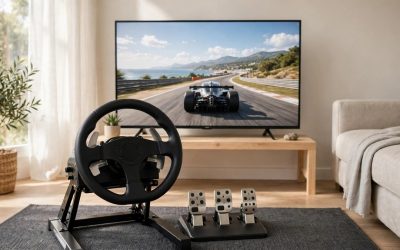
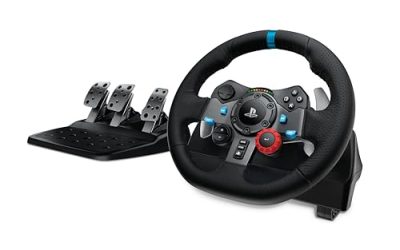
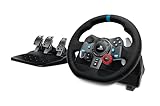
- Top Pick: Thrustmaster T128 P Force Feedback Racing Wheel & Pedal Set – PS5 & PC | For entry-level Simracing, Officially licensed by PlayStation, Mag-Shift paddle shifters, Hybrid drive, easily mountable
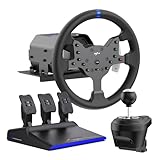
- Best Value: PXN V99 Force Feedback Racing Wheel, with Pedals and Shifter | Detachable 270°/900° Steering Wheel, Hall Pedals & H-Shifter – for PC, Xbox Series X|S, Xbox One, and PS4
- Premium Choice: PXN V99 3.2Nm Force Feedback Gaming Steering Wheel | 270-900 Degree, 11.8-inch, Hall 3-Pedal, H Shifter – Sim Racing Wheel for PC, PS4, Xbox One, Xbox Series X|S
The best force feedback racing wheel for most gamers is the Thrustmaster T248 if you want a polished all-in-one kit for PC and console, the Moza R5 if you race on PC and want your first true direct drive, and the Logitech G RS50 if you want an easy 8 Nm direct drive that also supports consoles. For a tight budget, the Logitech G923 and Thrustmaster T128 still deliver real force feedback, and the Fanatec CSL DD is the pick if you want a base you can grow with. This guide explains how force feedback works in each wheel type so you can match it to your games, your desk, and your platform.
As an Amazon Associate we earn from qualifying purchases at no extra cost to you.


Quick picks by gamer type
- Best all-in-one for PC and console: Thrustmaster T248, a hybrid belt-and-gear wheel with 3.5 Nm peak torque.
- Best entry into direct drive on PC: Moza R5, a 5.5 Nm base usually sold with a wheel and pedals.
- Best plug-and-play direct drive: Logitech G RS50, 8 Nm, with PC, PlayStation, and Xbox versions.
- Best classic gear-driven wheel: Logitech G923, 2.3 Nm with TRUEFORCE game support.
- Best low-cost starter: Thrustmaster T128, an entry-level force feedback wheel and pedal set.
- Best belt-driven option for PC and PlayStation: Thrustmaster T300RS, 3.9 Nm.
- Best for long-term growth: Fanatec CSL DD, 5 Nm and 8 Nm with the Boost Kit 180.
How we chose
This guide is based on research, not lab work. We read manufacturer specification pages and compared published buyer guides and long-term owner discussions. We scored each wheel on force feedback type, rated peak torque, platform support, pedal quality in the box, rig or desk requirements, and upgrade options. When sources disagree on a number, we describe the spec class instead of quoting a single figure.
Understanding force feedback in racing wheels
Force feedback is a motor in the wheel base that pushes against your hands based on what the game’s physics engine calculates: steering weight, tire slip, curbs, and loss of grip. Three motor systems cover most wheels:
- Gear-driven: a motor turns the rim through gears. Strong enough for casual driving, but you feel mechanical roughness and a notchy center. The Logitech G923 is the best-known example.
- Belt-driven or hybrid: a belt (or belt-plus-gear) transmits motor force more smoothly. The Thrustmaster T300RS and T248 sit here.
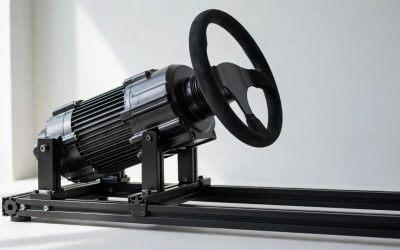
- Direct drive: the rim attaches directly to the motor shaft. It gives the smoothest and most detailed force, and it needs the most solid mounting. The Moza R5, Fanatec CSL DD, and Logitech RS50 are direct drive.
Worked example: what the torque numbers mean at your hands
Force at the rim equals motor torque divided by the radius of the wheel. A typical 28 cm rim has a 0.14 m radius.
- G923, 2.3 Nm: 2.3 / 0.14 = about 16 N, near 1.7 kg of pull.
- T248, 3.5 Nm: 3.5 / 0.14 = 25 N, near 2.5 kg.
- Moza R5, 5.5 Nm: 5.5 / 0.14 = 39 N, near 4 kg.
- Logitech RS50, 8 Nm: 8 / 0.14 = 57 N, near 5.8 kg.
A realistic GT car in a fast corner puts several kilograms of steering load into the rim. A 2.3 Nm wheel reaches that load only by clipping, meaning the signal tops out and detail disappears. A 5.5 Nm wheel at 70 percent strength keeps about 3.9 Nm of clean working torque, which sits well within its range. That difference, more than the number printed on the box, explains why direct drive feels more informative even at modest torque.
Best force feedback racing wheels
1. Thrustmaster T248
Spec line: 3.5 Nm peak · hybrid belt and gear drive · 900 degree rotation · magnetic paddle shifters · PC and console versions · wheel and two-pedal set (check which pedal set is in your version).
Best for: players who want the best mix of price, feel, and platform choice without moving to a rig.
Skip if: you want load-cell braking or direct drive detail. Check the exact platform version, because the PlayStation and Xbox versions are different products.
- Pros: smoother than gear-only wheels, wide game support, button layout suits console play, desk clamps included.
- Cons: torque ceiling is modest, pedals are basic, and the wheel rim is not a deep upgrade path.
2. Moza R5 bundle
Spec line: 5.5 Nm peak · direct drive · ES wheel rim and SR-P Lite pedals in the bundle · PC only · Pit House software.
Best for: PC sim racers who want the first true direct drive step and a clear upgrade path to better rims and pedals.
Skip if: you want a console-compatible wheel or no software tuning. It is PC-only.
- Pros: direct drive smoothness at an entry-level cost, compact base, large Moza accessory range.
- Cons: pedals are basic, force software takes time to learn, and it needs a firm mount.
3. Logitech G RS50
Spec line: 8 Nm peak · direct drive · TRUEFORCE support · versions for PC, PlayStation/PC, and Xbox/PC · integrated rim and base design.
Best for: players who want strong direct drive with simple setup and the option to play on console.
Skip if: you need a wide third-party rim ecosystem. Confirm the correct platform version.
- Pros: strong force, simple setup, mainstream brand support, platform-specific versions.
- Cons: costs more than gear or hybrid wheels, a smaller accessory ecosystem, and it deserves a rig or very solid desk.
4. Logitech G923
Spec line: 2.3 Nm peak · gear-driven with dual-motor force · TRUEFORCE game support · 900 degree rotation · Hall-effect sensor · PC and console versions.
Best for: casual drivers who want a widely compatible wheel and play games that support TRUEFORCE.
Skip if: you want the detail of belt or direct drive. Gears can feel notchy around center.
- Pros: mature product, broad game support, Hall-effect sensing without potentiometer wear, easy to find used.
- Cons: gear noise, modest torque, limited long-term upgrade options.
5. Thrustmaster T128
Spec line: entry-level force feedback · hybrid drive · 900 degree rotation · two-pedal set · versions for PC and console.
Best for: first-time wheel buyers and younger players on a small budget who want force feedback instead of a basic rumble.
Skip if: you plan to race seriously. Force strength and pedal feel are the lowest in this guide. We could not verify the exact torque figure, so treat it as an entry-level class.
- Pros: low cost, easy setup, console and PC versions.
- Cons: limited strength and detail, basic pedals, shortest upgrade path.
6. Thrustmaster T300RS
Spec line: 3.9 Nm peak · belt-driven · 1080 degree rotation capability · compatible with a large range of Thrustmaster rims and pedals · PC and PlayStation versions.
Best for: players who like to swap rims and pedals and still want a smooth belt-driven feel.
Skip if: you want Xbox support or the newest platform. It is an older design, so check current stock and support.
- Pros: smooth belt feel, modular design, strong aftermarket support.
- Cons: older platform, no Xbox version, and direct drive offers more detail for a modest premium.
7. Fanatec CSL DD
Spec line: 5 Nm base, 8 Nm with the Boost Kit 180 · direct drive · up to 2520 degrees of rotation · PC, with console support by version · works with the Fanatec rim, pedal, and shifter ecosystem.
Best for: drivers who want a long-term platform and plan to add pedals, rims, and a shifter.
Skip if: you want everything in a single box. The wheel rim and pedals are often separate purchases.
- Pros: deep ecosystem, upgradeable torque, strong game support.
- Cons: total cost rises quickly once you add a rim, pedals, and a boost kit, and console compatibility depends on the version.
Comparison table
| Wheel | Drive type | Peak torque | Platforms | Best use |
|---|---|---|---|---|
| Thrustmaster T128 | Hybrid | Entry-level class | PC, console by version | First wheel |
| Logitech G923 | Gear | 2.3 Nm | PC, console by version | Casual driving |
| Thrustmaster T248 | Hybrid belt and gear | 3.5 Nm | PC, console by version | All-in-one |
| Thrustmaster T300RS | Belt | 3.9 Nm | PC, PlayStation | Modular upgrade |
| Moza R5 | Direct drive | 5.5 Nm | PC | Entry direct drive |
| Fanatec CSL DD | Direct drive | 5 Nm, 8 Nm with boost | PC, console by version | Growth platform |
| Logitech G RS50 | Direct drive | 8 Nm | PC, PlayStation, Xbox by version | Plug-and-play DD |
Decision matrix: match the wheel to your situation
| Your situation | Choose | Why |
|---|---|---|
| Console only, small budget | T128 or G923 | Console versions, low cost |
| Console, want the best feel | Logitech RS50 | Console-supported direct drive |
| PC only, desk setup | Moza R5 | Compact direct drive |
| PC, plan a rig later | Fanatec CSL DD or Moza R5 | Upgrade path |
| PC and console, one wheel | T248 or RS50 | Versions for both |
| Rim swapping | T300RS or Fanatec | Modular ecosystems |
What to check before you buy
Platform and version
Wheels are licensed by platform. A PlayStation version may not work on an Xbox, and a PC-only wheel does not work on any console. Look for the console name in the product title and confirm that your most-played game lists support for it.
Pedals
Entry wheels ship with potentiometer pedals with a springy feel. A load-cell brake measures pressure instead of travel, which makes braking more consistent. If your budget forces a choice, upgrading pedals brings more consistency than a stronger base.
Mounting
Gear and belt wheels clamp to a desk with a bracket and work with a decent desk. Direct drive pulls hard against the clamp, so check the thickness of the desk edge and the clamp’s maximum depth. If the desk flexes, the force feels vague. A wheel stand or a folding cockpit is the next step.
Rotation and software
Most wheels offer 900 degrees lock to lock, and many games let you set a car-specific angle. Direct drive and some belt wheels use brand software to tune strength, damping, and filters. Set game strength first, then trim in the software.
Noise and room
Gear-driven wheels produce audible whine and rattle at higher force. If you use a microphone, use a directional mic, set a lower strength, or choose a belt or direct drive wheel. Direct drive bases have fans, so place them away from the mic.
Safety and setup tips
- Keep hands away from the wheel spokes during game startup and while the base calibrates.
- Do not connect or remove the wheel rim while the base is powered.
- Use the supplied power supply and a surge protector.
- Secure the desk clamp, and check it after the first week, since vibration can loosen it.
- Keep the pedals on a non-slip mat or fix them to a platform to stop creep under heavy braking.
Common mistakes to avoid
- Buying a PC wheel for a console, or a console wheel for another console.
- Setting in-game strength to maximum, which clips detail and tires your wrists.
- Assuming more torque is always better. Working torque and a solid mount matter more.
- Ignoring pedals. Poor pedals hurt braking consistency.
Frequently asked questions
What is the best force feedback racing wheel for beginners?
The Thrustmaster T248 is the safest beginner choice. It offers good feel, platform versions, and simple setup.
If you want to save money, the T128 and G923 are workable. If you want to go direct drive immediately, choose the Moza R5 on PC.
Is direct drive better than belt or gear force feedback?
Yes, for detail and smoothness. It transmits fine changes in grip without friction from gears or belts.
The trade-offs are cost and mounting. Direct drive needs a firm desk or rig.
Do I need force feedback for racing games?
Not for casual play, but it makes cars much easier to control. You feel slides before you see them.
Without force feedback you rely on visual and audio cues only, which is slower for most drivers.
Can I use a PC racing wheel on a console?
Only if the wheel lists your console. Many wheels are PC-only and will not work on a console.
Check the version name, for example PlayStation/PC or Xbox/PC, and the game’s supported wheel list.
How much torque do I need?
Gear and hybrid wheels from 2 to 4 Nm are fine for casual driving. Direct drive from 5 to 8 Nm suits most serious sim racers.
Torque is peak force. Real working force is lower, so avoid chasing large numbers if your desk cannot hold them.
Is the Logitech G923 still worth it?
It still works and is widely supported, especially for its TRUEFORCE-compatible games. It is a casual pick.
For similar spending, a hybrid or direct drive option usually feels more detailed, so compare current availability.
Do I need a racing rig?
Not for gear or belt wheels on a firm desk. For 5 Nm direct drive and above, a rig or stand is strongly recommended.
A rig also keeps the pedals fixed and sets a consistent driving position. A folding stand is a good compromise for small rooms.
Will force feedback work with every game?
Most mainstream racing games support force feedback on supported wheels. Some older or niche titles do not.
Check each wheel’s supported game list, and expect some games to need manual force settings to feel right.
Final verdict
If you want the safest broad pick, buy the Thrustmaster T248. If you race on PC and want true direct drive at an entry-level cost, buy the Moza R5. If you need console support with strong direct drive, buy the Logitech G RS50, and if you plan to build a long-term setup, start with the Fanatec CSL DD. Match platform and mounting first, then pick the strongest wheel your desk or rig can handle.