The best event tents for most weddings, parties, and backyard events are commercial-grade frame tents for maximum usable space, pole tents for large open lawns on a budget, and pop-up canopies for quick setups of roughly 10 to 50 guests.
As an Amazon Associate we earn from qualifying purchases at no extra cost to you.

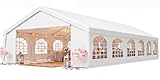


Choose the Tent Type Before Choosing the Size
The three main builds solve different problems. A larger tent is not automatically better if its supports block tables, its fabric leaks in heavy rain, or your setup crew cannot assemble it safely.
| Tent type | Best for | Typical setup time | Usable-space advantage | Main limitation |
|---|---|---|---|---|
| Pop-up canopy | Small parties, food stations, shade, short events | 10–30 minutes | Fast and portable | Less stable in wind; limited size |
| Frame tent | Weddings, dinners, patios, medium and large yards | 1–4 hours | No center poles; flexible placement | Heavier, more expensive, slower to install |
| Pole tent | Large lawns, receptions, festivals, cost-conscious rentals | 2–6 hours | Efficient coverage for large groups | Center and perimeter poles require anchoring space |
How Much Tent Space Do You Need?
Start with the floor plan rather than the guest count. A seated meal with round tables needs substantially more room than a standing cocktail party. These planning figures include table and circulation space but not a separate dance floor, buffet tent, bar, stage, or catering area.
| Event layout | Planning allowance | Example capacity in a 20 × 20 ft tent |
|---|---|---|
| Standing reception | 6–8 sq ft per guest | 50–65 guests |
| Seated rows or ceremony | 8–10 sq ft per guest | 40–50 guests |
| Seated dinner with round tables | 12–15 sq ft per guest | 25–33 guests |
| Dinner, buffet, bar and dancing | 18–22 sq ft per guest | 18–22 guests |
For a worked example, suppose 48 guests will attend a wedding reception with seated dinner and dancing. At 20 sq ft per person, the event requires about 960 sq ft. A 30 × 30 ft tent provides 900 sq ft, so it is marginal once a buffet and bar are included. A 30 × 40 ft tent provides 1,200 sq ft, leaving approximately 240 sq ft for those services and a modest dance area. If the dance floor is important, use a larger tent or place the bar and buffet under a second canopy.
Best Event Tents by Yard Size and Event Plan
Small yards: up to about 400 square feet of clear space
A 10 × 10 ft or 10 × 20 ft pop-up canopy is usually the practical choice. Use it for a gift table, buffet, drinks, or shade rather than trying to fit a complete wedding reception underneath it. A 10 × 20 ft canopy offers 200 sq ft, which is suitable for approximately 12–20 seated dinner guests depending on the table arrangement, or around 25–30 standing guests.
For a small dinner, a 12 × 12 ft or 15 × 15 ft frame tent can provide a more polished layout, but measure the clearance first. Include space for guy lines, weights, doors, and the movement of people around the tent. A compact frame tent is also preferable where trees, fences, or a house make pole placement difficult.
Medium yards: about 400–1,200 square feet of clear space
Frame tents in 20 × 20 ft, 20 × 30 ft, and 20 × 40 ft sizes offer the best balance for backyard birthdays, graduation parties, and small weddings. Their lack of center poles makes it easier to arrange rectangular tables, a buffet, or a DJ area.
A 20 × 30 ft tent supplies 600 sq ft. That is approximately 30–50 standing guests, 24–36 seated dinner guests, or 15–25 guests when a bar, buffet, and dance area share the floor. A 20 × 40 ft tent supplies 800 sq ft and is better suited to around 40–60 standing guests or 30–45 seated guests, depending on the layout.
Large yards: more than 1,200 square feet of open space
Pole tents become attractive at larger sizes because their structure can cover broad lawns efficiently. A 30 × 60 ft tent has 1,800 sq ft and may accommodate roughly 90–130 standing guests, 60–90 seated dinner guests, or fewer guests with a full dance floor and catering setup.
Choose a frame tent instead when you need unobstructed sight lines, sidewalls close to buildings, or installation on hard surfaces. Large frame systems are heavier and often require professional crews, especially when the tent has multiple sections, engineered anchoring, lighting, or weather-rated sidewalls.
Frame vs. Pole vs. Pop-Up: The Decision Matrix
| Your situation | Best choice | Why |
|---|---|---|
| Under 30 guests and less than an hour for setup | Commercial pop-up | Fastest assembly and easiest transport |
| 20–80 guests with tables, buffet, or dancing | Frame tent | Clear center and configurable entrances |
| 80 or more guests on a large, open lawn | Pole tent | Efficient coverage and generally lower cost per square foot |
| Concrete, pavers, or a deck | Weighted frame or pop-up | Ground stakes may be impossible; weights must be engineered for the tent |
| Frequent rain or a multi-day event | Frame or pole tent with sidewalls | More complete weather protection than an open canopy |
| Uneven ground or many trees | Frame tent after a site inspection | It avoids some pole conflicts but still needs level, safe anchoring |
Waterproofing: What to Check Before Buying
“Waterproof” can mean anything from water-resistant fabric to a fully enclosed, seam-managed shelter. Look for a coated polyester or vinyl canopy, taped or sealed seams, reinforced corner points, and sidewalls that attach continuously rather than leaving large gaps.
- Roof design: A sloped roof sheds rain better than a nearly flat canopy. Avoid designs that allow water to pool.
- Seams: Stitching alone can leak during prolonged rain. Sealed or factory-taped seams provide better protection.
- Sidewalls: Sidewalls reduce wind-driven rain but also reduce ventilation. Use removable panels and leave controlled openings in mild weather.
- Drainage: Do not place the tent in a low spot. Water collecting around legs can soften soil and weaken anchors.
- Wind rating: Follow the manufacturer’s limit and local rental guidance. A water-resistant canopy is not automatically safe in strong wind.
Never rely on thin plastic weights or improvised objects as a substitute for proper anchoring. On grass, stakes and tensioned ropes may be suitable if permitted. On concrete or pavers, use purpose-built ballast sized for the tent and expected conditions. Stop using the tent if the frame begins shifting, the roof ponds, or gusts make the canopy deform.
Assembly Time and Crew Planning
Advertised setup times often assume a level site, sorted parts, favorable weather, and an experienced crew. For a first-time installation, plan at least twice the advertised time. A 10 × 10 ft pop-up may take two people 10–20 minutes, while a 20 × 30 ft frame tent commonly needs three or four people for one to three hours. Larger pole or frame systems can require a trained installation crew for several hours.
Reserve additional time for sidewalls, flooring, lighting, tables, and weather adjustments. Assemble the canopy before the event day if the manufacturer permits it, but do not leave an unanchored tent unattended. Photograph the completed layout so it can be rebuilt consistently after a weather interruption.
Features Worth Paying For
- Commercial-grade steel or aluminum frame: Better suited to repeated assembly than lightweight recreational tubing.
- Replaceable roof and wall panels: A damaged component should not require replacing the complete tent.
- Adjustable leg height: Useful on gently uneven lawns and for improving headroom.
- Roll-up or removable sidewalls: They provide flexibility as temperature and wind change.
- Carry bags with labeled components: Faster setup and fewer missing parts.
- Certified flame-retardant fabric where required: Some jurisdictions and venues require documentation.
For lighting, keep electrical equipment away from wet fabric and use outdoor-rated extension cords and ground-fault protection. A typical 10-amp, 120-volt circuit provides up to 1,200 watts in theory, but leaving headroom is sensible: 200 watts of LED lighting, 300 watts for a small audio system, and 100 watts for device charging totals 600 watts, or roughly half that circuit’s theoretical capacity. Larger speakers, catering equipment, and heaters may require separate circuits or professional power distribution.
Bottom Line
Choose a commercial pop-up canopy for speed and small supplemental spaces, a frame tent for the most flexible backyard wedding or party layout, and a pole tent for large open lawns where coverage per dollar matters. Size the tent from the floor plan, allowing 12–15 sq ft per seated dinner guest and about 18–22 sq ft when dinner, dancing, a bar, and buffet must fit together. Waterproof fabric matters, but safe anchoring, drainage, sidewalls, and realistic assembly time matter just as much.
Ready to decide? Our #1 pick for 2026 is the Pop-up canopy.
Live price & availability on Amazon.