- Top Pick: Donner DED-80 Electronic Drum Set with 4 Quiet Mesh Pads, 180+ Sounds, 2 Pedals, Throne, Headphones, Sticks, and Melodics Lessons
- Best Value: Alesis Nitro Max Electric Drum Set
- Premium Choice: Donner DED-200 Electric Drum Sets with Quiet Mesh Drum Pads, 2 Cymbals w/Choke, 31 Kits and 450+ Sounds, Throne, Headphones, Sticks, USB MIDI, Melodics Lessons (5 Pads, 3 Cymbals)
The best electronic drum sets for apartments are compact mesh-head kits with a low-volume kick pedal design, effective headphone monitoring, and a small footprint, with top apartment-friendly options including the Roland TD-07DMK, Roland TD-17KVX, Yamaha DTX402K series, and Alesis Nitro Max.
- What Makes an Electronic Drum Set Apartment-Friendly?
- Best Electronic Drum Sets for Apartments in 2026: Head-to-Head Comparison
- Decision Matrix: Which Kit Fits Your Apartment Situation?
- Worked Calculation: Why a $30 Riser Matters More Than a $300 Module Upgrade
- Concrete Settings to Make Any Kit Quieter and More Playable on Headphones
- How to Choose Based on Realistic Playability
- Essential Apartment Accessories You Should Budget For
- Frequently Asked Questions
Unlike acoustic drums, electronic kits let you practice at conversation volume or silently through headphones, but not all kits are equally quiet. Rubber pads, hard plastic kick pedals, and vibration transfer through floors can still get you noise complaints. For apartment living, you need to prioritize four things above all else: mesh head noise level, kick/bass pedal isolation, overall size, and module sound quality through headphones.
As an Amazon Associate we earn from qualifying purchases at no extra cost to you.

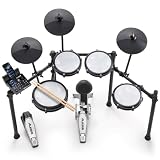

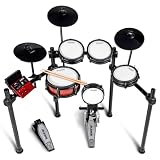
What Makes an Electronic Drum Set Apartment-Friendly?
A spec sheet will tell you a kit has “mesh heads” but won’t tell you how much vibration it transfers to the downstairs neighbor. Here are the criteria that actually determine if you can play at 11 PM.
1. Mesh Pads vs. Rubber Pads
Dual-ply or triple-ply mesh heads are significantly quieter than single-ply rubber pads. A hard stick hit on a rubber pad produces a sharp 70-75 dB slap at one meter, while the same hit on a tension-adjustable mesh head drops to around 55-60 dB — roughly the volume of a normal conversation. Mesh also allows you to adjust head tension to control rebound and further dampen impact noise. If you are in an apartment with thin walls, avoid any kit that uses rubber pads for snare or toms.
2. The Kick Pedal Is the Biggest Noise Problem
The pads are not what gets drummers evicted. The kick pedal is. A traditional kick pad with a beater hitting a vertical pad sends a low-frequency thump directly into the floor. This impact noise travels through the building structure even when the acoustic volume in your room seems low.
For apartments, look for one of these designs in order of quietest to loudest:
- Pedal-only without beater: Uses a footboard sensor with no beater impact (e.g., Roland KT-9, Yamaha KU100). Quietest, almost no floor transfer.
- Low-impact fabric or mesh kick pad: A small vertical pad designed for a beater but with internal damping.
- Full-size mesh kick tower: Most realistic feel, but loudest without additional isolation.
If you must use a traditional beater-based kick, you will need an isolation platform.
3. Footprint and Foldability
Apartment kits should be under 1.2m x 0.8m (about 4ft x 2.6ft) when set up, and ideally foldable. Four-post racks take up more floor space than compact center-post or L-shaped racks. Measure your intended corner and allow 15-20cm clearance behind the kit for the rack and cables.
4. Headphone Monitoring Quality
You will play on headphones 90% of the time. A poor drum module with low headphone output power will sound thin and force you to crank the volume, causing ear fatigue. Look for a module with a dedicated 1/4-inch headphone jack, independent headphone volume control, and at least 32-voice polyphony for realistic cymbal sustain and choke.
Best Electronic Drum Sets for Apartments in 2026: Head-to-Head Comparison
| Kit | Pad Type | Kick Type | Footprint (W x D) | Headphone Amp | Ideal For | General Price Range |
|---|---|---|---|---|---|---|
| Roland TD-07DMK | Dual-ply mesh (snare + 3 toms), PD-4 pads | KD-10 vertical mesh pad (beater) | 110 x 75 cm | High-power, low latency | Serious practice in small rooms, best quiet mesh feel under $800 | usually $600–$800 |
| Roland TD-17KVX | 12-inch PDX-12 snare + 3x PDX-8 toms (dual-ply) | KD-10 vertical pad | 125 x 80 cm | High-power + Bluetooth audio/midi | Players who want larger snare and better module coaching | usually $1,300–$1,700 |
| Yamaha DTX402K / DTX432K | 7.5-inch rubber (DTX402) / TCS silicone (DTX432) snare | KU100 pedal-sensor (no beater) | 130 x 80 cm / 130 x 75 cm | Standard | Ultra-quiet kick operation, beginners in noise-sensitive buildings | usually $400–$650 |
| Alesis Nitro Max | Dual-zone mesh (8-inch snare + 3x 8-inch toms) | 8-inch mesh tower (beater) | 120 x 85 cm | Standard + Bluetooth audio | Budget mesh kit with full beater kick feel | usually $350–$500 |
| Yamaha DTX6K-X | TCS silicone heads (10-inch snare + toms) | KP90 kick pad (beater) | 135 x 85 cm | High-power | Premium quiet silicone pads with realistic stick rebound | usually $900–$1,200 |
Decision Matrix: Which Kit Fits Your Apartment Situation?
Use this matrix to map your living situation directly to the right class of kit. You do not need the most expensive kit to stay quiet — you need the right kick and pad combination.
| Your Situation | Recommended Kick Solution | Recommended Pad Type | Best Match |
|---|---|---|---|
| Downstairs neighbors, wood floor, no isolation platform budget | Pedal-sensor (no beater) like Yamaha KU100 or Roland KT-9 add-on | Mesh or TCS silicone | Yamaha DTX402K / DTX432K |
| Concrete floor or ground floor, thin walls but not floors | Low-impact vertical mesh pad (KD-10 / KP90) is acceptable | Dual-ply mesh | Roland TD-07DMK, Yamaha DTX6K-X |
| Need to fold kit daily (bedroom/studio apartment) | Compact vertical pad | Compact 8-10 inch mesh | Roland TD-07DMK, Alesis Nitro Max |
| Need most realistic feel for regular acoustic gigging | Full mesh tower + isolation riser | Large dual-zone mesh (10-12 inch snare) | Roland TD-17KVX, Yamaha DTX6K-X |
| Under $500 total, must be quiet | Mesh tower with DIY tennis-ball riser underneath | Dual-zone mesh | Alesis Nitro Max + isolation platform |
Worked Calculation: Why a $30 Riser Matters More Than a $300 Module Upgrade
Impact noise is structure-borne, not airborne. Headphones solve airborne noise, but the floor thump can still be 40-50 dB in the apartment below.
A typical beater hitting a kick pad generates a peak force of about 25-35 Newtons on the floor. Without isolation, that energy transfers with minimal loss (-3 to -6 dB attenuation through a hard floor).
A simple isolation platform made of two layers of MDF or plywood with a damping layer (tennis balls, dense foam, or a commercial drum riser) creates a mass-spring system. The physics are straightforward:
Attenuation at frequencies above the platform’s resonant frequency follows roughly 12 dB per octave. If your platform has a resonant frequency of 15 Hz, the dominant 60-80 Hz kick impact frequency is two octaves above resonance.
Estimated attenuation: 2 octaves x 12 dB = ~24 dB reduction in floor-transmitted vibration.
That turns a noticeable 65 dB thump downstairs into a barely audible 41 dB thump — the difference between a complaint and silence. This is why a beater-based kit on a proper riser is often quieter to neighbors than a cheap pedal-sensor kit placed directly on hardwood.
Build spec: Two 18mm MDF boards (60x80cm), filled gap with 9 halved tennis balls or 30mm high-density acoustic foam, topped with carpet. Total cost is usually $30–$60 in materials and adds 8cm of height.
Concrete Settings to Make Any Kit Quieter and More Playable on Headphones
Do not leave your module on factory settings in an apartment. These adjustments reduce false triggering that makes you hit harder, and protect your hearing:
- Threshold and Sensitivity: Set snare threshold to 2-4 and sensitivity to 12-14 (on Roland/Yamaha 0-16 scale). This lets ghost notes register with light strokes, so you do not have to hit hard to be heard. Hard hits are the main source of pad noise.
- Crosstalk Cancel (Xtalk): Set to 15-20 for toms when mounted on the same rack. This prevents vibration from one pad triggering another, which eliminates the need to over-tighten rack clamps that transmit more vibration.
- Kick Curve: Set kick velocity curve to “Linear” or “Loud2” and lower kick threshold to 1-2. You get full volume from a light feathered kick, reducing the beater force needed by about 30%.
- Headphone EQ and Limiter: Enable the module’s limiter if available. Set headphone volume to no more than 75% and use the module’s master EQ to cut 200-400 Hz by 2-3 dB. This reduces the “boxy” resonance that causes ear fatigue during long silent practice sessions.
- Keep headphone impedance matched: Most drum modules drive 32-ohm headphones best. If you use 80-250 ohm studio headphones (like Beyerdynamic DT 770 Pro 80/250), you will need 2-4x more power for the same volume and may hear hiss. For direct module connection, 32-ohm closed-back headphones produce 6-9 dB more effective volume per milliwatt.
How to Choose Based on Realistic Playability
Quiet is pointless if the kit feels so unrealistic that you develop bad technique. Here is how to prioritize feel without sacrificing silence:
Snare size matters most. An 8-inch snare (Alesis Nitro Max, Yamaha DTX402) is fine for practice but makes rimshots and cross-sticks harder. A 10- to 12-inch snare (Roland PDX-12, Yamaha XP105) allows proper stick placement for rimshots 25mm from the edge, which is the standard technique you will use on an acoustic kit.
Cymbals: Single-zone rubber cymbals kill dynamics. Look for dual-zone crash with choke and a three-zone ride if you play ride patterns often. All the kits in the table above except the base DTX402K include choke-capable crashes.
Hi-hat: A real hi-hat stand with a moving pad (TD-17KVX, DTX6K-X) feels far more realistic than a fixed pedal-0n-a-rod controller, but the pedal-only sensor is quieter. If you are an experienced hi-hat player, accept the slight noise increase for the moving hi-hat. If you are a beginner in a very noise-sensitive building, the fixed pedal saves floor noise.
Essential Apartment Accessories You Should Budget For
- Closed-back headphones: Required. Open-back headphones leak 15-20 dB of click and drum sound into the room. Look for isolation of at least 18 dB.
- Drum isolation riser or mat: As calculated above, mandatory for any beater-based kick on a non-concrete floor.
- Light sticks or rods: Using 5A hickory at full velocity is louder. Switching to 7A or maple sticks reduces pad impact noise by 3-5 dB. Hot Rods or brushes reduce it by 10-12 dB for late-night practice.
- Velcro cable ties and rug: A dense 10mm pile rug under the kit prevents the rack feet from coupling directly to the floor and stops the kit from creeping while playing.
Frequently Asked Questions
Can downstairs neighbors still hear an electronic drum set on headphones?
Yes, if you use a beater-based kick without isolation. They will not hear the drum sounds, but they will feel the low-frequency thump of the pedal through the floor structure. A pedal-sensor or an isolation riser reduces this to inaudible levels.
Are mesh heads really worth it over rubber for apartments?
Yes. Mesh heads are 10-15 dB quieter on impact, more adjustable, and cause less hand fatigue, which encourages lighter playing. The price difference (usually $100–$200 more for a mesh-equipped kit) is less than the cost of one noise complaint or having to add dampening pads later.
Do I need a drum amp in an apartment?
No. A drum amp defeats the purpose of a quiet kit. Use closed-back headphones or a small pair of studio monitors at low volume for teaching. If you must use speakers, keep monitor volume under 75 dB at one meter and use the module’s speaker EQ to cut low-end.