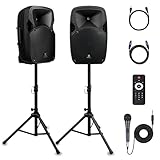
- Top Pick: PRORECK Party 12 12-Inch 1800W 2-Way Powered PA Speaker System Combo Set with Bluetooth/USB Drive/SD Card/FM/Remote Control/Speaker Stands for Indoor, Outdoor DJ Parties, Personal Gatherings, Karaoke
- Best Value: Pioneer DJ DM-40D 4-inch Active Desktop Monitor Speakers, Pair, Black
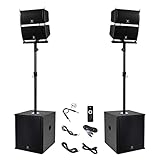
- Premium Choice: PRORECK Club 6000 15-inch 6000W P.M.P.O Stereo PA Speaker System Combo Set 4 Line Array Speakers, 2 15-inch Subwoofers with Bluetooth/USB Read/SD Card/Remote Control, for Party DJ Wedding Meeting
The best DJ speakers for clear, powerful sound are the Yamaha DXR12mkII for balanced all-purpose performance, JBL PRX912 for modern DSP and high output, QSC K12.2 for flexible venue work, RCF ART 912-A for punchy club sound, and Electro-Voice ZLX-12P G2 when you want strong features at a lower cost.
For most mobile DJs, an active 12-inch speaker with roughly 1,000–2,000 watts of manufacturer-rated peak power, a maximum SPL around 125–133 dB, built-in DSP, and at least one microphone input is the most useful starting point. The right choice depends less on the largest wattage number and more on venue size, bass requirements, coverage, transport, and how much control you need from the rear panel or an app.
As an Amazon Associate we earn from qualifying purchases at no extra cost to you.


Best DJ speakers compared
| Model | Driver and rated output | Maximum SPL | Coverage | Best suited to |
|---|---|---|---|---|
| Yamaha DXR12mkII | 12-inch woofer; 1,100 W dynamic power | 132 dB | 90° × 60° | Mobile DJs, weddings, general-purpose PA |
| JBL PRX912 | 12-inch woofer; 2,000 W peak power | 133 dB | 100° × 60° | High-output events and app-controlled setups |
| QSC K12.2 | 12-inch woofer; 2,000 W peak power | 132 dB | 75° conical | Venues needing flexible placement and presets |
| RCF ART 912-A | 12-inch woofer; 2,100 W peak power | 130 dB | 100° × 60° | Energetic dance music and vocal clarity |
| Electro-Voice ZLX-12P G2 | 12-inch woofer; 2,000 W peak power | 127 dB | 90° × 60° | Smaller events and value-focused buyers |
Power figures are not directly comparable because manufacturers use different peak, program, and continuous-rating methods. Maximum SPL, limiter behavior, driver design, and cabinet tuning tell you more about usable volume than watts alone. Treat the numbers above as a useful comparison, not a laboratory ranking.
Head-to-head: which speaker fits your setup?
Yamaha DXR12mkII: the safest all-round choice
The DXR12mkII is a strong choice when one pair needs to handle weddings, private parties, corporate events, and regular DJ work. Its 12-inch woofer gives more low-mid authority than a typical 10-inch cabinet, while the 90° horizontal coverage works well for dance floors and seated audiences. Yamaha’s D-CONTOUR processing includes a FOH/MAIN setting and a monitor setting, making the speaker easier to adapt to different positions.
Choose it when you value a predictable tonal balance, straightforward controls, and a cabinet that can work as either a main speaker or floor monitor. It is not the lightest option, and a pair still benefits from a subwoofer for bass-heavy music at larger events.
JBL PRX912: best for control and high output
The PRX912 combines a 12-inch driver with broad 100° horizontal coverage, useful when the audience is wide or the speakers must be placed close to the front corners of a room. Its built-in DSP and wireless control features make it attractive for DJs who want to adjust EQ, delay, gain, and system settings from a mobile device rather than reaching behind each cabinet.
It is a particularly good fit for event production where quick changes matter. The wide dispersion can reduce the need to aim the boxes sharply, but careful placement is still important: excessive overlap between two wide speakers can make the center of the room sound louder and less even.
QSC K12.2: best for versatile venue work
The K12.2 offers a 75° conical pattern, which spreads sound evenly in both dimensions rather than favoring a wide horizontal and narrower vertical shape. That makes it useful in rooms where the speakers must be mounted, placed on poles, or used as monitors. Its rear-panel DSP includes application presets, EQ, delay, and crossover-related functions.
Pick the K12.2 if the same pair will serve as mains, monitors, speech reinforcement, or part of a larger system. Its controlled coverage can help limit reflections in reverberant rooms. For a very wide dance floor, however, you may prefer a speaker with a broader horizontal pattern or add front-fill coverage.
RCF ART 912-A: best for energetic dance music
The ART 912-A is aimed at high-output PA use and combines a 12-inch woofer with a 1.75-inch compression driver. Its 100° × 60° pattern gives broad audience coverage, while its DSP is tuned for a lively, forceful presentation that suits house, hip-hop, pop, and electronic music.
It is a compelling choice when you want strong impact from the tops before adding subwoofers. Like any 12-inch full-range speaker, it cannot reproduce deep sub-bass at high levels as efficiently as a dedicated subwoofer. Avoid solving missing low bass by continually increasing the low EQ; that uses amplifier headroom and can trigger the limiter sooner.
Electro-Voice ZLX-12P G2: best value-oriented option
The ZLX-12P G2 provides a 12-inch format, built-in DSP, a color display, and useful input and mixing functions in a cabinet designed for smaller and mid-sized events. It is a practical choice for a new mobile DJ, a secondary system, or venues where transport and budget matter more than maximum headroom.
Its lower maximum SPL than the higher-output models is meaningful at large events. It can cover a small party effectively, but a pair of ZLX-12P G2 speakers should not be expected to deliver the same effortless volume or bass authority as a premium pair with a subwoofer.
Choose by venue size, not wattage alone
| Situation | Recommended system | Why |
|---|---|---|
| Bedroom, practice, or small room up to 40 people | One 10- or 12-inch active speaker | Simple setup; excessive output creates reflections and neighbor problems |
| Party or wedding up to 100 people | Pair of 12-inch active speakers | Even stereo coverage and useful headroom for peaks |
| Event up to 200 people | Pair of high-output 12-inch speakers | More headroom keeps vocals and transients clean |
| Dance event above 200 people | Pair of 12-inch tops plus one or two 15- or 18-inch subs | Subwoofers handle deep bass more efficiently than full-range tops |
| Long, narrow room | Controlled mains plus delayed fill speakers | Delay fills improve rear coverage without overloading the front |
These are planning ranges rather than guarantees. Room absorption, ceiling height, outdoor use, music style, and the target loudness can change the result substantially. An outdoor event usually needs more headroom because there are fewer walls to reinforce low frequencies.
A practical power-budget calculation
Suppose your DJ controller sends an average program level of -18 dBFS, with musical peaks reaching 0 dBFS. The peak-to-average difference is 18 dB, meaning the peaks require about 63 times more instantaneous power than the average signal. A speaker rated at 1,000 watts peak is not consuming 1,000 watts continuously; the limiter reserves that capacity for short transients.
For a 100-person wedding, a sensible plan is two 12-inch tops operated with several decibels of headroom rather than one speaker run at its limit. If each speaker can reach approximately 130 dB at 1 meter, distance reduces level by roughly 6 dB every time the distance doubles in free field: about 124 dB at 2 meters, 118 dB at 4 meters, and 112 dB at 8 meters before room effects. That does not mean the audience receives those exact levels, but it shows why high maximum SPL and headroom matter when the rear of a room is far from the speakers.
For bass-heavy events, adding a subwoofer is usually more effective than buying a top with a larger wattage label. Set the crossover around 80–100 Hz, then high-pass the tops so their amplifiers and woofers spend less energy reproducing deep bass. The result is often clearer vocals, stronger kick-drum impact, and less limiter activity.
Inputs, coverage, and portability checklist
- Inputs: Look for combo XLR/TRS inputs for a controller, mixer, or microphone, plus an XLR mix output for linking speakers. A dedicated mic input is useful for announcements.
- DSP: Presets, parametric EQ, high-pass filtering, delay, and feedback suppression are more useful than a long list of advertised watts.
- Coverage: A 90°–100° horizontal pattern suits broad audiences. A narrower or conical pattern can work better in reflective rooms or when precise aiming is possible.
- Portability: Check the actual cabinet weight, handle positions, pole-mount socket, and whether a protective cover is available. A speaker that is difficult to lift may stay at home.
- Durability: Favor plywood or well-braced composite cabinets, metal grilles, recessed controls, and a limiter designed to protect the driver during long events.
- Expansion: Confirm that the speaker can be used with a subwoofer and has a reliable link output. Wireless control is convenient, but audio should still work through physical cables.
Recommended buying decisions
- Choose the Yamaha DXR12mkII for the most balanced general-purpose pair.
- Choose the JBL PRX912 if app control, broad coverage, and high output are priorities.
- Choose the QSC K12.2 if you need one speaker to cover mains, monitors, speech, and varied placement.
- Choose the RCF ART 912-A if energetic dance music and punchy output matter most.
- Choose the Electro-Voice ZLX-12P G2 for smaller events, a backup system, or a more accessible entry price.
Typical market pricing for a professional active 12-inch speaker is often about $500–$1,100 per cabinet, depending on the model and sales period. Budget for stands, covers, balanced cables, and eventually a subwoofer; those accessories can improve a DJ system more than moving from one similar wattage rating to another.
Ready to decide? Our #1 pick for 2026 is the Yamaha DXR12mkII.
Live price & availability on Amazon.