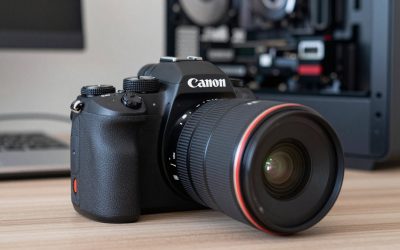
The best cinema cameras under $5,000 in 2026 are the Canon EOS C70 for built-in ND filters and dependable autofocus, the Blackmagic Cinema Camera 6K Full Frame for image quality and RAW value, the Sony FX3 for compact low-light production, and the Blackmagic Pocket Cinema Camera 6K Pro for the most affordable serious cinema rig.
As an Amazon Associate we earn from qualifying purchases at no extra cost to you.
Best Cinema Cameras Under $5,000 at a Glance
| Camera | Typical body price | Dynamic range | Internal ND | Mount | Best for |
|---|---|---|---|---|---|
| Canon EOS C70 | Usually $3,500–$4,500 | Up to about 16+ stops with DGO | Yes, electronic 2–10 stops | RF | Documentary, events, fast-moving productions |
| Blackmagic Cinema Camera 6K Full Frame | Usually $2,000–$2,600 | Up to about 13 stops | No | L-Mount | Controlled narrative work and RAW workflows |
| Sony FX3 | Usually $3,500–$4,000 | About 15 stops in suitable Log conditions | No | Sony E | Low-light, gimbal, travel, and solo shooting |
| Blackmagic Pocket Cinema Camera 6K Pro | Usually $2,000–$2,500 | Up to about 13 stops | Yes, 2, 4, and 6 stops | Canon EF | Budget cinema rigs and EF lens collections |
| Sony FX30 | Usually $1,500–$2,000 | About 14+ stops in Log conditions | No | Sony E | Affordable Super 35 production and B-cameras |
Dynamic-range figures are manufacturer or mode-dependent estimates rather than interchangeable laboratory scores. Exposure technique, ISO, noise reduction, and the chosen gamma profile can change the result substantially.
Head-to-Head: Which Camera Fits Your Production?
Canon EOS C70: The best all-round cinema camera
The C70 is the strongest choice when you need a traditional cinema-camera workflow without giving up autofocus. Its Super 35 DGO sensor is designed to preserve highlight and shadow information, and Canon Log 2 provides a broad grading file. The camera also offers electronic variable ND from 2 to 10 stops, which is a major advantage when exposure must change quickly without altering shutter speed or aperture.
Canon’s Dual Pixel CMOS AF is particularly useful for interviews, documentary work, weddings, and small crews. Face and eye detection can keep a subject sharp while the operator concentrates on framing and sound. The RF mount accepts modern RF lenses and, with an adapter, EF lenses. Canon’s EF-EOS R mount adapters also make it possible to retain autofocus and lens communication with many EF lenses.
The main limitation is recording flexibility compared with Blackmagic. The C70 records 10-bit 4:2:2 XF-AVC internally, which is robust for professional grading, but it does not provide the same internal BRAW workflow as a Blackmagic camera. It uses dual SD card slots, keeping media costs and logistics manageable.
Blackmagic Cinema Camera 6K Full Frame: The RAW-value leader
The Cinema Camera 6K Full Frame is the pick for filmmakers who value a large sensor, shallow depth of field, and flexible RAW post-production over automatic operation. It records Blackmagic RAW internally at resolutions up to 6K and can also record ProRes, giving editors a choice between a highly flexible RAW format and a more immediately editable codec.
Its L-Mount supports a wide range of full-frame lenses from Panasonic, Leica, and Sigma, while adapters can open access to Canon EF, Nikon F, PL, and other lens families. That flexibility is valuable if you are building a kit gradually or switching between photographic and cinema lenses.
The trade-off is the lack of internal ND filters and relatively limited continuous autofocus. This camera works best when focus is pulled manually or set before a take. For exterior work, budget for a matte box and a set of ND filters, or use a variable ND with care. The camera records to CFexpress Type B cards and can also record to an external USB-C SSD, which can reduce the cost of high-capacity media.
Sony FX3: The compact low-light specialist
The FX3 is a strong choice for handheld documentaries, gimbal work, travel films, and crews that need a small camera with reliable autofocus. Its full-frame sensor performs well in dim locations, while Sony’s subject-recognition autofocus can track people and other subjects with little operator intervention. It records 10-bit 4:2:2 XAVC S-I, Long GOP XAVC S, and XAVC HS formats.
The camera has no built-in ND filter, so bright daylight requires external filtration. Its body is compact and includes mounting points, but a cage, top handle, monitor, and audio accessories can quickly make the rig larger than the camera itself. The FX3 records to CFexpress Type A cards or compatible SDXC cards, although the highest-bitrate modes require media that meets Sony’s speed requirements.
Choose the FX3 over the FX30 when full-frame field of view and low-light performance matter more than sensor reach and price. Choose the FX30 when you want a less expensive Super 35 camera with the same general Sony cinema ecosystem.
Blackmagic Pocket Cinema Camera 6K Pro: The budget production workhorse
The Pocket Cinema Camera 6K Pro remains compelling when you want a real cinema interface, internal RAW, and built-in ND filters without approaching a $5,000 body budget. Its 2-, 4-, and 6-stop ND filters make outdoor shooting much easier than with the standard Pocket 6K or many mirrorless alternatives.
The EF mount gives access to a large used lens market, including affordable Canon, Sigma, and Tokina zooms. The camera records BRAW and ProRes to CFast 2.0 cards, SD UHS-II cards, or an external USB-C SSD, depending on the mode. BRAW is especially useful when you need to adjust ISO and white balance decisions during post-production.
Autofocus is basic compared with Canon and Sony systems, and the camera is not especially discreet once you add batteries, a cage, and storage. It is better suited to planned shots, interviews, music videos, and narrative work than fast-moving event coverage.
Codecs, Media, and Recording Bandwidth
Codec choice affects more than image quality: it determines storage cost, editing performance, and how much flexibility you have after exposure mistakes. BRAW is efficient for RAW capture and gives substantial control in DaVinci Resolve. Canon XF-AVC and Sony XAVC S-I produce edit-friendly 10-bit 4:2:2 files, but intraframe recording consumes more storage than Long GOP modes.
As a practical example, a camera recording a 600 Mbps intraframe stream needs approximately:
- 600 megabits per second ÷ 8 = 75 megabytes per second.
- 75 MB/s × 3,600 seconds = about 270 GB per hour.
- A 512 GB card therefore holds roughly 1 hour and 53 minutes before formatting overhead and file-management allowances.
For a two-hour event with safety capacity, plan on at least 600–700 GB of usable media at that data rate. Long GOP recording can reduce storage dramatically, but it is more demanding to edit and may show more visible damage after heavy grading or fast motion.
Decision Matrix: Match the Camera to the Job
| Your situation | Best match | Why |
|---|---|---|
| Bright exterior documentary with changing light | Canon EOS C70 | Built-in 2–10-stop ND and dependable autofocus reduce lens and rig changes. |
| Narrative film with a controlled set | Blackmagic Cinema Camera 6K Full Frame | Full-frame image, internal BRAW, and broad lens-adapter options reward manual operation. |
| Low-light handheld or gimbal production | Sony FX3 | Compact body, strong autofocus, full-frame coverage, and capable high-ISO performance. |
| Existing Canon EF lens collection | Blackmagic Pocket 6K Pro | Native EF compatibility, internal ND, and BRAW at a comparatively low body cost. |
| Affordable second camera for Sony production | Sony FX30 | Super 35 sensor, Sony autofocus, 10-bit recording, and compatibility with Sony E lenses. |
Rigging and Power: Budget Beyond the Body
A sub-$5,000 camera is rarely a complete production system. Reserve approximately $400–$1,200 for a cage or handle, batteries, charger, media, a monitor, and basic filtration. The C70 is the closest to a ready-to-shoot cinema body because it includes professional control layout, ND, and useful audio connections. The Blackmagic cameras often need more accessories, especially for long handheld takes.
For battery planning, use this calculation: if a camera and monitor draw 20 watts and your battery provides 100 watt-hours, the theoretical runtime is 100 ÷ 20 = 5 hours. Real-world usable runtime may be closer to 3.5–4 hours after conversion losses, screen brightness, autofocus activity, and temperature are considered. Compact cameras such as the FX3 and FX30 also benefit from USB-C power banks or larger external batteries, while a full cinema rig is better served by V-mount or Gold Mount power.
What to Buy
Buy the Canon EOS C70 if internal ND filters, autofocus, and fast documentary operation are your priorities. Choose the Blackmagic Cinema Camera 6K Full Frame if you want the strongest RAW-centric image workflow and are comfortable pulling focus manually. Pick the Sony FX3 for compact full-frame shooting and low-light mobility. Choose the Pocket Cinema Camera 6K Pro when you want BRAW, internal ND, and EF lens compatibility at the lowest serious-cinema price. The Sony FX30 is the sensible value option for Super 35 productions and Sony-based multi-camera kits.