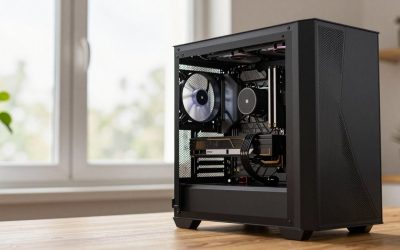
Assassin’s Creed IV: Black Flag is a light game by modern standards. It is the 2013 pirate open-world title from Ubisoft, built on the Anvil engine with a DirectX 11 renderer, and its official requirements describe hardware that has not been sold new in well over a decade: an Intel Core 2 Quad Q8400 or AMD Athlon II X4 620 at 2.6 GHz, 2 GB of RAM, and a GeForce GTX 260 or Radeon HD 4870 with 512 MB of VRAM. The recommended tier only rises to an Intel Core i5-2400S or AMD Phenom II X4 940, 4 GB of RAM, and a GeForce GTX 470 or Radeon HD 5850 with 1 GB of VRAM.
The practical takeaway is simple: you do not need a dedicated gaming GPU to run Black Flag at 1080p. Integrated graphics in a current Ryzen or Core Ultra laptop already sit at or above the recommended card, and any entry-level discrete GPU from the last several years is far more than the Caribbean needs. This guide explains what the official specs mean for a 2013 action-adventure title, which GPUs make sense at each resolution, and where the old engine still has quirks worth knowing about.
As an Amazon Associate we earn from qualifying purchases at no extra cost to you.


Assassin’s Creed IV: Black Flag Official PC System Requirements
| Component | Minimum (official) | Recommended (official) |
|---|---|---|
| OS | Windows Vista SP2 | Windows Vista SP2 |
| Processor | Intel Core2Quad Q8400 @ 2.6 GHz or AMD Athlon II X4 620 @ 2.6 GHz | Intel Core i5 2400S @ 2.5 GHz or better or AMD Phenom II x4 940 @ 3.0 GHz |
| Memory | 2 GB RAM | 4 GB RAM |
| Graphics | Nvidia Geforce GTX 260 or AMD Radeon HD 4870 (512MB VRAM with shader Model 4.0 or higher) | Nvidia GeForce GTX 470 or AMD Radeon HD 5850 (1024MB VRAM with Shader Model 5.0) or better |
| Storage | 30 GB available space | 30 GB available space |
Source: the official Assassin’s Creed® IV Black Flag™ Steam store listing (app 242050), checked October 2026. Publishers can update these specs after patches.
Those figures come from the publisher’s own store listing and describe a PC from 2013: a 2.6 GHz quad-core processor, 2 GB to 4 GB of system memory, a DirectX 10/11-class graphics card with 512 MB to 1 GB of VRAM, 30 GB of storage, and a DirectX-compatible sound card with current drivers. The official notes also specify that a Windows-compatible keyboard and mouse are required, with a controller optional, and they list the supported GPUs at the time of release: GeForce GTX 260 and better, covering the GTX 400, 500, 600 and 700 series, plus Radeon HD 4870 and better, covering the HD 5000, HD 6000 and HD 7000 series. Laptop versions of those cards were never officially supported, even though many of them worked.
Everything built since then clears the recommended tier by a wide margin, so the real questions are no longer “can this PC run Black Flag” but “how far can I push resolution and anti-aliasing” and “how do I avoid the stutter that old engines sometimes show on new hardware”.
How Demanding Is Black Flag Today?
Black Flag runs on Ubisoft’s Anvil engine with a DirectX 11 renderer. It draws a large, seamless Caribbean open world with naval combat against multiple AI ships, dense city districts in Havana, Kingston and Nassau, and alpha-heavy vegetation and water effects. The expensive parts of a frame are draw calls in cities, ship and crew AI during sea battles, jungle foliage, and — on the NVIDIA hardware of the era — the optional PhysX effects.
At release the game was considered moderately demanding for its time, mostly because it asked for a quad-core CPU and a 512 MB DirectX 10-class card when plenty of gaming PCs still had dual-core processors. On period hardware, the single-threaded draw-call load in cities and during large naval engagements could pull frame rates down even while the GPU sat partly idle.
On modern hardware, none of that is a concern. The official recommended CPU is a 2.5-3.0 GHz quad-core from 2010-2011, and a current 4-core/8-thread chip — or even a modern low-power laptop processor — is in an entirely different performance class. There is no ray tracing, no high-resolution texture pack, no mandatory upscaler and no aggressive background streaming to stress a current GPU. VRAM use stays modest: the official figures are 512 MB minimum and 1 GB recommended, and in practice the game stays comfortably within a couple of gigabytes even at high resolutions.
It is also worth being clear about what Black Flag is not. This is a 2013 action-adventure game, not a simulation, strategy title or large-scale multiplayer game, so it is not CPU-heavy in the way those genres are. The only caveat is frame pacing: processors that merely meet the minimum can still dip in busy city areas, and on very high-refresh displays some players prefer to cap the frame rate, since a 2013 engine was never designed around panels that refresh several times faster than the display it shipped for.
Best GPU by Resolution: What to Expect
The guidance below is derived from the official minimum and recommended specs and from the game’s age, not from benchmarks run by this site. The useful reference point is where a card sits relative to the recommended tier — a GeForce GTX 470 or Radeon HD 5850 — because anything above that is essentially free performance in this title.
1080p (Full HD) – 60 FPS and Higher
This is the easy target. The official minimum is a GTX 260 or HD 4870 and the recommendation is a GTX 470 or HD 5850, so nearly every GPU released since then has clearance.
- Integrated Graphics: AMD Radeon 780M and 760M, Intel Arc Graphics in Core Ultra processors, and older Intel Iris Xe or AMD Vega 8 iGPUs all sit at or above the recommended tier. A current Ryzen or Core Ultra laptop can run Black Flag at 1080p with high settings; on the weaker iGPUs, switching anti-aliasing to FXAA and lowering god rays is the usual way to keep the frame rate steady.
- Entry Discrete GPUs: NVIDIA GeForce GTX 1650, GTX 1660 Super, RTX 3050, RTX 5050 / RTX 5060; AMD Radeon RX 6500 XT, RX 7600, RX 9060 XT; Intel Arc A380 / A580. Every one of these is dramatically faster than the recommended GTX 470 and will run 1080p at maximum settings with room to spare.
If you are building a PC specifically for Black Flag and similar older titles, the cheapest current discrete card is already more than enough. The real reference points are the official minimum cards — a GTX 260 or HD 4870 — and anything sold today beats those easily.
1440p (QHD) – High Refresh
At 1440p the pixel count roughly doubles, but nothing in this engine scales badly with resolution except MSAA. Any modern budget or mid-range card handles it:
- Ideal choices: NVIDIA GeForce RTX 3060, RTX 4060, RTX 5060; AMD Radeon RX 6600, RX 7600, RX 9060 XT; Intel Arc A580 / A750. With FXAA or SMAA instead of MSAA, these cards run 1440p at maximum settings with a healthy margin above 60 FPS and into high-refresh territory.
- Older mid-range cards: GTX 1070, GTX 1660 Ti, RX 5600 XT and similar are still far above the recommended spec and remain comfortable at this resolution, with the usual dips in dense city scenes when paired with an old processor.
4K (Ultra HD) – 60 FPS
Black Flag has no official 4K texture pack, so scaling to 4K costs GPU throughput rather than VRAM — the game still fits comfortably inside the memory of cards that were never intended for 4K. The one setting that can make 4K genuinely expensive is MSAA:
- Comfortable 4K 60 FPS: NVIDIA GeForce RTX 3060 Ti, RTX 4060 Ti, RTX 5060 Ti, RTX 5070; AMD Radeon RX 6700 XT, RX 7700 XT, RX 9070. With MSAA off or at 2x and the remaining settings high, these cards have headroom to spare at 4K.
- High-refresh 4K: An RTX 5070 or RX 9070 and above gives you enough margin to run maximum settings at 4K and still stay well clear of a 60 FPS floor.
At 4K, set anti-aliasing to FXAA or SMAA rather than 4x or 8x MSAA. MSAA is disproportionately expensive in this engine relative to what it fixes at very high resolution, and it is the only setting that turns 4K into a real workload here.
CPU, RAM, and Storage Notes for Black Flag
CPU: Single-Thread Speed Is What Counts
Black Flag leans on one main thread for draw calls, which is why the official minimum asks for a quad-core at 2.6 GHz and the recommendation only moves up to a 2.5-3.0 GHz quad-core. On period-correct processors such as a Core 2 Quad Q8400 or Phenom II X4 940, busy cities and large naval battles could drop frames even when the GPU had headroom.
Any modern CPU removes that bottleneck entirely. An Intel Core i3-12100F, Core i5-12400 or 14400, Ryzen 5 5600 or Ryzen 5 7600 will not be the limiting factor at any resolution, and even low-power laptop chips like a Core i5-1335U or Ryzen 7 7840U are far beyond the recommended spec.
There is no benefit to buying a Core i7, Core i9, Ryzen 7 or Ryzen 9 for this game alone. A modern 4-core / 8-thread processor is all Black Flag can use; spend the difference on a newer, more demanding title instead.
RAM: 8 GB Is the Practical Floor
The official 2 GB minimum and 4 GB recommendation describe a 2013 Windows installation. With a modern 64-bit Windows, a browser and the Ubisoft Connect launcher running, 8 GB is the realistic minimum for stutter-free play and 16 GB is comfortable. The game itself rarely uses more than a few gigabytes, so going beyond 16 GB changes nothing.
If you are relying on integrated graphics, run the memory in dual-channel. Two matched DDR4 or DDR5 sticks give an iGPU meaningfully more bandwidth than a single stick, and this is exactly the kind of title that responds to it.
Storage: 30 GB, and an SSD Is Worth It
Black Flag needs about 30 GB of free space according to the official spec, and it will install and run from a mechanical hard drive. But the Caribbean streams continuously as you sail, so an HDD means longer initial loads, visible texture pop-in when fast travelling, and small hitches when synchronising a viewpoint. A SATA or NVMe SSD shortens load times substantially and smooths out sailing. At 30 GB the game fits easily on even a small 512 GB drive, so there is no reason to clear space by deleting other titles.
Two small official notes are worth repeating here: a Windows-compatible keyboard and mouse are required, with a controller optional, and the game expects a DirectX-compatible sound card with up-to-date drivers.
Recommended PC Builds for Black Flag
These are parts-level suggestions rather than specific product recommendations, and no prices are listed because they vary too much by region and over time.
1. Budget / Integrated Graphics Build – Plays at 1080p
Target: 1080p at high settings with FXAA, ideal for a returning player or a low-cost secondary PC.
- CPU with a strong iGPU: AMD Ryzen 5 8600G or an Intel Core Ultra 5 chip with Arc Graphics
- RAM: 16 GB (2×8 GB) DDR5, dual-channel
- Storage: 512 GB NVMe SSD
- No discrete GPU needed — the official recommended card is a GTX 470, and modern integrated graphics are well past that
This also describes most current thin-and-light laptops and mini-PCs, which will run Black Flag without breaking a sweat.
2. Balanced Build – 1440p and 4K, Plus Newer Games
Target: 1440p at maximum settings with MSAA, or 4K with FXAA, while also being sensible for modern AAA releases.
- CPU: Intel Core i5-14400F or Core i5-14600, or AMD Ryzen 5 7600
- GPU: NVIDIA GeForce RTX 5060 or AMD Radeon RX 9060 XT (step up to an RTX 5070 or RX 9070 only if you also play demanding modern titles)
- RAM: 16 GB or 32 GB DDR5
- Storage: 1 TB NVMe SSD
For Black Flag alone this is far more than necessary — the recommended card is a GTX 470 or HD 5850 — but it is a sensible all-round system for 1440p gaming in general.
Laptop and Handheld Suitability
Black Flag is an excellent fit for portable hardware:
- Gaming Laptops: Any gaming laptop with a GTX 1650, RTX 3050 or RTX 4050, or a Radeon RX 6500M and above will run the game at 1080p with maximum settings while staying quiet, because the hardware is barely working. Bear in mind that the official spec never supported laptop versions of the listed cards, so any laptop result is technically unofficial. Thin-and-light machines with just Radeon 780M or Intel Arc Graphics are also comfortably above the recommended spec.
- Steam Deck, ROG Ally, Legion Go: The game is light enough that handhelds have power headroom to spare, so 800p on the Deck or 1080p on the more powerful devices with high settings is realistic, and battery life benefits because power draw stays low. The main thing to plan for is Ubisoft Connect: the game requires the launcher, which can complicate first-time setup and offline play on a handheld, so check your device’s current compatibility notes before buying.
On handhelds and laptops, a frame cap is a good idea. It keeps frame pacing even and extends battery life, and this 2013-era engine was never designed around the very high refresh rates modern panels can reach.
Settings That Actually Raise FPS in Black Flag
If you are on older hardware or chasing higher refresh rates, these are the options that matter most. The PC version’s menu dates from 2013, so expect a short list rather than the dozens of toggles a modern game offers.
- Anti-Aliasing (MSAA vs FXAA/SMAA): The single biggest lever. MSAA multiplies the cost of every edge in the scene, while FXAA or SMAA costs almost nothing and is barely noticeable at 1440p and 4K. If you need performance, this is the first setting to change.
- God Rays: Light shafts through jungle canopy and at dawn are among the more expensive effects in the engine. Lowering or disabling them helps most in forested areas and changes very little out on the open sea.
- Shadow Quality: Higher settings increase both resolution and draw distance for city shadows, and they load the CPU as well as the GPU. Dropping one step is usually invisible in motion.
- Environment Quality: Controls vegetation density and view distance on islands. Lowering it eases the load when sailing close to dense land.
- PhysX Effects: An NVIDIA-era feature. If the option is present and you are on AMD or Intel graphics, the particle work can fall back to the CPU and cause spikes during combat, so turning it off is the safe choice on non-NVIDIA systems and older processors.
- Texture Quality: The official VRAM figures are 512 MB minimum and 1 GB recommended, so on any card with 4 GB or more this setting costs nothing meaningful. Leave it high.
- V-Sync and Frame Caps: Use in-game V-Sync or your GPU control panel to cap the frame rate at your display’s refresh rate or a divisor of
Explore Our Guides & Free Tools