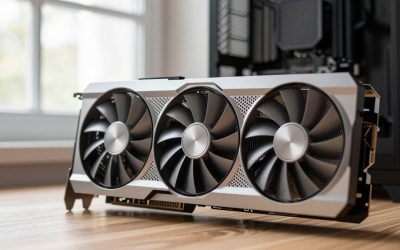
Buy the RTX 5050 if you want a new card with low power draw, a warranty, broad DLSS 4 support and frame generation; buy the Arc A750 only if you can get one used for clearly less money and your PC supports Resizable BAR. In raw rasterized performance the two are much closer than their generation gap suggests, so price and platform should decide this one.
Both cards carry 8 GB of VRAM and target 1080p, which makes this matchup more about efficiency, features and driver maturity than about one card crushing the other. Below is a breakdown of where each one wins.
Quick answer: Our top pick in 2026 is the Architecture — our #1 rated choice. See the full ranked comparison, alternatives and buying advice below.
Specs Side by Side
| Specification | Arc A750 | RTX 5050 |
|---|---|---|
| Architecture | Xe-HPG (Alchemist, Gen 12.7) | Blackwell |
| Release date | 12 October 2022 | 1 July 2025 |
| Launch MSRP | $289 | $249 |
| Shader units | 3,584 | 2,560 CUDA cores |
| Boost clock | 2,400 MHz | 2,572 MHz |
| Process node | 6 nm | 5 nm |
| VRAM | 8 GB GDDR6 | 8 GB GDDR6 |
| Memory bus | 256-bit | 128-bit |
| Memory bandwidth | 512.0 GB/s | 320.0 GB/s |
| L2 cache | 16 MB | 24 MB |
| TDP | 225 W | 130 W |
| PCIe interface | PCIe 4.0 x16 | PCIe 5.0 x8 |
| Power connectors | 1x 6-pin + 1x 8-pin | 1x 8-pin |
| Slot width | 2-slot | 2-slot |
| Display outputs | 1x HDMI 2.1, 3x DP 2.0 | 1x HDMI 2.1b, 3x DP 2.1b |
The A750 has the wider memory bus and more bandwidth, while the RTX 5050 compensates with a much larger L2 cache and a newer, more efficient architecture. The most striking line is power: 225 W versus 130 W for broadly similar gaming performance.
Raster Performance: Closer Than Expected
The easiest way to place these cards is through the RTX 3060 12GB, which both are frequently tested against.
- In TechPowerUp’s Arc A750 review, the RTX 3060 was about 4% faster at 1080p, while the A750 was about 4% faster at 1440p. In other words, the A750 is a 3060-class card that scales better at higher resolution.
- For the RTX 5050, reviews disagree somewhat. TechPowerUp’s data places it ahead of the RTX 3060, and Quasar Zone’s numbers (reported by TweakTown) put it around 13% faster at 1080p. Hardware Unboxed’s game selection showed a smaller gap, with the 5050 only marginally ahead of the RTX 3060 in titles like Black Ops 6 and Cyberpunk 2077.
Putting that together, the RTX 5050 is roughly 0–15% faster than the Arc A750 at 1080p depending on the game mix, and the gap narrows or flips at 1440p, where the A750’s 256-bit bus helps. For a typical modern AAA game on high settings at 1080p, expect both to sit somewhere in the 55–75 FPS range, varying with settings, CPU and patch level.
Older and DirectX 11 games
Intel’s Alchemist drivers have improved enormously since launch, but older DX11 and DX9 titles remain less consistent on the A750 than on NVIDIA hardware. If your library is full of older games or niche titles, the RTX 5050 is the safer bet.
Ray Tracing and Upscaling
Both cards can run ray tracing, but at 1080p with 8 GB, RT is best limited to lighter effects plus upscaling. NVIDIA’s fourth-generation RT cores in Blackwell generally hold up better under RT loads than Alchemist’s first-gen units, and the A750 also loses ground when RT pushes VRAM usage.
The feature gap is bigger than the performance gap:
- RTX 5050: DLSS 4 Super Resolution with the transformer model, DLSS Frame Generation and DLSS 4 Multi Frame Generation (up to three generated frames per rendered frame), plus NVIDIA Reflex. DLSS has the widest game support of any upscaler.
- Arc A750: XeSS 2 Super Resolution, XeSS Frame Generation and Xe Low Latency in supported games, plus FSR 3.1 as a fallback. XeSS runs best on Arc’s own XMX hardware, so image quality is good, but the game list is shorter.
A caution about frame generation on 8 GB cards: it raises memory use, and a game already near the VRAM limit can stutter when you enable it. Multi Frame Generation also works best when the base frame rate is already around 50–60 FPS; it smooths motion but does not fix sluggish input from a low base frame rate.
8 GB on Both: What That Means
Neither card wins on VRAM capacity. At 1080p, 8 GB still runs most games at high settings, but a growing number of new releases want medium textures to avoid stutter, especially with RT on. At 1440p, 8 GB is a real constraint on either card.
One difference: the RTX 5050 uses a PCIe 5.0 x8 link. On a modern PCIe 4.0 or 5.0 board this is fine. On an older PCIe 3.0 motherboard, the x8 link halves the available bus bandwidth, and when an 8 GB card spills over into system memory the penalty is more severe. The A750’s full PCIe 4.0 x16 link is more forgiving there, but the A750 has its own platform requirement (see below).
Power Draw and PSU Math
The efficiency gap is large. Using GPU TDP + CPU power + about 150 W of headroom:
| Build | Arc A750 | RTX 5050 |
|---|---|---|
| GPU TDP | 225 W | 130 W |
| CPU (65 W-class, ~90 W under load) | 90 W | 90 W |
| Headroom | 150 W | 150 W |
| Estimated total | ~465 W | ~370 W |
| Practical PSU | 550–600 W | 450–550 W |
Over a few years of gaming, the A750’s extra ~95 W adds up. At three hours of gaming a day and an electricity price of $0.15 per kWh, a 95 W difference comes to roughly $15–$16 a year. Not huge, but it erodes the A750’s used-price advantage over time and means more heat and fan noise in small cases.
Connectors also differ: the A750 needs a 6-pin plus an 8-pin, while the RTX 5050 needs a single 8-pin. Older or budget power supplies with only one PCIe lead favor the 5050.
Size and Case Fit
Both are dual-slot cards. Many RTX 5050 partner models are compact dual-fan designs suited to small-form-factor builds, helped by the 130 W TDP. A750 cards are generally full-size dual-fan designs with more cooling mass to handle 225 W. If you are building in a Mini-ITX case, the RTX 5050 offers more model choices.
Platform Requirements
- Arc A750: Resizable BAR is effectively mandatory. Without it, performance can drop dramatically. Check that your motherboard and CPU support ReBAR and that it is enabled in the BIOS.
- RTX 5050: runs well with or without ReBAR. Prefer a PCIe 4.0 or newer slot because of its x8 link.
Used Arc A750 vs New RTX 5050
The A750 is largely a used-market card now. Secondhand units usually sell roughly in the $120–$170 range, while the RTX 5050 launched at $249 new. If the A750 costs around $100 less and your system supports ReBAR, it offers similar 1080p raster performance for much less money. If the gap is only $40–$50, the RTX 5050’s efficiency, warranty, driver consistency and DLSS 4 support make it the better buy.
Decision Table by Budget and Resolution
| Scenario | Pick |
|---|---|
| 1080p, new build, want lowest risk | RTX 5050 |
| 1080p, tight budget, ReBAR-capable PC, used card OK | Arc A750 |
| Light 1440p gaming with upscaling | Slight edge A750 in raster; RTX 5050 for DLSS |
| Small case or weak PSU | RTX 5050 |
| Older PC without ReBAR | RTX 5050 (in a PCIe 4.0 slot if possible) |
| Library of older DX11 games | RTX 5050 |
| Want frame generation in many games | RTX 5050 |
Frequently Asked Questions
Is the RTX 5050 faster than the Arc A750?
Slightly, at 1080p. Published reviews place the RTX 5050 roughly level with to about 15% ahead of RTX 3060-class performance, and the A750 sits around the RTX 3060. At 1440p the A750’s wider memory bus closes the gap.
Does the Arc A750 support frame generation?
Yes, through XeSS 2 Frame Generation in games that support it, and FSR 3.1 frame generation as a fallback. It does not support NVIDIA DLSS Frame Generation. Game support for XeSS 2 is narrower than DLSS.
Can the RTX 5050 run on a PCIe 3.0 motherboard?
Yes, it works in PCIe 3.0 slots. Because it uses only eight lanes, bus bandwidth is halved compared with PCIe 4.0. This matters most when a game exceeds 8 GB of VRAM, so keep texture settings reasonable on older boards.
What PSU do I need for the Arc A750?
A quality 550–600 W unit with a 6-pin and an 8-pin PCIe connector is a safe choice. The card is rated at 225 W. Pair it with a lower-power CPU if you want to stay near 550 W.
Is 8 GB of VRAM still enough for 1080p?
For most games at 1080p with high settings, yes, but some new releases need medium textures to avoid stutter, especially with ray tracing. Both of these cards share that limitation. If you want headroom, consider a 10–12 GB card instead.
Ready to decide? Our #1 pick for 2026 is the Architecture.
Live price & availability on Amazon.