The RTX A4000 is Nvidia’s single-slot professional card built on the Ampere architecture, and it keeps showing up on the used market at prices that make gamers curious. It is not a gaming card first. It is a workstation part that happens to share silicon with the RTX 3070-ish tier, and that overlap is exactly why it’s worth a close look before you buy one off eBay thinking you found a deal.
What the A4000 actually is
Nvidia sells the A4000 as a Quadro-successor product for CAD, 3D rendering, and ML workstations. It uses the GA104 die, the same family that powers the RTX 3070 and 3070 Ti, with 16GB of GDDR6 on a single-slot blower cooler and a 140W power limit. No power connector drama either, it runs off a single 6-pin or PCIe slot power depending on the revision, which matters if you’re building in a small case or a workstation chassis with limited headroom.
The headline spec that gets gamers interested is the 16GB of VRAM. That is more than most consumer cards at a similar compute level offered at the time, and it still looks decent now for anyone doing video editing, Blender, or local AI model work where VRAM capacity matters more than raw gaming frame rates.
How it actually performs in games
Clock speeds are conservative because Nvidia tuned this for sustained workstation loads, not boost-clock gaming benchmarks. In practice it lands close to an RTX 3070, sometimes a bit behind it, depending on the game and whether it’s CPU-bound. You will not see ray tracing performance that competes with anything from the 40-series, and DLSS support is limited to the older versions supported by Ampere, so don’t expect Frame Generation.
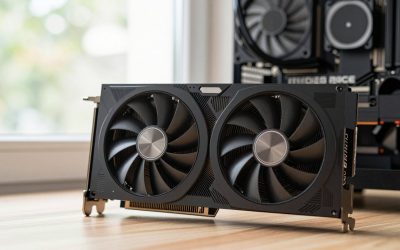
The single-slot blower cooler is also the card’s biggest weakness for a gaming build. Blower coolers are loud under sustained load compared to the dual or triple-fan open-air coolers on gaming cards, because they’re designed to exhaust heat out the back of a dense rackmount workstation, not to be quiet in a bedroom gaming PC. If noise matters to you, this is a real downside, not a minor one.
| Card | VRAM | TDP | Typical Use Case | Gaming Noise Level |
|---|---|---|---|---|
| RTX A4000 | 16GB GDDR6 | 140W | Workstation / rendering / light gaming | Loud under load (blower) |
| RTX 3070 | 8GB GDDR6 | 220W | Gaming | Quiet (open-air) |
| RTX 3070 Ti | 8GB GDDR6 | 290W | Gaming | Quiet (open-air) |
| RTX 4060 Ti 16GB | 16GB GDDR6 | 165W | Gaming / light creative work | Quiet (open-air) |
That table is the honest version of the pitch. If you want 16GB of VRAM for gaming specifically, a current-gen card like the RTX 4060 Ti 16GB gets you there with better drivers, DLSS 3, and a cooler that won’t sound like a hair dryer. The A4000 only makes sense once its used price drops meaningfully below that.
Who this card actually suits
The A4000 is a good fit for a specific kind of buyer: someone running a workstation that does CAD, video editing, or ML inference during the day and wants to game occasionally at night without owning two machines. The single-slot form factor is genuinely useful in small-form-factor workstations or multi-GPU rendering rigs where space is tight. If that’s your actual use case, the A4000 is a legitimate buy, especially used, since professional cards tend to get resold by businesses doing refresh cycles rather than abused by miners or overclockers.
It’s a bad fit if you’re building a dedicated gaming PC and just saw “16GB VRAM” and got excited. You’re paying for ECC memory support, certified pro drivers, and a form factor you don’t need, while giving up gaming-focused driver optimizations and a cooler suited to a case with real airflow. For a pure gaming build, your money goes further on a RTX 4070 or similar, which will outrun the A4000 in every game that matters and run quieter doing it.
Buying used: what to check
Most A4000s on the secondhand market came out of workstations, not gaming rigs, which is a point in their favor, but still verify a few things before buying. Ask for a recent GPU-Z or HWInfo screenshot showing total hours if the seller has one, since enterprise cards often ran continuously rather than intermittently. Check that the single-slot cooler’s fan spins freely and isn’t grinding, since replacement blower fans for workstation cards are harder to source than standard gaming card fans. Confirm the seller is including original mounting brackets if your case needs a specific bracket kit, since Nvidia’s pro cards sometimes use different mounting hardware than consumer cards.
If you’re nervous about used pro cards generally, a safer middle ground is buying a certified refurbished unit through a marketplace listing rather than a random private seller, or just comparing current prices on RTX A4000 cards to see where new old-stock units land relative to used gaming cards with similar performance.
FAQ
Is the RTX A4000 good for gaming?
It performs roughly like an RTX 3070 in most games, which is fine for 1440p, but the blower cooler is louder than gaming-oriented coolers and DLSS support stops at older versions. It’s usable for gaming, not optimized for it.
Does the A4000 need a separate power supply connector?
It draws power through either the PCIe slot or a single 6-pin connector depending on revision, and its 140W TDP is lower than most gaming cards in its performance class, which helps in small or power-limited builds.
Why does the A4000 have 16GB of VRAM if it performs like a 3070?
Workstation workloads like 3D rendering, CAD assemblies, and large AI models need VRAM capacity more than raw shader throughput, so Nvidia prioritized memory size over clock speed for this card’s intended market.
Is a used A4000 cheaper than a new 16GB gaming card?
It depends on the week and the seller, but prices fluctuate enough that it’s worth comparing current listings directly rather than assuming the pro card is automatically the better deal.