As an Amazon Associate we earn from qualifying purchases at no extra cost to you.
- Top Pick Between Amd Intel Gaming Picks for 2026
- Quick Answer: What to Buy Right Now
- The Five Criteria That Actually Matter
- The Buying Checklist
- Spec Primer: What the Numbers Actually Mean
- Common Mistakes Buyers Make
- Related Guides
- Frequently Asked Questions
- Specific Build Recipes Compared
- Specific Games Where the Choice Matters
- What I Would Personally Buy in May 2026
- Final Take
- Related Articles
- Related Guides


🛒 Best Price Today on Amazon
Prime members get fast, free shipping on everything above, plus member-only deals. New members get a 30-day free trial — cancel anytime.
Top Pick Between Amd Intel Gaming Picks for 2026
Here are our current top pick between amd intel gaming picks, compared on real Amazon owner reviews, price, and features. Live prices update below.


How to Pick Between AMD vs Intel for Gaming — The Definitive Buyer’s Guide
This guide may contain affiliate links. We may earn a small commission on purchases made through these links at no extra cost to you. Our recommendations are based on detailed research and independent analysis.
Quick Answer: What to Buy Right Now
For pure gaming in 2026, AMD’s Ryzen 7 9800X3D is the fastest gaming CPU on the market and the easy pick if budget allows. For mixed workloads, productivity, and cheaper midrange builds, Intel’s Core Ultra 7 265K offers better multi-thread value and a more modern platform. There is no wrong choice; there is a right choice for your specific workload.
The Five Criteria That Actually Matter
Most buying guides for choosing between AMD and Intel for gaming list ten or twelve specs to consider. In practice, the difference between a satisfying purchase and a regretted one usually comes down to five decisions. The rest are details you can adjust later or simply do not notice.
1. Gaming-only ceiling
The 3D V-Cache cache stack on AMD’s X3D chips gives a measurable 8-15% lead in 1080p CPU-limited games. If you play competitive shooters at 360 Hz or strategy/simulation games with large maps, that lead is real and visible.
2. Productivity multi-thread
Intel’s hybrid P-core/E-core layout lands more total cores at every price tier. For video encoding, code compilation, and 3D rendering, Intel typically wins per dollar. AMD’s non-X3D Ryzen 9 chips are competitive but cost more.
3. Platform longevity
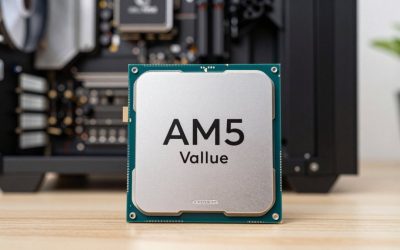
AMD’s AM5 socket is guaranteed through 2027 and likely 2028, meaning your motherboard can take two more CPU generations. Intel’s LGA-1851 is current but its roadmap beyond 2026 is uncertain. AMD wins this category cleanly today.
4. Power and heat
Ryzen X3D chips run cool (under 90W in games) and quiet. Intel K-series chips draw 200-250W under all-core load and need 360mm AIO cooling. Power bills and noise floors matter; this is not a small difference.
5. Price including motherboard
Mid-range B650 boards for AMD have dropped to 130-150 USD with full feature sets. Intel B860/H810 boards are similarly priced but Z890 enthusiast boards run higher. Total platform cost (CPU + board + cooler) usually favours AMD by 50-100 USD at the midrange.
The Buying Checklist
Print this, save it, or screenshot it on your phone. Walk through it before you commit to a purchase – every one of these is a real mistake we have seen people make and regret.
- Decide gaming-only or mixed-workload first
- Look up the specific games you play on a CPU-only benchmark, not synthetic
- Compare total platform cost (CPU + motherboard + cooler + DDR5 kit)
- Check your case for clearance – some Intel coolers are huge
- Verify BIOS support is mature for your chosen CPU revision
- Confirm DDR5 QVL (qualified vendor list) for the motherboard you pick
- Budget for at least a 280mm AIO if you go Intel K-series
- Read recent thermal reviews, not launch reviews from a year ago
Spec Primer: What the Numbers Actually Mean
X3D refers to AMD’s stacked L3 cache, which adds 64 MB on top of the CCD’s base 32 MB for a total of 96 MB. Games benefit from the cache because shader caches, BVH structures for ray tracing, and game-state working sets often fit entirely in L3. Intel’s hybrid architecture uses Performance cores (full-featured, hyperthreaded) and Efficiency cores (smaller, no hyperthreading, designed for background tasks). Windows 11 schedules game threads to P-cores, but bad scheduling on older Windows or Linux distributions can pin a game to E-cores and destroy frame rates. Both platforms now use DDR5 exclusively, so RAM is not a differentiator.
Common Mistakes Buyers Make
These are the patterns we see most often in support forums, return reviews, and our own past mistakes. Avoiding them is more valuable than chasing the top of the spec sheet.
- Picking the more expensive CPU because it is faster on synthetic benchmarks you do not run
- Buying a Ryzen 9 X3D for a workload that does not benefit from the extra cores
- Underestimating Intel cooling needs and shipping with a 240mm AIO
- Choosing AM5 and pairing it with DDR5-4800 instead of the recommended 6000
- Ignoring motherboard VRM quality and crashing under sustained loads
Frequently Asked Questions
Will AMD or Intel be faster in five years?
AMD will likely hold the gaming crown through the AM5 generation thanks to V-Cache momentum. Intel’s roadmap suggests strong multi-thread gains in 2027, but gaming gains depend on whether Intel adopts a stacked-cache equivalent. Buy for today, not for 2031.
Do I need an X3D chip for high-refresh-rate gaming?
Only if you play CPU-bound games (esports titles, simulators, strategy games) at 240 Hz or above. For most AAA games at 1440p high settings with a midrange GPU, the gain is under 5% – real but not life-changing.
Is the 9800X3D worth the upgrade from a 5800X3D?
For pure 1440p AAA gaming, no – the GPU is more likely the limit. For 1080p competitive gaming or sim racing with VR, yes – the gain is 25-40%. Check your specific games before committing.
Does the Intel hybrid architecture cause problems?
Rarely now. Windows 11 24H2 and modern game engines handle the P-core/E-core split correctly. The horror stories from 12th-gen launch are largely resolved by 2026. Linux gaming is the one remaining caveat – kernel 6.6 or newer is required for clean scheduling.
Specific Build Recipes Compared
AMD Sweet Spot (Around 1,900 USD)
Ryzen 7 9800X3D + B650E motherboard + 32 GB DDR5-6000 CL30 EXPO + 280mm AIO + RTX 5070 Ti + 2 TB Gen 4 NVMe + 850W 80+ Gold PSU. Highest gaming FPS at this price tier, runs cool and quiet, platform upgradeable through 2027.
Intel Sweet Spot (Around 1,950 USD)
Core Ultra 7 265K + Z890 motherboard + 32 GB DDR5-6400 CL32 + 360mm AIO + RTX 5070 Ti + 2 TB Gen 4 NVMe + 850W 80+ Gold PSU. Slightly more multi-thread performance, comparable gaming performance, runs hotter under all-core load, platform future uncertain.
Productivity Crossover (Around 2,400 USD)
For users who also render, encode, or compile: Intel Core Ultra 9 285K still beats Ryzen 9 9950X in many multi-thread workloads at slightly higher power draw. Pair with the same GPU and storage as above. The choice flips back to AMD if your workload is cache-sensitive (compilation, certain simulation tools).
Specific Games Where the Choice Matters
Microsoft Flight Simulator, Stellaris, Cities Skylines 2, Total War Warhammer, and EA Sports F1 series all benefit measurably from V-Cache – typically 15-25% higher minimum FPS on X3D chips vs comparable Intel. Esports titles like Counter-Strike 2, Valorant, and League of Legends benefit less because they are not cache-bottlenecked at modern resolutions. If your game library leans into the cache-heavy category, the AMD choice is clear. If you play primarily esports or AAA shooters, the difference shrinks below 5% and other factors (platform cost, cooling, productivity) dominate.
What I Would Personally Buy in May 2026
For a new build today, I would pick the Ryzen 7 9800X3D paired with a 130 USD B650E motherboard and a 280mm AIO. The gaming performance is the highest available, the platform has two more CPU generations of upgrade headroom, the power draw is genuinely low (under 90W in games), and the build is cheaper than an equivalent Intel system by about 100 USD all-in. The only scenarios that would push me to Intel are: a workload heavy in video encoding or compilation where Ryzen 9 9950X is preferred over X3D, an existing Intel motherboard upgrade path, or a personal preference for Intel’s platform polish (which is real but minor in 2026). The X3D versus non-X3D AMD decision is straightforward – X3D for gaming, non-X3D for productivity. Cross-platform Windows-Linux dual-booters might consider AMD because Linux gaming on AMD is currently smoother than on Intel hybrid architectures, though kernel 6.6+ closes most of that gap.
Final Take
AMD wins gaming, Intel wins multi-thread value, and AMD wins platform longevity. If you only play games, buy AMD X3D. If you also stream, encode, render, or compile code, run the numbers on your specific workload. The era of one platform being obviously better is over.