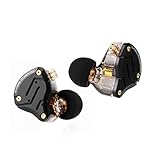
- Top Pick: Linsoul KZ ZS10 Pro, 4BA+1DD 5 Driver in Ear Monitor, HiFi Wired Earbuds, Gaming Earbuds, Hybrid IEM Earphones with Stainless Steel Faceplate, Detachable Cable for Musician(Without Mic, Dark Black)
- Best Value: Linsoul KZ ZS10 Pro, 4BA+1DD 5 Driver in Ear Monitor, HiFi Wired Earbuds, Gaming Earbuds, Hybrid IEM Earphones with Stainless Steel Faceplate, Detachable Cable for Musician(Without Mic, Black)
- Premium Choice: KZ ZS10 Pro in Ear Monitor, 4BA+1DD Hybrid Driver IEM Earphones, HiFi Gaming Earbuds with Stainless Steel Faceplate, in Ear Headphone for Musician Audiophile (Without Mic, Black)
The KZ ZS10 Pro is one of the most popular five-driver hybrid in-ear monitors in budget Chi-Fi, pairing four balanced-armature drivers with a single dynamic driver per side for a total of ten drivers across the pair. At around $50 it sits at the upper end of KZ’s mainstream lineup and competes with the brand’s own ZSN PRO X and the wider 7Hz Zero:2 / Moondrop CHU II class. This KZ ZS10 Pro review covers the driver topology, tuning, build quality and realistic use cases.

Linsoul KZ ZS10 Pro, 4BA+1DD 5 Driver in Ear Monitor, HiFi Wired Earbuds, Gaming Earbuds, Hybrid IEM Earphones with Stainless Steel Faceplate, Detachable Cable for Musician(Without Mic, Dark Black)


As an Amazon Associate we earn from qualifying purchases. Product prices and availability are accurate as of the date/time indicated.
🛒 Best Price Today on Amazon
Prime members get fast, free shipping on everything above, plus member-only deals. New members get a 30-day free trial — cancel anytime.
As an Amazon Associate we earn from qualifying purchases.


KZ ZS10 Pro at a Glance
| Feature | Specification |
|---|---|
| Driver configuration | 4 balanced armature + 1 dynamic driver (4BA + 1DD hybrid) |
| Impedance | 24 ohm |
| Sensitivity | 111 dB/mW |
| Frequency response | 20 Hz to 40,000 Hz |
| Cable type | Detachable 2-pin (0.78mm) |
| Microphone | Optional (mic cable available separately) |
| Connector | 3.5mm TRS |
| Sound signature | V-shaped with extended treble |
| Approx price | around $50 |
Sound Quality & Driver Configuration
Before getting into the specifics of this set it is worth a short refresher on the technical realities that shape every wired in-ear monitor. The most important is driver topology. An IEM with a single dynamic driver (DD) moves air with a small cone-and-magnet motor, much like a miniature loudspeaker, and tends to produce a warmer, fuller and more physical bass response with smooth midrange. An IEM with one or more balanced armature (BA) drivers uses a tiny electromagnetic reed inside a sealed enclosure that vibrates with very low mass — this gives BA drivers their characteristic strengths of fine treble detail, fast transient response and excellent separation of instruments, at the cost of slightly thinner low-end weight on bass-only BA designs. A hybrid configuration combines both: a DD handles the bass for warmth and impact, and one or more BAs handle the mids and treble for detail and clarity, which is why hybrids dominate the budget Chi-Fi market.
Impedance and sensitivity govern how easy an IEM is to drive. Most modern IEMs sit in the 16 to 32 ohm range with sensitivity ratings of 100 to 110 dB/mW, which means a phone, a laptop headphone jack or a Nintendo Switch can drive them to comfortable listening volumes without a separate amplifier. Higher impedance (50 ohm and above) or low sensitivity may benefit from a portable DAC/amp, but the IEMs in this guide are all designed to be plug-and-play from a 3.5mm jack. The frequency response figure quoted on the spec sheet is usually 20 Hz to 20 kHz or wider, but it is a marketing number — the actual tuning is what matters, and is described in plain language in each review.
Finally, cables, connectors and the wired-audio advantage. The two universal detachable connectors on modern IEMs are the 2-pin (0.78mm) standard, used across virtually every KZ, CCA, Moondrop and 7Hz model, and the MMCX coaxial connector, used by Shure, MEE Audio’s PRO series and a number of premium models. Both let you swap a stock cable for a better one, an upgrade with a microphone, or a balanced 4.4mm cable for a portable DAC/amp. Cheaper IEMs ship with fixed, non-detachable cables — usually fine, but a failure point if the cable develops a crackle. The headline advantage of every IEM in this guide over a wireless equivalent is zero added latency and no codec compression: a 3.5mm cable carries the analog signal directly to the driver, which is exactly why competitive musicians, sound engineers and serious gamers still choose wired IEMs over Bluetooth earbuds.
The ZS10 Pro is a serious multi-driver hybrid for the money. The single dynamic driver handles the sub-bass and mid-bass, the four balanced armatures cover the midrange and the treble across multiple bands, and an internal crossover network routes the signal between them. The result is the headline strength of every well-designed BA/DD hybrid: the dynamic driver delivers the warmth, weight and physical impact that BAs cannot match in the bass, and the BAs deliver the fine detail retrieval, transient speed and instrument separation that single-DD IEMs cannot match in the midrange and treble. This is the technical reason hybrids dominate the budget Chi-Fi market.
KZ tunes the ZS10 Pro with a V-shaped signature and notably extended treble. Bass is full and impactful without bleeding into the mids, the midrange is slightly recessed in classic V-shape style and the upper treble has the brightness that defines the KZ house sound. Detail retrieval, layering and stage are class-leading at the price — comparing the ZS10 Pro directly with the Panasonic ErgoFit or LUDOS Clamor in this guide is the clearest possible illustration of what additional drivers and a real crossover network buy you.
Build Quality & Cables
KZ builds the ZS10 Pro shells from a CNC-machined zinc-alloy faceplate over a resin body, which feels substantial in the hand and is more premium than the all-plastic shells of cheaper KZ models. The cable is detachable on the standard 2-pin (0.78mm) connector, which is the connector standard across virtually every KZ, CCA, Moondrop and 7Hz model — that means a vast aftermarket of upgrade cables, microphone cables, balanced 4.4mm cables and braided silver cables is available for a few dollars each. Buyers who want a microphone for Discord chat simply order a mic-equipped 2-pin cable separately; the stock unit ships without a mic on most variants.
Comfort & Fit — Tips Included
The ZS10 Pro uses an over-ear cable routing — the cable loops up over the top of the ear before running down behind the head — which is the standard configuration on every modern multi-driver IEM and provides notably more stable fit than the cable-down design of basic earbuds. The shells are larger than a single-DD IEM because they have to house five drivers and a crossover, so users with very small ears may find them noticeably present. KZ ships a basic set of silicone tips; aftermarket foam tips are a standard $5 upgrade and meaningfully improve seal, isolation and perceived bass.
Sound Signature — Neutral / V-Shape / Bass
KZ tunes the ZS10 Pro firmly in the V-shape camp with the extended, bright treble that defines the KZ house sound. The dynamic driver delivers a generous, full bass response — not bass-cannon levels, but more weight than any pure-BA configuration would manage. The midrange is recessed in classic V style but does not feel hollow because the BA detail retrieval is strong. The upper treble is the most polarising element: KZ tunes brightly, which gives a perceived sense of detail and air but can feel sharp at high volumes on poorly mastered tracks. Sensitive listeners may want to look at the more neutral 7Hz Zero:2 or Moondrop CHU II as alternatives.
Use Cases — Gaming / Music / Stage
For music the ZS10 Pro is a clear technical step up over single-DD IEMs in this guide — the BA detail and DD bass are a meaningful upgrade for any genre with complex arrangements. For competitive gaming the bright treble and strong instrument separation help with positional cues (footsteps, gunfire direction) on PC and console, where a 3.5mm jack carries zero-latency audio. For stage monitoring the V-shape is less appropriate than a Shure SE215 — a stage monitor needs neutral mids for vocal accuracy. For casual everyday use the ZS10 Pro is a serious upgrade over the budget tier. See our best hybrid IEMs guide for similar multi-driver options.
Pros and Cons
Pros: Five-driver hybrid with real DD-plus-BA topology; class-leading detail at the price; detachable 2-pin cable opens vast aftermarket; substantial zinc-alloy build; full impactful bass from a dedicated DD.
Cons: KZ house signature is bright in the upper treble — not for sensitive listeners; larger shells than single-DD IEMs; basic stock tips and cable benefit from inexpensive aftermarket upgrades.
Verdict
At around $50 the KZ ZS10 Pro is one of the strongest values in the budget hybrid IEM category. The five-driver topology genuinely delivers the technical advantages of mixing DD bass with BA detail, the 2-pin detachable cable opens the door to inexpensive upgrades and microphones, and the build is substantial. The KZ-house bright treble is the main caveat — sensitive listeners should compare against the Harman-tuned 7Hz Zero:2 or the smoother Moondrop CHU II covered in this guide. For the buyer who wants a serious step up from a single-DD IEM, the ZS10 Pro earns the recommendation. See our best audiophile IEMs guide for higher-tier options.
Frequently Asked Questions
How many drivers does the KZ ZS10 Pro have?
Five per side — four balanced armatures plus one dynamic driver — for a total of ten drivers across the pair, with an internal crossover routing the signal between them.
Is the KZ ZS10 Pro cable detachable?
Yes. It uses the universal 2-pin (0.78mm) connector standard, which means a vast aftermarket of upgrade cables, microphone cables and balanced 4.4mm cables is available.
Does the KZ ZS10 Pro need an amplifier?
No. At 24 ohm and 111 dB/mW sensitivity it is easily driven by a phone, laptop or console headphone jack. A portable DAC/amp may add a small refinement but is not required.
Is the KZ ZS10 Pro good for gaming?
Yes. The 3.5mm wired connection delivers zero-latency audio and the BA-driven detail retrieval helps with positional cues like footsteps and gunfire direction.
More IEM Reviews
- Shure SE215 PRO Review: Legendary Stage Monitor IEM
- MEE Audio M6 Sport Review: Noise-Isolating Wired Sports IEM
- KZ ZST Colorful Hybrid Review: Budget 1BA+1DD IEM
- SoundMAGIC E10 Review: HiFi Bass-Forward Wired Earbuds
- MEE Audio M6 PRO 2nd Gen Review: Detachable Cable Stage IEM
- Moondrop CHU II Review: Budget Audiophile Pivot Point IEM
- KZ ZST PRO X Review: Budget 1BA+1DD Hybrid Gaming IEM
- 7Hz x Crinacle Zero:2 Review: Harman-Tuned 10mm Dynamic IEM
Affiliate Disclosure: As an Amazon Associate, we earn from qualifying purchases. If you click a link and make a purchase, we may earn a small commission at no extra cost to you. Prices and availability are accurate as of publication and may change.