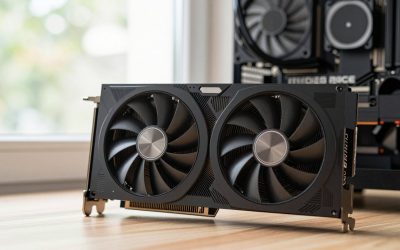
The RTX 3050 gets dismissed a lot in comment sections, usually by people comparing it to cards two tiers above its price. Judged on its own terms, as a budget 1080p card, it’s a reasonable chip with a specific set of compromises. Whether it’s “good” depends entirely on what you’re coming from and what you expect it to do.
What it actually does well
The RTX 3050 is a 1080p card, full stop. At that resolution with medium to high settings, it handles most current games at 60fps or close to it. It supports DLSS, which matters more than the raw horsepower numbers suggest, since it lets you claw back frames in supported titles without a huge image quality hit. It also supports ray tracing in the sense that it won’t crash trying to render it, though you’ll want DLSS on if you turn RT on, because the card doesn’t have the muscle to do both at native resolution.
Power draw is modest, usually under 130W depending on the model, so it works in systems with weaker power supplies and doesn’t need a chunky cooler to stay quiet. For someone upgrading from integrated graphics or a card from six or seven years ago, the jump is substantial and immediately noticeable.
Where it falls short
8GB (on most 3050 cards; some early variants shipped with less) is enough for 1080p today but it’s not a lot of headroom. Newer AAA titles are creeping up in VRAM usage, and texture-heavy games at higher settings can start stuttering not because the GPU core is too slow, but because it runs out of memory. That’s a specific failure mode worth knowing: if a game feels like it’s randomly hitching rather than just running low frames, VRAM is often the culprit.
1440p is possible in older or less demanding games, but you’ll be dropping settings meaningfully to get there, and in newer titles it’s often not worth the trade-off versus just staying at 1080p with better settings. If 1440p is the goal, the 3050 is the wrong card.
Price is the other issue. The 3050 occupies an awkward spot where, depending on sales, it’s sometimes priced close enough to the RTX 4060 or RX 7600 that those become the smarter buy. It’s only a clearly good deal when it’s discounted relative to that next tier up.
How it stacks up
| Card | Best for | VRAM | Ray tracing | Notes |
|---|---|---|---|---|
| RTX 3050 | 1080p, budget builds | 8GB | Usable with DLSS, weak without | Good entry point, low power draw |
| RX 6600 | 1080p, better raw rates | 8GB | Weaker than 3050 | Often cheaper, no DLSS (FSR instead) |
| RTX 4060 | 1080p/light 1440p | 8GB | Noticeably stronger | Better value if price gap is small |
| GTX 1660 Super | Older/light titles, tight budget | 6GB | None | Fine for esports titles, nothing modern-heavy |
The RX 6600 is worth mentioning specifically because it frequently beats the 3050 in traditional rasterized performance for similar or less money, it just lacks DLSS and has weaker ray tracing. If you don’t care about ray tracing and want more consistent frames in competitive or non-RT titles, it’s the better buy more often than not.
Who should actually buy it
It makes sense for a few specific people. Anyone building a budget 1080p rig from scratch, where every dollar matters and the alternative is integrated graphics, will see a big improvement. Anyone upgrading an old pre-RTX card in a system with a limited power supply benefits from the low power draw without needing a PSU upgrade. And anyone who specifically wants DLSS support, maybe to future-proof a bit for upscaling in newer games, gets real value from it that AMD’s equivalent price point doesn’t match as cleanly.
It doesn’t make sense if you already own something like a GTX 1070 or RX 5600 XT, both of which are close enough in performance that the upgrade isn’t worth the money. It also doesn’t make sense if 1440p or high refresh rate gaming is the actual goal, no amount of settings tweaking turns the 3050 into that card.
If you’re shopping, it’s worth browsing current RTX 3050 graphics cards to see where pricing sits relative to the next tier up, since the value proposition shifts a lot with sales. It’s also worth cross-checking against RX 6600 graphics cards if ray tracing isn’t a priority for you, since that comparison is close enough to matter.
Building around it
Pair the 3050 with a mid-range CPU rather than something ancient. Bottlenecking a budget GPU with a worse CPU defeats the purpose, since you’ll be capped by the processor in CPU-heavy games anyway. You don’t need a premium motherboard or exotic cooling for this card. A decent 500-550W PSU covers it comfortably even with a mid-tier CPU, and if you’re assembling a new build around it, it’s worth looking at budget gaming PC parts to keep the rest of the system proportional to what the GPU can actually use.
One thing to watch for when buying used: the 3050 has been in laptops and OEM desktops for a while, and some of those versions are cut down compared to the standalone desktop card. Check the exact model number before buying secondhand, since “RTX 3050” alone doesn’t guarantee you’re getting the full desktop part.
FAQ
Can the RTX 3050 run modern games?
Yes, at 1080p with settings adjusted. Most current titles run acceptably, though you’ll often be at medium-high rather than maxed out, and DLSS helps a lot in supported games.
Is 8GB of VRAM enough in 2024 and beyond?
It’s enough for 1080p right now, but it’s not generous. Some newer games will push against that limit at higher texture settings, which can cause stuttering independent of frame rate.
Is the RTX 3050 good for ray tracing?
Technically yes, practically limited. It can run ray-traced effects, but you’ll need DLSS turned on to get playable frame rates. Without it, ray tracing tanks performance too much to be worth using.
Should I buy the 3050 or save for something better?
If you can comfortably stretch your budget to an RTX 4060 or similar without straining the rest of the build, that’s usually the better long-term buy. If the 3050 is what fits your budget right now, it’s a legitimate 1080p card, not a compromise you’ll regret.