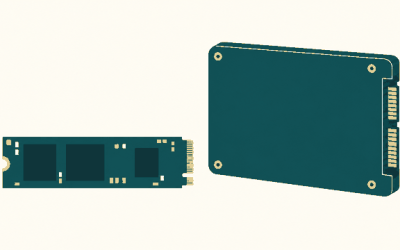
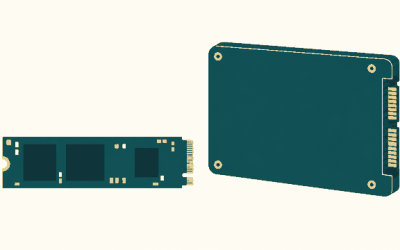
A good NVMe SSD is roughly 30–35x faster than a hard drive in sequential reads and over 1,000x faster in random access — but the gap you actually feel depends entirely on the task, and in game load times it’s closer to 3–5x. Here’s what the real numbers look like across every workload that matters in 2026.
As an Amazon Associate we earn from qualifying purchases at no extra cost to you.



The Speed Gap in One Table
The reason “how much faster are SSDs than HDDs” has no single answer is that drives are fast at different things. Sequential speed is what you see in big file copies; random IOPS is what drives boot times, game loads, and app launches.
| Drive class | Sequential read | Sequential write | Random 4K read IOPS | Access latency |
|---|---|---|---|---|
| 7200 RPM HDD (WD Blue, Seagate BarraCuda) | 150–250 MB/s | 150–240 MB/s | 100–200 | 8–15 ms |
| SATA SSD (Samsung 870 EVO, Crucial MX500) | ~550 MB/s | ~520 MB/s | 60,000–98,000 | ~0.1 ms |
| Gen3 NVMe (Samsung 970 EVO Plus class) | ~3,500 MB/s | ~3,000 MB/s | 400,000–600,000 | ~0.04 ms |
| Gen4 NVMe (WD Black SN850X, Samsung 990 Pro) | ~7,000–7,450 MB/s | ~6,500–6,900 MB/s | 1,000,000–1,400,000 | ~0.03 ms |
| Gen5 NVMe (Crucial T705, WD Black SN8100 class) | ~13,000–14,800 MB/s | ~10,000–13,000 MB/s | 1,500,000–2,000,000 | ~0.02 ms |
Two takeaways: the sequential gap between an HDD and a Gen4 NVMe drive is about 35x, but the random-access gap — the metric that governs how responsive a system feels — is closer to 5,000x and more. A hard drive head physically moves to find each file fragment; an SSD has no moving parts and answers instantly. That’s why even a “slow” SATA SSD transforms a PC far more than any CPU upgrade ever will.
Boot Times and Everyday Responsiveness
This is where the random IOPS advantage shows up in wall-clock time:
- Windows boot to usable desktop: 35–90 seconds on an HDD, versus 10–18 seconds on even a cheap SATA SSD. NVMe shaves a few more seconds off, mostly in how quickly the desktop stops being sluggish after login.
- Launching a large app (browser with 30 tabs, Photoshop, a game launcher): 15–40 seconds on HDD, 2–6 seconds on SSD.
- System updates and patching: games like live-service titles that rewrite tens of thousands of small files patch 3–6x faster on SSD because patchers are random-write-bound.
Notice the pattern: HDD-to-SSD is a massive jump, but SATA-to-NVMe is a small one in everyday tasks. That’s because once latency drops below human perception, extra bandwidth mostly sits idle.
Game Load Times: Where You Save Minutes vs. Seconds
Game loading is a mix of sequential reads (big asset files) and random reads (thousands of small textures and scripts), so it sits between the two extremes:
| Scenario | 7200 RPM HDD | SATA SSD | Gen4 NVMe |
|---|---|---|---|
| Open-world game initial load (Cyberpunk 2077 / Starfield-class) | 60–95 s | 20–30 s | 12–20 s |
| Fast travel / level transition | 20–40 s | 6–10 s | 3–6 s |
| Competitive shooter map load | 25–45 s | 8–14 s | 5–9 s |
| DirectStorage-optimized title | Not recommended (often unsupported) | 15–25 s | 8–14 s |
So in games specifically, the honest answer to how much faster SSDs are than HDDs is 3–5x on load screens, plus qualitative wins the stopwatch misses: no texture pop-in, no stutter when streaming assets mid-gameplay, and audio/dialogue that doesn’t hitch. Some newer titles with heavy streaming effectively require an SSD — running them off an HDD produces broken textures and frozen geometry, not just longer waits.
A Worked Calculation: What Those Seconds Add Up To
Take a typical open-world play session:
- 1 initial load: 75 s on HDD vs 15 s on NVMe = 60 s saved
- 10 fast travels: 30 s vs 5 s each = 250 s saved
- 4 respawns/level transitions: 25 s vs 6 s = 76 s saved
That’s ~6.5 minutes saved per session. Play five nights a week and you’re reclaiming roughly 28 hours per year — an entire game’s worth of playtime, just from the drive. And it doesn’t include the hidden cost of HDD asset streaming: micro-stutters that cost you fights, which no load-time number captures.
For a pure sequential sanity check: copying a 150 GB game install to a HDD at ~200 MB/s takes about 12.5 minutes. The same copy to a Gen4 NVMe at ~6,000 MB/s sustained takes under 30 seconds — a 25–30x real-world gap for file moves.
Why NVMe Specs Don’t Fully Translate to Games
A Gen5 drive reads at nearly 15,000 MB/s on paper — over 60x an HDD — yet loads most games only a second or two faster than a Gen4 drive. The bottleneck isn’t the drive; it’s the CPU decompressing assets and the engine scheduling loads. Raw throughput only pays off when software is built to use it, which is why DirectStorage titles are the exception rather than the rule in 2026. Don’t buy Gen5 for gaming alone — buy it for scratch disks, 4K/8K video work, or large file transfers.
Decision Matrix: Which Drive for Which Job
| Your situation | Best fit | Why |
|---|---|---|
| Older PC with no M.2 slot | SATA SSD (870 EVO, MX500) | Still 20x+ faster than HDD in random access; cheap per TB |
| Main OS + game drive | Gen4 NVMe 1–2 TB | Sweet spot: fast loads, DirectStorage-ready, usually $80–$150 for 2 TB |
| Budget secondary game library | Cheap Gen4 NVMe or SATA | Load-time difference vs flagship drives is 1–3 s |
| Video editing, AI/ML datasets, big transfers | Gen5 NVMe | Sustained 12+ GB/s actually gets used |
| Bulk media, backups, cold archives | 7200 RPM HDD | $15–$20 per TB beats any SSD; speed doesn’t matter for streaming a movie |
The pragmatic 2026 setup most builders land on: a 1–2 TB Gen4 NVMe as the OS and active-game drive, plus a large HDD for footage, backups, and an archive game library you’re not currently playing.
FAQ
Is a SATA SSD still worth it over an HDD?
Absolutely — it’s the single biggest upgrade you can make to an HDD-based system. You keep ~90% of the real-world benefit of NVMe for gaming and everyday use.
Do I need a Gen5 SSD for gaming in 2026?
No. Even DirectStorage titles show only small gains over Gen4, because decompression and engine overhead dominate load times. Gen5 makes sense for content creation and heavy file workloads.
Can I keep my HDD as a secondary drive?
Yes, and it’s a reasonable use — for media libraries, backups, and rarely-played games. Just don’t keep your OS or active competitive/streaming-heavy games on it.
Does SSD speed affect FPS?
Not frame rates directly, but slow storage causes stutter, texture pop-in, and hitching during asset streaming — which feels worse than low FPS. Minimum SSD is effectively a requirement for modern open-world games.
Bottom line: SSDs are 30–35x faster than HDDs in sequential throughput and thousands of times faster in random access, but in practice expect 3–5x faster game loads and a night-and-day difference in system responsiveness. Any SSD is transformative; the jump between SSD tiers is incremental.