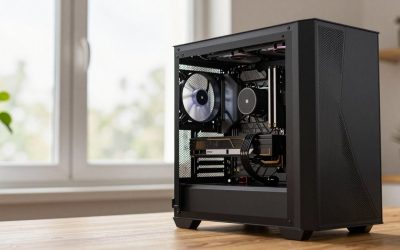
- Top Pick: ASUS ROG G700 (2025) Gaming Desktop PC, Intel® Core™ Ultra 7 265F Processor, NVIDIA® GeForce RTX™ 5070, 1TB M.2 NVMe™ PCIe® 4 SSD, 16GB DDR5 RAM, Windows 11 Home, G700TF-DS774
- Best Value: ASUS ROG G700 (2026) Gaming Desktop PC, Intel® Core™ Ultra 7 265KF Processor, NVIDIA® GeForce RTX™ 5070Ti, 1TB M.2 NVMe™ PCIe® 4 SSD, 32GB DDR5 RAM, Windows 11 Home, G700TF-PB776Ti
- Premium Choice: ASUS ROG G700 Gaming Desktop PC Intel Core Ultra 7 265F 32GB RAM 1TB NVMe SSD NVIDIA GeForce RTX 5060 8GB RGB Keyboard Mouse Windows 11 Pro with 12 Month CPS Protection
Fallout 76 is an online, open-world multiplayer RPG set in post-nuclear Appalachia, and it is not a demanding game by modern standards. Its official specs are modest — a Core i5-6600K / Ryzen 3 1300X with a GTX 780 / R9 285 at minimum, and a Core i7-4790 / Ryzen 5 1500X with a GTX 970 / R9 290X and 8 GB of RAM at recommended — so any current entry-level gaming PC clears the recommended bar at 1080p, and a mid-range system from the last few years will run high settings at 1080p and 1440p comfortably. What actually shapes the experience here is not raw GPU power but the CPU (other players’ camps, public events and constant world streaming), plus an SSD, because this is a 96 GB online world that loads and streams continuously.
As an Amazon Associate we earn from qualifying purchases at no extra cost to you.


Fallout 76 Official PC System Requirements
Bethesda publishes two sets of specs for Fallout 76 on its store page: a minimum configuration and a recommended one. Here is what they actually ask for.
| Component | Minimum (official) | Recommended (official) |
|---|---|---|
| OS | Windows 8.1/10 (64-bit versions) | Windows 8.1/10 (64-bit versions) |
| Processor | Intel Core i5-6600k 3.5 GHz /AMD Ryzen 3 1300X 3.5 GHz or equivalent | Intel Core i7-4790 3.6 GHz /AMD Ryzen 5 1500X 3.5 GHz |
| Memory | 8 GB RAM | 8 GB RAM |
| Graphics | NVIDIA GTX 780 3GB /AMD Radeon R9 285 2GB or equivalent | NVIDIA GTX 970 4GB /AMD R9 290X 4GB |
| Storage | 96 GB available space | 96 GB available space |
Source: the official Fallout 76 Steam store listing (app 1151340), checked October 2026. Publishers can update these specs after patches.
Those numbers are genuinely modest. The minimum GPUs, the GeForce GTX 780 3GB and Radeon R9 285 2GB, are long superseded, and the recommended GeForce GTX 970 4GB / Radeon R9 290X 4GB is several generations behind anything sold today. In practice, any discrete graphics card released in the last several years beats the recommended spec, which is why Fallout 76 is one of the easier online RPGs to run.
A few details in the official listing are worth reading closely. The recommended CPU, a Core i7-4790 or Ryzen 5 1500X, is an older part than the minimum Core i5-6600K / Ryzen 3 1300X, which tells you the game values four cores with eight threads over raw clock speed. RAM is 8 GB at both tiers. Storage is 96 GB of available space, and that figure is the install size before later patches and any local data pile up, so leaving headroom on the drive is sensible. Networking is listed as required rather than optional, because Fallout 76 is an online-only game with no offline mode. Windows 8.1 and Windows 10 64-bit are the official supported operating systems, but Windows 8.1 is long out of support, so Windows 10 or 11 64-bit is the practical choice.
What Kind of PC Do You Need Today?
Fallout 76 does not need a high-end PC. It is a DirectX 11 title built on Bethesda’s Creation Engine, with relatively simple shaders next to modern open-world games, no ray tracing, and no built-in upscaling. The realistic stressors are not the renderer: they are draw calls in built-up areas, player camps, and public events full of enemies and effects, all running on top of an online world that streams constantly.
For a new build or upgrade, think in these tiers:
- Budget 1080p PC: any modern 4-core / 8-thread CPU (Intel Core i3-12100F, Ryzen 5 5500 or newer) with an entry-level discrete GPU (RTX 3050, Radeon RX 6600, Intel Arc A580) already exceeds the official recommended spec by a wide margin and is enough for high settings at 1080p.
- Mid-range 1440p PC: a modern 6-core CPU (Ryzen 5 5600 / 7600, Core i5-12400 / 13400 or newer) paired with a current mid-range card (RTX 5060, RX 9060 XT, Arc B580) gives you plenty of headroom for 1440p at high refresh rates and comfortable 4K.
- High-end 4K PC: not required for this game. An upper mid-range card such as the RTX 5070 or RX 9070 is already more GPU than Fallout 76 can use at 4K, and the CPU and engine usually become the limiter long before the graphics card does.
GPU Recommendations by Resolution
Fallout 76 scales predictably with GPU power, and because the official recommended card is a GTX 970 / R9 290X, almost anything on sale today is overqualified. The tiers below are based on the official specs and on how Creation Engine titles of this generation generally behave, along with public testing from outlets such as TechSpot, Tom’s Hardware and TechPowerUp — they are not measurements taken by this site.
1080p (1920×1080) – High / Ultra
This is the easiest target, and cards at or above the official recommended spec handle it without effort.
- Entry-level options: GeForce GTX 1660 Super, GeForce RTX 3050, RTX 5060, Radeon RX 6600, RX 7600, RX 9060 XT, Intel Arc A580 / B580. Every one of these sits well above the official recommended GTX 970 / R9 290X.
- What to expect: high settings at 1080p are comfortable on any of these cards, and how high your frame rate climbs will depend more on your CPU, the server population and how many camps are in view than on the GPU itself. If you are still running something at or below the official minimum, lowering shadow distance and volumetric lighting is the usual first step.
1440p (2560×1440) – High / Ultra
1440p remains comfortable territory for current mid-range cards and is the sweet spot if you want a high-refresh monitor.
- Mid-range options: GeForce RTX 4060, RTX 4060 Ti, RTX 5060, RTX 5060 Ti, RTX 5070, Radeon RX 7600 XT, RX 9060 XT, RX 9070, Intel Arc B580.
- What to expect: high or ultra settings at 1440p with little compromise. VRAM is not a constraint here — the official recommended spec asks for only 4 GB, so even an 8 GB card is comfortably above what the game needs. If you are chasing very high frame rates, the CPU and the engine will typically be your ceiling rather than the graphics card.
4K (3840×2160) – High / Ultra
4K raises the GPU load, but it stays well within reach and does not call for a flagship card.
- Upper mid-range options: GeForce RTX 4070, RTX 4070 Super, RTX 5070, RTX 5070 Ti, Radeon RX 7800 XT, RX 9070, RX 9070 XT. Older cards in the RTX 3070 / RX 6800 class also handle 4K at high settings with small tweaks.
- What to expect: 4K at high settings is realistic on any of these. Shadows and volumetric lighting cost the most at this resolution, while textures stay cheap if you have the VRAM. There is no official DLSS, FSR or XeSS support in Fallout 76, so driver-level or community solutions are the only upscaling options available, and native performance is generally high enough that you will not need them.
CPU, RAM and Storage Notes for Fallout 76
CPU
Because Fallout 76 is an online game, the CPU has more to do than in a single-player Bethesda title: it tracks other players, their camps and large public events while the engine streams the world around you. The official CPU list is revealing — the recommended chip (Core i7-4790 / Ryzen 5 1500X) comes from an older generation than the minimum (Core i5-6600K / Ryzen 3 1300X) but has hyper-threading, which suggests the game benefits more from four cores and eight threads than from raw single-core clock speed.
That said, it is not a heavily multi-threaded workload. Fallout 76 does not scale much beyond six cores, and it is not a simulation or strategy game where a huge CPU pays off. A modern 6-core processor such as a Ryzen 5 5600 or 7600, or a Core i5-12400 or 13400, is more than enough, and you do not need an 8-core or an X3D part for this game. If you see stuttering in busy areas or on camp-heavy servers, that is usually draw calls and object handling rather than raw compute; closing background apps and making sure your RAM runs in dual-channel mode often helps more than a CPU upgrade.
RAM
The official requirement is 8 GB at both the minimum and recommended tiers, and that figure is honest for a clean machine running only the game. In practice 16 GB is the sensible target: Windows, a launcher, voice chat and a browser or two will fill 8 GB quickly, and running out of memory shows up as stutter rather than a clean crash.
Speed matters less than capacity and channel count. 16 GB in dual-channel is the practical sweet spot, and 32 GB is only worth it if you keep a lot of other software open while you play. Because Fallout 76 is online-only, you will almost always have something else running alongside it, which is another argument for going past the official 8 GB.
Storage
The official figure is 96 GB of available space, and that is the number to plan around. It is the install size before later patches and any local data accumulate, so leaving headroom on the drive is wise.
An SSD is the single most noticeable quality-of-life upgrade for this game. Fallout 76 streams an open world continuously and hides loading behind fast travel and interior transitions; on a SATA SSD those waits are short, on an NVMe drive shorter still, and on a mechanical hard drive you will wait noticeably longer and see more hitching when sprinting through Appalachia. Any SSD will do — NVMe is nice to have but not required by the game.
Example Builds for Fallout 76
The builds below are performance targets rather than shopping lists, since exact parts and availability vary by region. Each one clears the official recommended spec comfortably; no peripherals are included.
Build 1: Budget 1080p
- CPU: Intel Core i3-12100F / Core i5-12400F or AMD Ryzen 5 5500 / 5600
- GPU: Radeon RX 6600 / RX 7600 or GeForce RTX 3050 / RTX 5060
- RAM: 16 GB (2×8 GB) DDR4-3200
- Storage: 1 TB NVMe SSD
- What it does: clears the official recommended spec by a wide margin and runs high settings at 1080p comfortably, with enough headroom for a high-refresh monitor if you trim shadow distance slightly.
Build 2: Balanced 1440p / Entry 4K
- CPU: AMD Ryzen 5 7600 / 7600X or Intel Core i5-13400F / 14400F
- GPU: GeForce RTX 5060 / RTX 5070 or Radeon RX 9060 XT / RX 9070 or Intel Arc B580
- RAM: 16 GB or 32 GB (2×16 GB) DDR5-5600 to DDR5-6000
- Storage: 1 TB – 2 TB NVMe SSD
- What it does: handles 1440p at high refresh rates and 4K at high settings, and keeps frame times steady during public events and nuke zones, where the engine is under the most strain.
Beyond this level you are buying for other games. Fallout 76 is limited by its engine, its online nature and its CPU-side draw-call load long before it is limited by a modern graphics card, so spending much more on a GPU will not translate into a noticeably better experience here.
Laptop and Handheld Suitability
Gaming Laptops
Fallout 76 runs well on gaming laptops, and the bar is low: anything with a GTX 1650, RTX 2050, RTX 3050 Laptop or newer comfortably exceeds the official recommended spec and handles 1080p at high settings. Laptops with RTX 4050 / 4060 / 5060 Laptop GPUs can push 1440p or high-refresh 1080p without trouble. As on desktop, prioritise 16 GB of dual-channel RAM and an NVMe SSD, and remember that power limits and cooling matter more than the exact GPU name — a well-cooled mid-tier laptop will often sustain better frame rates than a thin machine with a faster chip.
Steam Deck, ROG Ally and Similar Handhelds
Fallout 76 is playable on handheld PCs, but it is an online-only game: it needs a constant internet connection and has no offline mode, so a handheld is only useful where you have Wi-Fi or a hotspot.
On a Steam Deck, expect to run at reduced settings and the Deck’s 1280×800 resolution, with lower shadows and volumetric lighting to keep frame times steady; capping the frame rate also helps battery life and consistency. Windows handhelds such as the ROG Ally, Ally X and Lenovo Legion Go have more GPU headroom and can run at higher settings, and they too benefit from a performance profile and a frame cap. Steam’s compatibility rating for the game can change with updates, so check it before buying if handheld play is your main plan.
Settings That Raise FPS the Most
Fallout 76’s display options are relatively simple, but a few of them have an outsized effect. If you need more performance — most likely on hardware at or near the official minimum — these are the ones to change first: