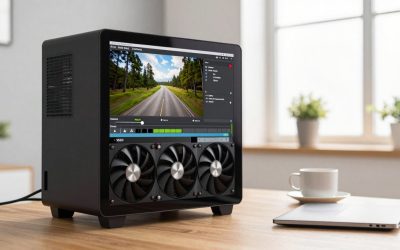
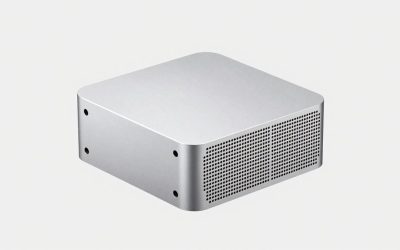
Choosing between an external USB 3.0 SSD and an internal hard disk drive (HDD) comes down to what you value most: speed, portability, capacity, or price. Both can store games, photos, videos, backups, and general files, but they behave very differently in daily use.
An external SSD connects through a USB cable and can be moved between computers. An internal HDD is installed inside a desktop or laptop, usually over SATA. USB 3.0 is now commonly labeled USB 3.2 Gen 1, with a theoretical limit of 5Gbps. In practical use, that gives a good external SSD roughly 350 to 500 MB/s, depending on the drive, enclosure, cable, and computer port.
As an Amazon Associate we earn from qualifying purchases at no extra cost to you.

Speed and responsiveness
The external SSD is much faster at random access. It has no spinning platters or moving heads, so opening small files, launching applications, and loading game assets takes less time. Large file transfers are also usually several times faster than with a hard drive.
A typical internal 3.5-inch HDD reaches about 100 to 220 MB/s for sequential transfers, with the fastest speeds appearing near the outside edge of the platter. Small-file performance is far lower. Seek delays can make an HDD feel sluggish even when its headline sequential speed looks acceptable.
A USB 3.0 SSD may be limited by the interface rather than the flash storage. A modern NVMe SSD in a USB 3.0 enclosure will not reach its advertised 3,000 or 7,000 MB/s speeds; the USB connection will cap it near 500 MB/s. That is still a useful improvement over an HDD, but it is not the same as a direct PCIe connection.
| Factor | External USB 3.0 SSD | Internal HDD |
|---|---|---|
| Typical sequential speed | 350–500 MB/s | 100–220 MB/s |
| Random access | Very fast | Slow because of seek time |
| Noise | Silent | Audible spinning and seeking |
| Shock resistance | Good while unplugged and idle | Poor while operating; moving parts can be damaged |
| Cost per terabyte | Higher | Lower |
| Installation | Plug in and use | Requires mounting, cables, and an available drive bay or slot |
When an external SSD is the better buy
Choose an external SSD if you regularly move files between computers, work from a laptop, or need a fast drive for an operating system, applications, or active project files. Video editors, photographers, and PC gamers benefit from shorter load times, especially when the internal drive is already full.
Portability is a major advantage. A small SSD has no spinning mechanism to damage when the drive is carried in a bag. It is still not indestructible: dropping it while connected can damage the USB connector, enclosure, or cable. Keep the drive disconnected when moving it, and avoid sharply bending the cable at the drive’s socket.
For a sensible purchase, look at portable external SSDs with a USB 3.x connection and a capacity suited to the job. A 500GB drive is enough for documents and a small application library. A 1TB model is a more flexible choice for games, photos, and video work. Check whether the included cable matches your computer; USB-C and USB-A are connector shapes, not speed ratings.
An SSD is also the safer choice for a drive that will be bumped or moved while powered on. That does not make it a backup. Flash storage can fail suddenly, and deleted or corrupted files may be difficult to recover. Keep a second copy of anything important.
When an internal HDD makes sense
An internal HDD is the economical choice for bulk storage. If you need several terabytes for a media collection, archived photos, installers, surveillance footage, or backups that are not accessed constantly, the lower price per terabyte matters more than SSD speed.
It is also fine for a desktop used mainly for web browsing, office work, and storing files. An HDD can hold a large Steam or game library, although games installed on it may have longer loading screens and occasional texture pop-in. For a better balance, use an SSD for Windows and frequently played games, then keep the HDD for large files and less-used titles.
Internal installation has trade-offs. A desktop needs a free 3.5-inch bay, SATA data cable, SATA power connector, and suitable airflow. A laptop may not accept a 2.5-inch HDD at all, or it may require removing the existing drive. Spinning drives also create vibration, heat, and noise.
For desktop bulk storage, compare internal SATA hard drives by capacity, warranty, and intended workload rather than peak speed alone. A 4TB or 8TB drive is often cheaper per terabyte than buying several small drives. Do not assume a higher RPM rating makes every task fast; seek latency still dominates small-file work.
Reliability, backups, and failure modes
Neither option should be your only copy of important data. HDDs can develop bad sectors, make clicking or scraping sounds, disappear from the operating system, or fail after years of vibration and heat. A clicking drive should be shut down rather than repeatedly tested.
SSDs can slow down when nearly full, particularly cheaper models with small write caches. Sustained transfers may drop sharply after the cache is exhausted. They can also fail without much warning, sometimes because of a controller or USB bridge problem rather than worn-out flash.
Use the 3-2-1 approach for valuable files: keep three copies, on two different types of storage, with one copy off-site or in the cloud. Safely eject an external SSD before unplugging it, especially during writes. For an HDD, monitor health with SMART software, but treat health warnings as an early opportunity to replace the drive, not as proof that the drive is safe.
Which one should you buy?
Buy the external USB 3.0 SSD if you need speed, portability, quiet operation, or a drive for active work. It is the better everyday companion for a laptop and a practical upgrade when your computer’s internal storage cannot be replaced.
Buy the internal HDD if your main requirement is the most storage for the least money and you can accept slower loading, noise, and a fixed installation. For many desktop users, the strongest setup is not either-or: use an SSD for the operating system and current work, then an internal HDD for bulk storage, with a separate backup drive protecting both.
If you need the least expensive large-capacity backup, consider external USB hard drives. They are slower than external SSDs, but for overnight backups and archives, that limitation is often acceptable.