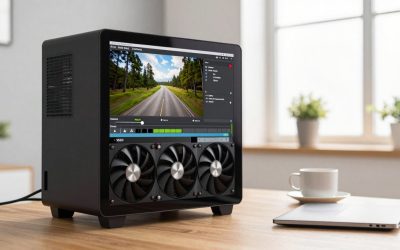
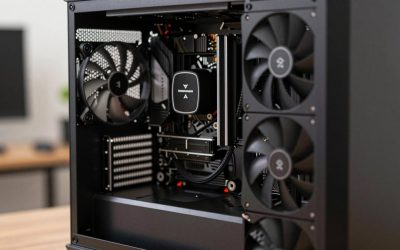
Internal computer hardware is everything that lives inside the chassis and talks to the motherboard through dedicated sockets and buses — the CPU socket, DIMM slots, PCIe slots, M.2 slots and SATA ports — while external hardware is anything that reaches the system through the I/O ports on the front or rear panel: USB, HDMI/DisplayPort, Ethernet and audio jacks. The chassis wall, not the component’s job, is the dividing line — the same NVMe drive is “internal” screwed into an M.2 slot and “external” sitting in a USB enclosure on your desk, and which side it sits on determines its speed cap, its cable, and whether upgrading it means picking up a screwdriver.
- What actually separates internal from external computer hardware
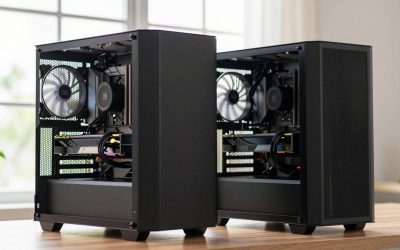
- Internal hardware: the parts inside the case
- External hardware: peripherals and plug-in devices
- How each component connects to the motherboard
- The gray zone: external boxes that borrow internal buses
- Which upgrades require opening the case
- Worked example: will a GPU upgrade force more internal work?
- FAQ
As an Amazon Associate we earn from qualifying purchases at no extra cost to you.


What actually separates internal from external computer hardware
The real difference is the connection path. Internal components ride the motherboard’s high-speed fabric directly: the CPU and RAM sit on the memory fabric, and everything else hangs off PCI Express lanes provided by the CPU or chipset. External devices must cross a boundary — the signal passes through an onboard controller (USB host controller, network chip, audio codec, the GPU’s display engine), out through a standardized port, and down a cable. That hop costs bandwidth and adds latency, which is why no external port has ever matched a socket, and why the interface names below matter more than the marketing names on the box.
Internal hardware: the parts inside the case
- CPU (processor) — seats in a socket such as AM5 or LGA 1851, executes every instruction, and supplies the PCIe lanes your GPU and primary M.2 slot use. Requires a cooler mounted on top.
- Motherboard — the hub every other component plugs into. Its form factor (ATX, micro-ATX, Mini-ITX) dictates case size and expansion count.
- RAM (memory) — DDR5 sticks in DIMM slots beside the CPU. Capacity and running in dual channel (slots 2 and 4 on most boards) directly affect frame rates.
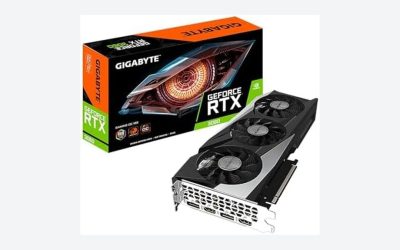
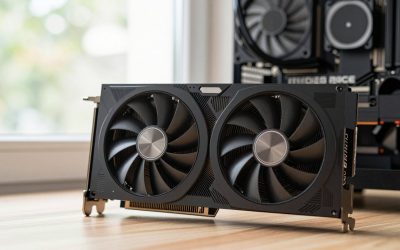
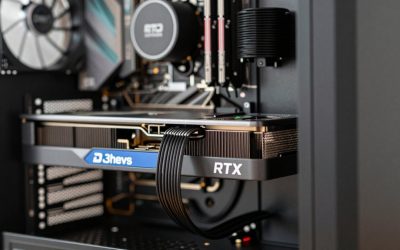
- Graphics card (GPU) — occupies the top PCIe x16 slot and is usually the largest power draw. Note the quirk: the card is internal, but its HDMI and DisplayPort connectors are the external ports your monitor cable uses.
- Storage — NVMe SSDs in M.2 slots on the board itself, plus 2.5-inch SSDs and 3.5-inch HDDs in drive bays wired to SATA ports and PSU power.
- Power supply (PSU) — converts wall AC into 12V/5V/3.3V DC, feeding the motherboard via the 24-pin ATX and EPS CPU cables, and the GPU via PCIe or 12V-2×6 connectors.
- Cooling hardware — CPU air towers or AIO liquid coolers, case intake/exhaust fans, all powered from motherboard fan headers.
- Expansion cards — optional Wi-Fi cards, capture cards, sound cards and 10GbE NICs in spare PCIe x1/x4 slots.
- Small internals — CMOS battery, front-panel connectors, fan/RGB hubs and case lighting controllers.
External hardware: peripherals and plug-in devices
External hardware is anything designed to connect and disconnect while the PC runs — hot-swappable by design:
- Display — monitor(s) over HDMI or DisplayPort.
- Input — keyboard, mouse, gamepad, racing wheel, flight stick, drawing tablet.
- Audio — headsets, speakers, USB microphones, DAC/amp combos.
- Video — webcams and external capture devices.
- Storage — USB flash drives, external HDDs/SSDs, NVMe enclosures.
- Networking — USB Wi-Fi or Bluetooth adapters (alternatives to internal cards).
- Miscellaneous — printers, USB hubs, docking stations, and even the UPS battery backup feeding your PC.
How each component connects to the motherboard
This table is the whole article in one view — the interface tells you both the category and the performance ceiling:
| Component | Internal / External | Connection path | Real-world bandwidth ceiling |
|---|---|---|---|
| CPU | Internal | Socket (AM5, LGA 1851) | Direct — sources PCIe/memory lanes |
| RAM | Internal | DIMM slots | DDR5-6000 dual channel ≈ 96 GB/s |
| GPU | Internal | PCIe x16 slot | ≈32 GB/s (Gen 4) / ≈64 GB/s (Gen 5) |
| NVMe SSD | Internal | M.2 slot | ~7,400 MB/s (Gen 4), ~14,000+ MB/s (Gen 5) |
| SATA SSD/HDD | Internal | SATA data port + PSU power | ~550 MB/s (6 Gbps link) |
| PSU | Internal | 24-pin ATX, EPS, PCIe/12V-2×6 | N/A — rated in watts (650–1000W typical) |
| Monitor | External | GPU’s HDMI 2.1 / DisplayPort output | 48 Gbps HDMI 2.1; 80 Gbps DP 2.1 |
| Keyboard/mouse | External | USB port | Trivial — under 1 Mbps needed |
| External NVMe SSD | External | USB port | ~1,050 MB/s (10 Gbps) to ~3,000+ MB/s (USB4 40 Gbps) |
| Wi-Fi | Either | PCIe x1 / M.2 E-key card inside, or USB adapter outside | Internal card typically sustains higher throughput and latency stability |
Read the storage rows together and the internal/external trade-off becomes concrete: a Gen 4 NVMe drive capable of 7,400 MB/s inside the case drops to about 1,050 MB/s in a 10 Gbps USB enclosure — roughly 85% of its speed thrown away by the port. Only USB4/Thunderbolt at 40 Gbps (~3,000–3,800 MB/s real) makes an external enclosure worth buying a fast drive for.
The gray zone: external boxes that borrow internal buses
Thunderbolt and USB4 complicate the tidy split because they can tunnel PCI Express itself. That enables external GPU enclosures, NVMe enclosures and docking stations that behave like internal hardware from the operating system’s point of view — the drive or GPU appears on the PCIe bus, just through a cable. The catch is bandwidth: Thunderbolt 4/USB4 offers roughly a PCIe 3.0 x4 equivalent (~32 Gbps tunnel), so a desktop-class GPU in an eGPU enclosure typically gives up 10–20% of its in-slot performance; Thunderbolt 5’s 80 Gbps link narrows that gap considerably. Rule of thumb: if a device shows up in Device Manager as PCIe hardware, it’s functionally internal hardware with an extension cord.
Which upgrades require opening the case
Use this matrix to know what you’re signing up for before buying parts:
| Upgrade | Open the case? | Tools | Time | Key gotcha |
|---|---|---|---|---|
| Add/replace RAM | Yes | None usually | 10 min | Use the correct DIMM pair; enable XMP/EXPO in BIOS afterward or it runs at slow JEDEC speed |
| Add M.2 SSD | Yes | Phillips screwdriver | 15 min | Peel the heatsink film; some M.2 slots share lanes and disable SATA ports |
| Swap GPU | Yes | Phillips screwdriver | 20–30 min | PSU wattage, card length vs. case clearance, correct power connector |
| Swap CPU | Yes | Thermal paste, cooler tools | ~45 min | Socket must match; older boards may need a BIOS update first |
| Replace PSU | Yes | Phillips screwdriver | 30–45 min | Rewire every cable — never mix modular cables between PSU brands |
| Add Wi-Fi | Depends | Phillips (or none) | 10–20 min | PCIe/M.2 card = open case; USB adapter = zero disassembly but weaker antennas |
| Add storage | Depends | None | 2 min | External enclosure avoids the case entirely at a speed penalty (see table above) |
| Monitor, keyboard, audio, controller | No | None | Minutes | Pure external upgrades — the easiest performance/comfort gains |
Whenever you do open the case: shut down, flip the PSU switch to 0, hold the power button five seconds to drain residual charge, and touch a bare metal part of the frame before handling components. That’s the entire safety ritual for everything on the “Yes” rows.
Worked example: will a GPU upgrade force more internal work?
Say you’re upgrading to an RTX 5080-class card (~360W board power) alongside a 120W-class gaming CPU like a Ryzen 7 X3D chip:
- GPU: ~360W
- CPU under load: ~120W
- Motherboard, RAM, drives, fans, pump: ~80W
- Sustained total: ≈560W
GPUs spike briefly above their rating, so target roughly 1.4–1.5× headroom: 560 × 1.5 ≈ 840W, meaning an 850W ATX 3.1 PSU is the sensible pick. If your current unit is 650W, the GPU purchase quietly becomes a two-part internal upgrade — case open, GPU out, PSU rewired. External upgrades never cascade like this; a new monitor just needs a port that can feed it. On that note, 4K at 144 Hz needs ≈28.7 Gbit/s of active video (~35 Gbit/s with overhead): HDMI 2.1 (48 Gbps) and DisplayPort 2.1 handle it natively, while DisplayPort 1.4 only manages it with DSC compression — so even the “external” half of an upgrade depends on which internal GPU generation you own.
FAQ
Is laptop hardware classified the same way?
Yes — the rule is identical. The screen, keyboard and trackpad are actually internal (the panel connects via an internal eDP cable), while anything you plug into USB or HDMI is external. The wrinkle: much modern laptop hardware is internal but non-upgradeable because RAM and storage are soldered.
Can I add a graphics card without opening the case?
Only via a Thunderbolt eGPU enclosure, and only on systems with a Thunderbolt 4/5 or USB4 port — mostly laptops and mini PCs. Expect a 10–20% performance penalty versus the same card in a slot, plus enclosure cost in the $200–$400 range.
Does opening the case void my warranty?
On a self-built or standard tower PC, no — consumer protections generally cover opening your own machine. Prebuilts with warranty seals and many laptops are different; check the terms on the specific chassis before prying.