The best wide-field-of-view VR headsets for immersive gaming make the virtual world feel larger, because more of the scene fills the edges of vision. A narrow headset can feel like looking through binoculars, with dark edges intruding on every scene. A wide headset pushes those edges outward, so a cockpit wraps around the player, a forest feels open, and a fast turn in a racing game feels natural rather than framed.
The three headsets below all give a wide view, from 120 degrees up to 140 degrees, and all three pair that view with a high-resolution display and a strong PC VR connection.
What to Look For
Start with how the field of view is measured. Manufacturers quote horizontal, vertical, and diagonal figures, and those numbers are not directly comparable. A horizontal figure of 140 degrees is wider than a diagonal figure of the same number. Look for the horizontal figure where it is published, and treat a single number without a stated axis as a rough guide rather than an exact comparison.
Lens quality matters as much as the raw number. A wide view needs lenses that stay sharp across the full image, with a large sweet spot in the centre and a gradual fall-off toward the edges. Automatic IPD adjustment helps here too, because lenses that align with the pupils give a wider clear area than lenses that sit off-centre.
Resolution per eye decides whether a wide view looks crisp or stretched. Spreading the same number of pixels across a wider view lowers the pixels per degree, so a wide headset needs a higher resolution to keep text and distant detail readable. A resolution of 2448 x 2448 pixels per eye or higher suits a wide view well, while 3840 x 3840 pixels per eye gives the sharpest image in this group. A wide, high-resolution headset needs a strong graphics card, and a DisplayPort connection gives a direct video link with no compression.
Best Wide-Field-of-View VR Headsets for Immersive Gaming
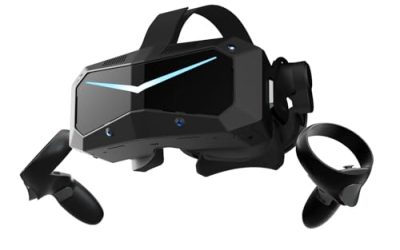
1. Pimax Crystal Super VR Headset, Ultrawide, Full Payment Version

The Pimax Crystal Super in its Ultrawide configuration has the widest view in this guide, at 140 degrees horizontal. It uses QLED panels with mini-LED local dimming at 3840 x 3840 pixels per eye, with a refresh rate of 72 or 90 Hz and built-in Tobii eye tracking for dynamic foveated rendering. The optical engine is swappable, so the same headset can use a 50 PPD engine at 127 degrees, a 57 PPD engine at 106 degrees, or the Ultrawide engine at 140 degrees, depending on whether clarity or width matters more for a given game.
The Crystal Super is a PC VR headset that connects over DisplayPort 1.4 and USB, with inside-out SLAM tracking from four cameras and optional Lighthouse tracking through a separate faceplate. It works with SteamVR and OpenXR software, and Pimax lists a strong PC as a requirement, starting at a high-end graphics card and 32 GB of system memory for the best experience. The headset includes controllers, a DisplayPort cable, and DMAS earphones in the listed configuration.
This headset suits a flight or racing simulation gamer who wants the widest possible view and the highest resolution here, and who has a powerful PC to drive it. Confirm the exact optical engine in the listing, because the field of view depends on which engine is fitted.
2. Valve Index VR Full Kit

The Valve Index VR Full Kit gives a 130-degree field of view with a display that stays clear across most of the image. It uses dual LCD panels at 1440 x 1600 pixels per eye, with a native refresh rate of 120 Hz, rising to 144 Hz in supported software.
The kit includes the headset, two Knuckles controllers, and two Base Station 2.0 units, so tracking is handled by external base stations rather than headset cameras. The Knuckles controllers track each finger and sense grip pressure, which makes hand interaction feel natural in games that support it. Off-ear speakers give a wide sound stage, and the headset connects to the PC over DisplayPort and USB.
This kit suits a PC gamer who wants a wide view, a very high refresh rate, and precise base-station tracking in a complete kit. It is a strong match for action games and room-scale titles. Confirm the listing says Full Kit before ordering.
3. HTC Vive Focus Vision — Mixed Reality and PC VR Headset + Controllers — Consumer Edition

The HTC Vive Focus Vision gives a field of view up to 120 degrees horizontal, with a display that is sharper per eye than the Index. It uses dual LCD panels at 2448 x 2448 pixels per eye, with a 90 Hz refresh rate, rising to 120 Hz in DisplayPort mode. A Snapdragon XR2 Gen 1 processor works with 12 GB of memory and 128 GB of storage, expandable with a microSD card up to 2 TB, so the headset can run games on its own as well as stream PC VR titles.
Eye tracking is built in, with automatic IPD adjustment from 57 to 72 mm, so the lenses align to each wearer and the clear area of the lenses is used well. Two full-color passthrough cameras and a depth sensor support mixed reality, while four tracking cameras and an infrared floodlight support hand tracking in low light. The headset connects to a PC wirelessly, over USB-C, or over DisplayPort through the optional VIVE Wired Streaming Kit, which gives a direct video link for PC VR.
This headset suits a gamer who wants a wide view, a very sharp display, and the freedom to play standalone or tethered, with a battery that can be swapped mid-session.
| Headset | Field of view | Resolution per eye | Refresh rate | Tracking | PC connection |
|---|---|---|---|---|---|
| Pimax Crystal Super, Ultrawide | 140° horizontal | 3840 x 3840 | 72 or 90 Hz | Inside-out, Lighthouse optional | DisplayPort 1.4 |
| Valve Index Full Kit | 130° | 1440 x 1600 | 120 Hz, up to 144 Hz | Base Station 2.0 | DisplayPort |
| HTC Vive Focus Vision | Up to 120° | 2448 x 2448 | 90 Hz, 120 Hz via DisplayPort | Inside-out | DisplayPort, USB-C, wireless |
FAQ
How much field of view do I need for immersive gaming?
A field of view around 100 degrees is a solid baseline, while 110 to 120 degrees feels noticeably more open, and 130 to 140 degrees gives a strong sense of peripheral vision.
Does a wider field of view need a stronger PC?
Yes, in most cases. A wider view spreads pixels across a larger area, so a higher resolution is needed to keep the image sharp, and that higher resolution needs more graphics power. A headset at 3840 x 3840 pixels per eye needs a much stronger graphics card than a headset at 1440 x 1600 pixels per eye, especially at 120 Hz. Check the manufacturer PC guidance for the exact headset.
Is a wide field of view better for motion discomfort?
It can help and it can hurt, depending on the game. A wide view feels more natural and can reduce the sense of looking through a tunnel, but fast movement across a wide view can also increase motion discomfort for some players.
Conclusion
A wide field of view makes virtual worlds feel larger, but it works best when the display, lenses, and PC behind it can keep up. The Pimax Crystal Super Ultrawide gives the widest view and the highest resolution here, the Valve Index gives a wide view with a very high refresh rate and precise tracking, and the Focus Vision gives a wide view with a sharp standalone display and flexible PC connections.
Disclosure: As an Amazon Associate, we earn from qualifying purchases.