The best business-class standalone VR headsets for immersive gaming sit in a different class from entry-level headsets. They are built for long sessions and shared use, with higher-resolution displays, eye tracking, full-color passthrough, and processors that can run games on the headset itself. They also connect to a gaming PC when a title needs more power, so one headset can handle standalone play and PC VR streaming.
The same features that suit training and collaboration help in gaming: eye tracking enables foveated rendering and automatic lens adjustment, passthrough lets a player see the room without removing the headset, and a balanced strap makes a two-hour session feel less tiring. The three headsets below are all standalone devices, and all three can also stream PC VR games.
What to Look For
Start with the display. Resolution per eye, lens type, and refresh rate decide how sharp text looks and how smooth motion feels. Pancake lenses are thinner and clearer across more of the view than older Fresnel lenses, while 90 Hz is a solid baseline for comfortable play. A wider field of view helps immersion, but only when the lenses stay sharp toward the edges.
Eye tracking is a defining business-class feature. It can guide lens adjustment, support foveated rendering in supported software, and make avatar eye movement feel natural in social games. Face tracking adds expression to avatars. Check whether eye tracking is built in or an add-on, and whether the games you play actually use it.
Standalone performance depends on the processor, memory, and storage. A Snapdragon XR2 or XR2+ Gen 1 chip with 12 GB of memory handles standalone games well, while 128 GB or 256 GB of storage decides how many games can stay installed. A swappable battery or a wired PC connection can extend a session well beyond a single charge. For PC VR, DisplayPort gives a direct video link with no compression, while Wi-Fi streaming gives freedom of movement at the cost of encoding.
Best Business-Class Standalone VR Headsets for Immersive Gaming
1. Meta Quest Pro
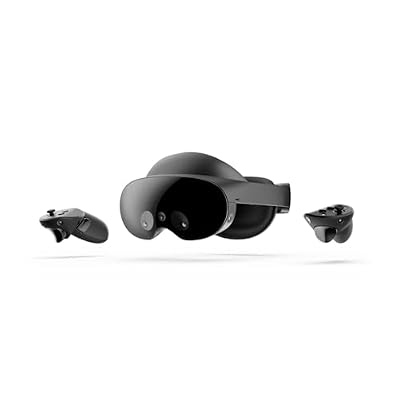
The Meta Quest Pro was built as a professional headset, and its sensor set still stands out for immersive gaming. It uses dual LCD panels with a quantum dot layer and mini-LED backlighting, at 1800 x 1920 pixels per eye, with pancake lenses and a 90 Hz refresh rate. The field of view is 106 degrees, and the lenses adjust continuously for interpupillary distance from 55 to 75 mm, with eye tracking to guide the setting.
Inside, a Snapdragon XR2+ Gen 1 processor works with 12 GB of memory and 256 GB of storage. Eye tracking and face tracking are built in, and the Touch Pro controllers track themselves with built-in cameras, so they keep working even when they move out of the headset cameras view. Full-color passthrough supports mixed reality games, and the Quest Pro connects to a PC for PC VR play over a cable or wirelessly.
This headset suits a gamer who wants eye and face tracking, self-tracking controllers, and a slim pancake-lens design, and who values mixed reality as much as fully virtual games. Check the exact listing and the included controllers before ordering.
2. HTC Vive Focus Vision — Mixed Reality and PC VR Headset + Controllers — Consumer Edition

The HTC Vive Focus Vision is a hybrid headset that works as a standalone device and as a PC VR headset, and it has the sharpest display in this group. It uses dual LCD panels at 2448 x 2448 pixels per eye, with a field of view up to 120 degrees and a 90 Hz refresh rate, rising to 120 Hz in DisplayPort mode. A Snapdragon XR2 Gen 1 processor works with 12 GB of memory and 128 GB of storage, expandable with a microSD card up to 2 TB.
Eye tracking is built in, with automatic IPD adjustment from 57 to 72 mm, so the lenses align to each wearer without manual dials. Two full-color passthrough cameras and a depth sensor support mixed reality, while four tracking cameras and an infrared floodlight support hand tracking in low light. The rear battery is swappable, with up to two hours of general use, and a DisplayPort connection through the optional VIVE Wired Streaming Kit gives a direct PC link for visually lossless PC VR.
This headset suits a gamer who wants the clearest standalone image here, a wide view, and a direct DisplayPort route to a PC, plus a battery that can be swapped mid-session.
3. HTC Vive XR Elite Virtual Reality Headset + Controllers
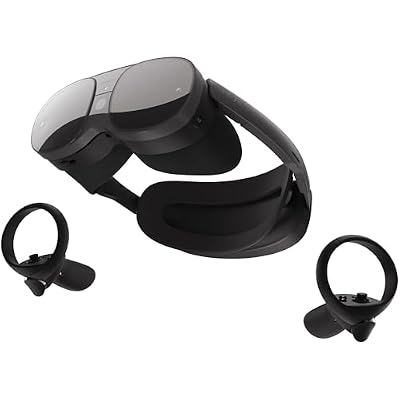
The HTC Vive XR Elite is a compact standalone headset built around portability and comfort. It uses dual LCD panels at 1920 x 1920 pixels per eye, with a 110-degree field of view and a 90 Hz refresh rate. A Snapdragon XR2 Gen 1 processor works with 12 GB of memory and 128 GB of storage, and the headset supports standalone play and PC VR streaming over Wi-Fi or a cable.
Its most distinctive feature is the convertible design. The rear battery pack can be removed, turning the headset into a lighter glasses-style device for seated play, and the battery itself is hot-swappable, so a charged spare can take over without a long pause. Full-color passthrough and a depth sensor support mixed reality, and the headset tracks with four cameras and no base stations. At around 625 grams with the battery fitted, it is lighter than the other two headsets here, which helps during long sessions.
This headset suits a gamer who travels with a headset, plays in more than one room, or wants a lighter device that can switch between a full strap and a compact form.
| Headset | Resolution per eye | Refresh rate | Field of view | Processor | Storage |
|---|---|---|---|---|---|
| Meta Quest Pro | 1800 x 1920 | 90 Hz | 106° | Snapdragon XR2+ Gen 1 | 256 GB |
| HTC Vive Focus Vision | 2448 x 2448 | 90 Hz, 120 Hz via DisplayPort | Up to 120° | Snapdragon XR2 Gen 1 | 128 GB, microSD |
| HTC Vive XR Elite | 1920 x 1920 | 90 Hz | 110° | Snapdragon XR2 Gen 1 | 128 GB |
FAQ
What makes a VR headset business-class?
A business-class headset usually combines a sharper display, eye tracking, full-color passthrough, and a design built for shared use and long sessions. It also tends to include more memory and storage, a better strap and balance, and PC VR support for demanding software. Those same traits help in gaming, where clarity, comfort, and tracking all affect immersion.
Can a standalone headset play PC VR games?
Yes. Standalone headsets can stream PC VR games over Wi-Fi or a cable, and some also support a direct DisplayPort connection. Wi-Fi streaming gives freedom of movement, while a cable or DisplayPort link gives a more stable image with lower latency. A powerful graphics card is still needed for high-resolution PC VR titles.
Is eye tracking useful for gaming, or only for work?
Eye tracking is useful in both. In supported games it enables foveated rendering, which keeps the area being looked at sharp while easing the load elsewhere, and it can drive avatar eye movement in social games. It also helps with automatic lens adjustment, so the headset can align its lenses to each wearer.
Conclusion
A business-class standalone headset is a strong choice for immersive gaming when it combines a sharp display, eye tracking, and a reliable PC VR connection. The Quest Pro leads on sensors and controllers, the Focus Vision leads on display sharpness and DisplayPort PC VR, and the XR Elite leads on portability and comfort. Choose the one whose strengths match the games you play most.
Disclosure: As an Amazon Associate, we earn from qualifying purchases.