

- Top Pick: Thermal Grizzly Kryonaut – 1 Gram – Extremely High Performance Thermal Paste + 12 Cleaning Wipes 6 Wet & 6 Dry – for Demanding Applications and Overclocking CPU/GPU/PS4/PS5/Xbox
- Best Value: Thermal Grizzly Kryonaut – 1 Gram Thermal Paste Extremely High Performance
- Premium Choice: Thermal Grizzly Putty Advance – 30 Gram – Electrically Non-Conductive
🛒 Best Price Today on Amazon
Prime members get fast, free shipping on everything above, plus member-only deals. New members get a 30-day free trial — cancel anytime.
- Top Thermal Paste Photo Editing Picks for 2026
- Best Thermal Paste for Photo Editing at a Glance
- 1. ARCTIC MX-4 (4 g) – Premium Performance Thermal Paste for All Processors
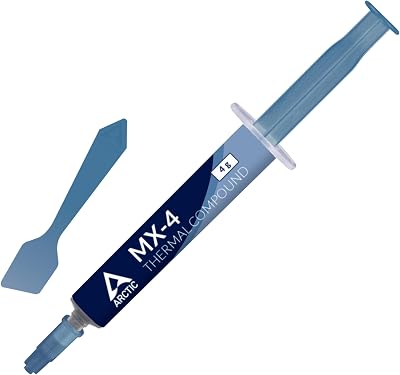
- 2. ARCTIC MX-4 (incl. Spatula, 4 g) – Premium Performance Thermal Paste
- 3. Noctua NT-H1 3.5g, Pro-Grade Thermal Compound Paste
- 4. Thermal Grizzly Kryonaut – 1 Gram – Extremely High Performance Thermal Paste
- 5. Arctic Silver 5 AS5-3.5G Thermal Paste
- 6. Corsair TM30 Performance Thermal Paste, Ultra-Low Thermal Impedance, 3g
- How to Choose Thermal Paste for Photo Editing
- Frequently Asked Questions
- Related Guides
- Related Articles
- Related Guides
Top Thermal Paste Photo Editing Picks for 2026
Here are our current top thermal paste photo editing picks, compared on real Amazon owner reviews, price, and features. Live prices update below.
As an Amazon Associate we earn from qualifying purchases at no extra cost to you.


Thermal paste rarely makes anyone’s upgrade wishlist, but for a photo-editing workstation it quietly matters. Editing in Lightroom, Photoshop and similar tools produces steady, moderate CPU and GPU load — exporting batches, applying filters, generating previews — rather than the extreme, sustained pinning of heavy 3D rendering or AI training. What that kind of everyday creative load really needs from thermal paste is reliability and consistency: a compound that fills the microscopic gaps between your chip and cooler, transfers heat dependably, and keeps doing so for years without drying out or needing fuss. This guide rounds up the best thermal paste for photo editing in 2026, focused squarely on dependable, easy-to-live-with everyday performers.
Our picks were chosen on the things that genuinely matter for an editing rig: consistent thermal transfer, ease of application, long-term stability so you are not re-pasting often, electrical safety (non-conductive is reassuring near delicate components), and value — with prices from around $5 to around $9. Because all of these are proven, trusted compounds, we focus on which suits the everyday creative use-case best and where small differences in handling or longevity might sway you. Below is an at-a-glance comparison of all six, then a closer look at each paste and a buyer’s guide to choosing and applying thermal compound for a stable, cool photo-editing workstation.
Best Thermal Paste for Photo Editing at a Glance
| Thermal Paste | Best For | Standout Spec | Approx Price |
|---|---|---|---|
| ARCTIC MX-4 (4g) | Reliable everyday default | Non-conductive, long-lasting, easy | around $9 |
| ARCTIC MX-4 (4g, incl. Spatula) | Easy first-time application | Non-conductive, spatula included | around $5 |
| Noctua NT-H1 (3.5g) | Fuss-free pro-grade compound | Non-conductive, forgiving, durable | around $9 |
| Thermal Grizzly Kryonaut (1g) | Maximum thermal headroom | High-performance, non-conductive | around $9 |
| Arctic Silver 5 (3.5g) | Proven classic compound | High-density, long-established | around $8 |
| Corsair TM30 (3g) | Budget low-impedance paste | Ultra-low thermal impedance, value | around $8 |
1. ARCTIC MX-4 (4 g) – Premium Performance Thermal Paste for All Processors

ARCTIC MX-4 (4 g) - Premium Performance Thermal Paste for All Processors




As an Amazon Associate we earn from qualifying purchases. Product prices and availability are accurate as of the date/time indicated.
The ARCTIC MX-4 is the reliable everyday default and the natural first pick for a photo-editing workstation. It is one of the most popular thermal compounds in the world for good reason: it is non-conductive (so a stray smear near pins or components will not cause a short), spreads easily, and is known for excellent long-term stability — ARCTIC rates it for many years of use without drying out. At around $9 for a generous 4g, it is dependable value.
For everyday editing this is exactly what you want. The steady, moderate thermal load of Lightroom exports and Photoshop work does not demand exotic compounds; it demands consistency and a paste you can apply once and forget. MX-4 delivers that — reliable heat transfer that keeps your CPU stable through long sessions, easy non-curing application, and longevity that means you are not re-pasting every year. If you want a no-drama, trusted thermal paste for a stable creative workstation, the MX-4 is the obvious, well-judged starting point.
Pros: Non-conductive, easy to apply, excellent long-term stability, generous 4g, trusted everywhere.
Cons: Not the absolute highest-performance paste for extreme overclocking (rarely relevant here).
2. ARCTIC MX-4 (incl. Spatula, 4 g) – Premium Performance Thermal Paste


As an Amazon Associate we earn from qualifying purchases. Product prices and availability are accurate as of the date/time indicated.
This is the same acclaimed ARCTIC MX-4 compound, but bundled with an application spatula — and, at around $5 for 4g, it is actually the best-value way to buy it on this list. The spatula is a genuinely helpful inclusion for anyone who is not confident spreading paste, making it easy to apply a thin, even layer across the CPU’s heatspreader. Everything that makes MX-4 great applies here, at a lower price.
For a photo editor doing a first build or re-paste, this is arguably the smart pick. You get MX-4’s non-conductive safety, reliable everyday heat transfer and multi-year stability, plus the spatula to help you apply it cleanly the first time. The steady creative workload is well within what this paste handles comfortably, and the lower price and included tool remove any excuse for a messy application. If you want the dependable MX-4 experience with a little extra help and the best value, this spatula-included version is an excellent choice.

Pros: All the MX-4 strengths plus an included spatula for clean application, best value here.
Cons: Spatula aside, performance is identical to standard MX-4 — not a higher-end compound.
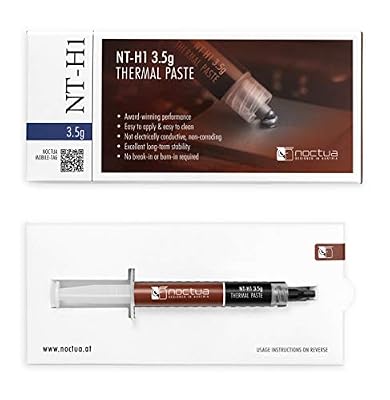
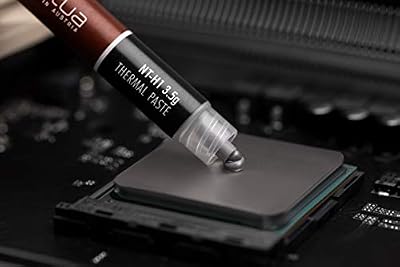
3. Noctua NT-H1 3.5g, Pro-Grade Thermal Compound Paste

Noctua NT-H1 3.5g, High-Performance Thermal Paste | High-Performance, Easy to Apply and Clean, Good Long-term Stability, for 3-20 Applications


As an Amazon Associate we earn from qualifying purchases. Product prices and availability are accurate as of the date/time indicated.
The Noctua NT-H1 is the fuss-free, pro-grade pick — a compound with a reputation among builders for being exceptionally forgiving and reliable. Made by the cooling specialists at Noctua, it is non-conductive, non-corroding, easy to apply and clean off, and very stable over a long service life. At around $9 for 3.5g it is a trusted choice that simply works without drama.
For an editing workstation, NT-H1’s strengths align perfectly with the use-case. Its forgiving nature means you do not need a perfect application to get excellent, consistent results — ideal for anyone who wants dependable temperatures without obsessing over technique. The non-conductive formula is reassuring around delicate components, and its long-term stability means your rig stays cool through years of editing without re-pasting. If you value ease of use and rock-solid reliability from a respected cooling brand for a stable creative machine, the NT-H1 is a superb, low-stress choice.
Pros: Very forgiving and easy to apply, non-conductive, long service life, trusted Noctua quality.
Cons: Mid-pack on outright peak performance; you pay a small premium for the brand.
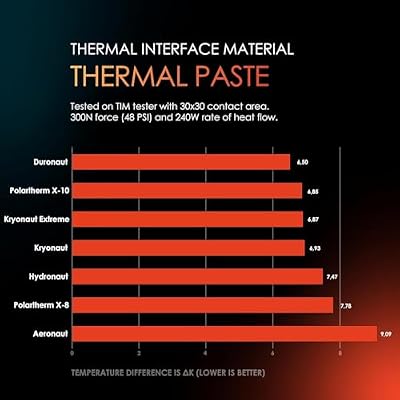
4. Thermal Grizzly Kryonaut – 1 Gram – Extremely High Performance Thermal Paste

Thermal Grizzly Kryonaut - 1 Gram Thermal Paste Extremely High Performance | Thermal Compound for Demanding Applications and Overclocking - Thermal Paste for CPU/GPU/PS4/PS5/Xbox




As an Amazon Associate we earn from qualifying purchases. Product prices and availability are accurate as of the date/time indicated.
The Thermal Grizzly Kryonaut is the maximum-headroom pick, a compound famous among overclockers and enthusiasts for its excellent thermal transfer. It is a high-performance, non-conductive paste designed to wring out low temperatures, and at around $9 for 1g it is sold in a smaller quantity aimed at people who want top-tier performance for a build or two rather than a big tub.
For photo editing specifically, it is worth an honest note: Kryonaut’s extreme-performance pedigree is more than the steady, moderate load of Lightroom and Photoshop strictly requires, so its headline advantage over a reliable everyday paste like MX-4 will be modest in this use-case. That said, it is non-conductive, well-made and dependable, so there is no downside to using it beyond the smaller quantity and price. If you happen to want the lowest temperatures you can get — perhaps because your editing rig doubles for heavier rendering — Kryonaut delivers that peace of mind, just know the extra margin is largely insurance for a pure editing machine.

Pros: Excellent thermal transfer, non-conductive, well-made, gives maximum temperature headroom.
Cons: Overkill for pure editing’s moderate load; small 1g quantity at a premium price.
5. Arctic Silver 5 AS5-3.5G Thermal Paste

Arctic Silver 5 AS5-3.5G Thermal Paste,Black, Grey | NBR Material, 12mm Inner Diameter, 2mm Thickness, Spare Gasket


As an Amazon Associate we earn from qualifying purchases. Product prices and availability are accurate as of the date/time indicated.
The Arctic Silver 5 is the proven classic — a high-density, silver-based compound that has been a staple of PC building for many years. It is well-regarded for strong thermal performance and a long, established track record, and at around $8 for 3.5g it remains a popular, dependable choice that countless builders know and trust.
For an editing workstation it is a solid, time-tested option that handles the moderate creative load comfortably. One practical detail worth knowing: as a silver-based, high-density paste, Arctic Silver 5 is not fully electrically non-conductive in the way pastes like MX-4 or NT-H1 are, so apply a thin, careful layer and avoid letting it bridge onto pins or surrounding components. Used correctly it delivers excellent, reliable temperatures and has the longevity to last for years. For a builder who trusts a classic and applies paste carefully, Arctic Silver 5 is a dependable, value-priced pick for a stable editing rig.
Pros: Proven high-density performance, long track record, reliable temperatures, good value.
Cons: Silver-based and not fully non-conductive — apply carefully and thinly to avoid bridging.
6. Corsair TM30 Performance Thermal Paste, Ultra-Low Thermal Impedance, 3g

Corsair TM30 Performance Thermal Paste | Ultra-Low Thermal Impedance CPU/GPU | 3 Grams|w/applicator, Silver for Desktop


As an Amazon Associate we earn from qualifying purchases. Product prices and availability are accurate as of the date/time indicated.
Rounding out the list is the Corsair TM30, the budget low-impedance pick. It is a performance thermal compound formulated for ultra-low thermal impedance between your CPU or GPU and its cooler, supplied in a practical 3g quantity. At around $8 it offers Corsair’s quality and dependable everyday performance at a sensible price, making it an easy, accessible choice.
For a photo-editing workstation, the TM30 covers the essentials well. Its ultra-low thermal impedance means efficient heat transfer for the steady, moderate load that editing produces, keeping your CPU stable through long Lightroom and Photoshop sessions. The 3g quantity is enough for several applications, and as part of Corsair’s well-supported ecosystem it is a safe, familiar buy. While it does not carry the cult following of an MX-4 or NT-H1, it is a perfectly capable, value-oriented compound. For a dependable everyday paste at a fair price, the Corsair TM30 rounds out the list nicely.
Pros: Ultra-low thermal impedance, efficient everyday heat transfer, several applications, fair price.
Cons: Less of a cult favourite than MX-4 or NT-H1; performance is solid rather than class-leading.
How to Choose Thermal Paste for Photo Editing
The most important thing to internalise is that photo editing is a moderate thermal load, not an extreme one. Lightroom exports, Photoshop filters and preview generation push your CPU and GPU steadily but nowhere near the relentless, all-cores pinning of heavy 3D rendering or AI training. That means you should prioritise reliability, consistency and ease of use over chasing the last degree of cooling. A trusted everyday compound like the ARCTIC MX-4 or Noctua NT-H1 is far more sensible here than an exotic, extreme-performance paste whose advantage you would barely notice in a creative workflow.
Electrical conductivity is a safety detail worth understanding. Most of the pastes here — MX-4, NT-H1, Kryonaut and the Corsair TM30 — are non-conductive, which is reassuring because a small smear that strays onto pins or surrounding components will not cause an electrical short. Silver-based or metal-based compounds, such as the classic Arctic Silver 5, can be mildly conductive and demand a more careful, thin application to avoid bridging. For peace of mind, especially if you are not a confident applier, a non-conductive paste is the safer default for an editing build.
Ease of application and longevity should weigh heavily for a workstation you want to set up once and rely on. A forgiving, easy-to-spread paste — NT-H1 is renowned for this, and the spatula-included MX-4 makes a clean application simple — gets you good results without perfect technique. Longevity matters just as much: a stable compound that resists drying out, like MX-4’s multi-year rating, means you are not pulling your cooler off to re-paste every year. For a machine that just needs to stay cool and stable through editing, those practical traits beat marginal performance differences.
Finally, apply it correctly, because technique matters more than the specific paste for a moderate load like editing. A small amount — roughly a pea-sized dot or a thin line in the centre of the CPU — is all you need; the cooler’s pressure spreads it into an even layer, and using too much can actually hurt performance and create mess. Make sure the surfaces are clean before applying. Set your budget across this list’s roughly $5 to $9 range, favour a reliable non-conductive compound for everyday creative work, and pick the paste that matches how confident you are applying it and how long you want to go between re-pastes.
Frequently Asked Questions
Does thermal paste choice really matter for photo editing?
It matters for stability and consistency more than for chasing extreme low temperatures. Photo editing is a moderate, steady load, so a reliable everyday compound like the ARCTIC MX-4 or Noctua NT-H1 keeps your CPU cool and stable through long Lightroom and Photoshop sessions without any drama. The difference between a good non-conductive paste and an extreme-performance one is small for this use-case — reliability and easy application are what really count.
What does ‘non-conductive’ thermal paste mean and why does it matter?
A non-conductive paste, like MX-4, NT-H1, Kryonaut or the Corsair TM30, will not carry electrical current, so if a little strays onto CPU pins or nearby components it will not cause a short. Silver- or metal-based compounds such as Arctic Silver 5 can be mildly conductive and need a careful, thin application. For an editing build, especially if you are not a confident applier, a non-conductive paste is the safer, more forgiving default.
How much thermal paste should I apply?
Less than you might think. A small pea-sized dot, or a thin line, in the centre of the CPU’s heatspreader is plenty — the cooler’s mounting pressure spreads it into an even layer. Using too much creates mess and can actually worsen heat transfer. Make sure both the chip and cooler base are clean first. Forgiving pastes like NT-H1, or the spatula-included MX-4, make getting this right easier for a stable editing rig.
How often do I need to replace thermal paste on an editing PC?
With a quality, stable compound and a moderate editing load, rarely — often many years. Pastes like the ARCTIC MX-4 are rated to resist drying out for a long service life, so you are not re-pasting frequently. You would typically only redo it if you remove the cooler, notice temperatures creeping up over time, or are doing other maintenance. Choosing a long-lasting paste up front is the easiest way to set and forget your workstation’s cooling.
Related Guides
- Best CPU Coolers
- Best AIO Liquid Coolers
- Best CPUs for Your Build
- Best Monitors for Content Creation
- Best Gaming and Workstation PCs
- Best PC Cases with Great Airflow
Affiliate Disclosure: As an Amazon Associate, we earn from qualifying purchases. If you click a link and make a purchase, we may earn a small commission at no extra cost to you. Prices and availability are accurate as of publication and may change.










