

Buying an indoor surge protector is really a decision about fit between protection and hardware. A plain power strip with a surge label may pass electricity for years while its protective parts quietly wear down, and a strip with a big headline figure can still fail a desk full of bulky adapter bricks. The useful question is narrower: does this strip protect at a level your gear deserves, reach a grounded outlet, and leave room for every plug you own?
This guide serves three kinds of buyers: gamers running a tower, monitors and a console from one wall socket, home-office users whose router and network lines sit beside the PC, and anyone with a single-PC desk who wants honest protection without clutter. Every pick below was chosen from the names and specifications printed on its Amazon listing, and readers building around a tower can compare this shortlist with our guide to surge protection built around gaming rigs before deciding.
Quick Picks
As an Amazon Associate we earn from qualifying purchases
| Product | Best for | Key spec from title |
|---|---|---|
| Belkin 12-Outlet Surge Protector BE112230-08 | A full gaming desk with many plugs | 12 outlets, 3,940 joules, 8 ft cord |
| Belkin PivotPlug 12-Outlet Surge Protector BP112230-08 | Desks crowded with bulky adapter bricks | 12 outlets with 8 pivoting, 4,320 joules |
| Anker 351 Power Strip A9192 | Charging phones and headsets from the strip | 12 outlets plus USB-A and USB-C, 2,100 joules |
| APC SurgeArrest P11VNT3 | Setups with phone, coax and Ethernet lines | 11 outlets, 3,020 joules, data-line protection |
| Eaton Tripp Lite TLP808B | A smaller single-PC desk | 8 outlets, 1,440 joules, 8 ft cord |
How to Choose
Joule Capacity Is Endurance, Not Armor
A joule figure describes how much surge energy a strip can absorb across its whole working life, not how strong it is on any single day. Each spike it handles consumes part of that capacity, so joule capacity is spent gradually and then suddenly gone. A strip rated in the low thousands suits a desk that sees occasional minor spikes, while higher figures buy more headroom for setups that stay plugged in for years. Whatever figure you choose, treat the protected indicator light as the real gauge: once it goes out, the capacity is spent and replacement time has arrived.
Clamping Voltage Decides What Slips Through
Clamping voltage, also printed as let-through voltage under UL 1449, is the level at which the strip steps in and diverts excess energy. Anything below that threshold passes straight to your PC, monitor and console, so a lower clamping figure generally means tighter protection for sensitive electronics. Listings state this value in tiers, and comparing two otherwise similar strips often comes down to this line rather than the joule headline. Check it on the product page before ordering, because makers sometimes print it only in the detailed specifications instead of the title.
Outlet Count Means Little Without Spacing
Twelve outlets on paper can behave like eight in practice when adapter bricks cover their neighbors. Count your plugs first, including monitors, speakers, router, console and chargers, then look at how the strip arranges them. Widely spaced or block-style outlets accept large bricks without waste, pivoting outlets turn sideways to escape a crowded row, and a few tightly packed sockets still suit slim plugs for lamps or speakers. A desk with several gaming accessories benefits more from thoughtful spacing than from the highest outlet count in the category.
Cord Length, Plug Shape and Mounting
Measure the distance from the wall socket to where the strip will live before choosing a cord length. An 8-foot cord reaches behind most desks comfortably, while a 5-foot cord only works when the outlet sits close to the setup. Flat plugs let furniture push nearer the wall without bending the cable, and a pivoting plug helps in awkward corners. Some strips can be screw-mounted under a desk edge, which keeps bricks off the floor and cables tidy. Whatever length you pick, the strip must plug directly into a grounded outlet, never into another strip.
The 5 Best Options
Belkin 12-Outlet Surge Protector BE112230-08

This Belkin is the straightforward answer for a desk where everything converges on one strip: tower, two monitors, speakers, console, router and the chargers that follow them. Twelve outlets include BlockSpace sockets spaced for larger plugs, so bricks stop stealing their neighbors. Belkin states 3,940 joules, the cord runs 8 feet with a flat plug, and phone and coax protection is built in alongside protected and grounded status lights. There are no USB ports, which sounds like a gap yet keeps every outlet free for AC gear while phones charge from their own adapters.
Specs
- Outlets: 12 AC, including BlockSpace outlets for large plugs
- Surge capacity: 3,940 joules
- Cord: 8 ft with flat plug
- Electrical: 125V, 15A, 1,875W maximum
- Listing: UL listed
- Extras: Phone and coax protection, status lights, no USB
Best for: A full gaming or work desk that needs many well-spaced outlets on one strip.
Watch out for: There are no USB ports, so confirm you are happy charging phones from separate adapters.
ASIN: B000J2EN4S
Belkin PivotPlug 12-Outlet Surge Protector BP112230-08

The PivotPlug attacks the brick problem mechanically instead of with spacing alone. Eight of its twelve outlets rotate, so a bulky power supply can turn sideways rather than swallowing the socket beside it, while four fixed outlets take ordinary slim plugs. Belkin states 4,320 joules and a maximum spike voltage of 6,000V in its product details. The 8-foot cord ends in a pivoting flat plug that behaves behind desks pushed close to a wall. Coax and RJ11 protection are included, indicator lights confirm protection and grounding, and EMI and RFI filtering is stated by the maker.
Specs
- Outlets: 12 AC, 8 pivoting plus 4 fixed
- Surge capacity: 4,320 joules
- Cord: 8 ft with pivoting flat plug
- Electrical: 125V, 15A, 1,875W maximum
- Extras: Coax and RJ11 protection, status lights, no USB
- Filtering: EMI and RFI filtering stated by maker
Best for: Desks where several large adapter bricks fight over a normal straight strip.
Watch out for: The four fixed center outlets sit close together, so check that your slimmest plugs are planned for those sockets.
ASIN: B000JE9LD4
Anker 351 Power Strip A9192

Anker built this strip for the desk where phones, a headset dock and a tablet keep demanding chargers of their own. Twelve AC outlets handle the PC and its companions, while two USB-A ports and one USB-C port charge small devices directly and hand the AC sockets back to real hardware. The USB-C port delivers up to 20W on its own, with total USB output shared when several ports run together. Anker states 2,100 joules and a TUV listing. The strip can be screw-mounted under a desk edge, keeping the whole arrangement off the floor and out of sight.
Specs
- Outlets: 12 AC
- Surge capacity: 2,100 joules
- USB: 2 USB-A ports plus 1 USB-C port, up to 20W on USB-C alone
- Cord: 5 ft
- Electrical: Up to 1,875W AC maximum stated by the maker
- Listing: TUV listed
Best for: A compact gaming corner where built-in USB charging removes separate phone adapters.
Watch out for: The 5-foot cord is the shortest here, so measure the run from your wall outlet before ordering.
ASIN: B09SG2Q23M
APC SurgeArrest P11VNT3
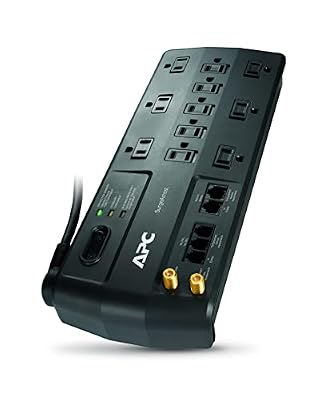
The P11VNT3 is the pick for a desk where data lines arrive alongside power. Eleven outlets include six spaced for block plugs, and the strip adds protection for phone, coax and Ethernet lines, coverage the other models here only partly match. That Ethernet path matters when a wired router sits next to the PC, because a spike can travel a network cable as readily as a power cord. APC states 3,020 joules, the cord runs 6 feet, and status lights report whether the protection circuit is still working. There are no USB ports, so charging stays with separate adapters.
Specs
- Outlets: 11 AC, 6 spaced for block plugs
- Surge capacity: 3,020 joules
- Cord: 6 ft
- Voltage: 120V
- Data lines: Phone, coax, and Ethernet protection
- Extras: Status indicator lights, no USB ports
Best for: A networked home office where Ethernet, phone or coax lines enter the same desk as the PC.
Watch out for: Data-line protection only works if those cables are actually routed through the strip, so plan the cable path first.
ASIN: B0012YFXSW
Eaton Tripp Lite TLP808B
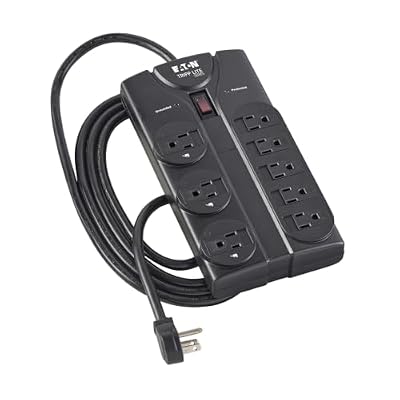
The TLP808B keeps things deliberately simple for a single-PC desk. Eight outlets cover a tower, monitor, router and a few accessories without the sprawl of a twelve-outlet strip, and the 8-foot cord with a flat plug reaches a distant wall socket while staying easy to hide behind furniture. Diagnostic lights report protection status and grounding, a genuinely useful check in older rooms where outlet wiring is uncertain. Tripp Lite states 1,440 joules, names UL 1449 on the listing, and describes full normal mode and common mode suppression with EMI and RFI filtering. There are no USB ports or data-line jacks.
Specs
- Outlets: 8 AC
- Surge capacity: 1,440 joules
- Cord: 8 ft with flat plug
- Voltage: 120V
- Listing: UL listed, UL 1449 named on the listing
- Extras: Diagnostic lights, EMI and RFI filtering, no USB
Best for: A smaller desk with one PC and a handful of accessories, especially in an older room.
Watch out for: The 1,440-joule capacity is the lowest here, so it suits a modest setup rather than a growing multi-console desk.
ASIN: B014JWEELK
Which One Fits Your Situation
A Full Gaming Desk With Everything Plugged In
Choose the Belkin BE112230-08. Twelve outlets with BlockSpace spacing absorb a tower, monitors, speakers, console and router without a second strip, the 8-foot cord reaches behind wide desks, and 3,940 joules gives the setup reasonable endurance. If Ethernet and coax lines also land on that desk, the APC P11VNT3 is the alternative worth weighing.
Adapter Bricks Keep Blocking Each Other
Choose the Belkin PivotPlug BP112230-08. Rotating eight outlets sideways ends the familiar shuffle where one wide brick hides two sockets, and the pivoting flat plug copes with desks jammed against the wall. Its stated 4,320 joules is also the highest figure in this group, which suits a strip you expect to keep for years.
Phones and Headsets Add Charger Clutter
Choose the Anker 351 Power Strip A9192. Its USB-A and USB-C ports charge the small devices that otherwise colonize AC outlets with their own bricks, and the housing can mount under a desk edge for a cleaner run. Just confirm the 5-foot cord reaches your outlet, because it is the shortest cord among these picks.
One PC, One Monitor, and a Distant Wall Socket
Choose the Eaton Tripp Lite TLP808B. Eight outlets match a modest setup without leftover sockets inviting clutter, the flat plug and 8-foot cord handle a socket hidden behind furniture, and the grounding light earns its keep in older rooms. It is the calm, minimal option when the desk will not grow much.
Common Mistakes
- Buying on the joule headline alone while ignoring clamping voltage, outlet spacing and whether the protection light still works.
- Leaving a strip in service after its protected indicator goes out, even though the outlets keep delivering unprotected power.
- Plugging one surge protector into another, or into an ungrounded adapter, which defeats the protection the strip was bought for.
- Ordering a short cord and then adding an extension lead, instead of measuring the run and choosing the right cord length first.
- Running a space heater, kettle or other high-heat appliance from the same strip as a PC and monitors.
Frequently Asked Questions
How many joules does a gaming PC desk actually need?
There is no single required figure, because the right capacity depends on how much gear shares the strip and how long you expect it to serve. Many desk buyers land in the low thousands of joules, then pay closer attention to clamping voltage, outlet spacing and a working protected light, which shape daily usefulness more than the headline number.
Can a surge protector stop a direct lightning strike?
No. A plug-in strip is built for the smaller spikes that travel along indoor wiring, and no model in this guide can absorb a direct strike. Whole-home protection at the panel addresses a different layer of risk, and unplugging valuable gear during severe storms is still the most reliable step when it is practical.
When should an indoor surge protector be replaced?
Replace it when the protected indicator light goes out, after a major surge event, or if the cord or housing shows damage. Joule capacity is consumed over time, so a strip that still passes power may already have spent its protection. Age alone is a warning sign for a strip that has served through several storm seasons.
Is it safe to run a PC and monitor from the same strip?
Yes, provided the strip plugs directly into a grounded wall outlet and the combined load stays within its stated maximum. Keep high-heat appliances on a different circuit where possible, never chain a second strip into the first, and leave enough space around adapter bricks for air to circulate.







