Quick answer: For most people in 2026, the best smart outdoor light switches for easy control is the Kasa Smart HS200 — our #1 rated choice. See the full ranked comparison, alternatives and buying advice below.
- Top 3 Picks
- Quick Comparison
- How We Chose
- 1. Kasa Smart Light Switch HS200 – Best Overall
- 2. Amazon Basics Smart Light Switch – Best Budget
- 3. SURAIELEC 15 AMP WiFi Smart Timer Switch – Best for Exposed Outdoor Boxes
- 4. Leviton Decora Smart Switch D315S-1RW – Best Premium / Best Without a Neutral
- 5. Kasa Outdoor Smart Dimmer Plug – Best for String Lights and Plug-In Fixtures
- How to Choose
- Frequently Asked Questions
- Which One to Buy
Top 3 Picks
The Kasa Smart Light Switch HS200 is the best overall starting point if your outdoor box already has a neutral wire and you just want a single-pole switch that answers to Alexa or Google without a hub. The SURAIELEC 15 AMP WiFi Smart Timer Switch is the better call for genuinely exposed outdoor enclosures because it was designed for that environment from the ground up rather than adapted from an indoor device. If you have no neutral wire run to the box, the Leviton Decora Smart Switch D315S-1RW is the premium answer, provided the circuit supports it and you are willing to pay for the flexibility.
Everything below is a comparison of published specifications, stated wiring requirements, and manufacturer documentation. No product here was installed or measured by us.
Quick Comparison
| Product | Best for | Wiring / neutral | Connectivity | Load notes | Price tier |
|---|---|---|---|---|---|
| Kasa Smart HS200 | Best overall for covered outdoor boxes with a neutral | Single-pole, neutral required | 2.4 GHz Wi-Fi, no hub | Resistive/incandescent class, single-pole only | Budget |
| Amazon Basics Smart Light Switch | Best budget if you are already in the Alexa ecosystem | Single-pole, neutral required | 2.4 GHz Wi-Fi, Alexa only | Standard residential switch load, single-pole only | Budget |
| SURAIELEC 15 AMP WiFi Smart Timer Switch | Best for exposed outdoor electrical boxes | Fits outdoor box form factor, timer-first design | 2.4 GHz Wi-Fi app control | 15 A rated, timer/schedule oriented rather than dimming | Mid-range |
| Leviton Decora Smart Switch D315S-1RW | Best premium / best when there is no neutral | Decora form factor, no-neutral-capable design class | 2.4 GHz Wi-Fi, no hub | Residential lighting loads, single-pole | Premium |
| Kasa Outdoor Smart Dimmer Plug | Best for string lights and plug-in outdoor fixtures | No wiring at all — plugs in | 2.4 GHz Wi-Fi, Alexa/Google | IP64 rated, dimming plug load | Mid-range |
How We Chose
Selection here was driven by four filters, in this order: whether the device is plausibly safe and legal in an outdoor or semi-outdoor location, what it demands from the existing wiring, what it demands from your network and smart-home ecosystem, and whether it can grow with you.
Weather resistance came first because it is the single most common reason an outdoor smart switch fails early. Devices sold as indoor switches installed inside a covered, gasketed outdoor box behave differently from devices rated for exposed mounting, and the listing language usually tells you which you have. Wiring requirements came second: neutral-wire presence, single-pole versus multi-way, and box depth are the three things that decide whether an install is a twenty-minute job or a call to an electrician. Hub compatibility came third because a hub-free Wi-Fi switch is convenient right up until your 2.4 GHz band is congested, and a hub-based switch costs more upfront but centralizes control. Load limits came last but matter most for anyone driving a large fixture, a pump, or a landscape transformer rather than a single bulb.
Where a manufacturer does not publish an exact number, we describe the device by spec class rather than guessing. Prices appear only as tiers or broad market ranges because listings move daily.
1. Kasa Smart Light Switch HS200 – Best Overall
As an Amazon Associate we earn from qualifying purchases at no extra cost to you.

The HS200 is the default recommendation for a covered outdoor box — a porch, a soffit, a gasketed weatherproof enclosure under an eave — where a neutral wire is already present and you want a straightforward single-pole switch with no hub. It is the switch most people should buy first, and the one they should stop considering the moment their box has no neutral or their fixture is plugged in rather than hardwired.
Who it suits
You are switching a hardwired outdoor light — a porch sconce, a pair of garage-wall lanterns, a soffit fixture — from inside the house or from the box itself. You have confirmed a neutral bundle in the box. You use Alexa, Google Assistant, or the Kasa app and do not want to run a hub. You are not trying to dim and not trying to control a multi-way circuit.
Key specs
- Single-pole switching only; neutral wire required.
- 2.4 GHz Wi-Fi radio with no hub or bridge.
- Works with Alexa and Google Assistant; Kasa app for scheduling, timers, and away routines.
- Standard residential wall-box form factor; fits a Decora-style opening.
- Firmware-updatable over Wi-Fi.
Strengths
The HS200’s real advantage is that it removes every unnecessary variable. There is no hub to power, no bridge to place near a window, and no proprietary protocol to learn. The Kasa app is one of the more predictable smart-home apps for scheduling because schedules live on the device and the device remembers them across brief outages — a detail that matters far more outdoors than indoors, where a breaker trip during a storm can leave an indoor schedule harmless but an outdoor schedule security-relevant.
Away and randomization routines are the other quiet win. A porch light that fades on and off at slightly shifting times is doing more security work than one on a fixed 7:00 p.m. timer, and the HS200 supports that pattern natively without a hub or a cloud rule.
Because it is Wi-Fi and hub-free, it also plays nicely with voice control from a phone that is already on the network, and it survives the common case where someone later adds a smart speaker but never adds a hub.
Pros
- No hub, no bridge, no extra hardware.
- Schedules and timers persist on-device rather than depending on a cloud round trip.
- Very wide ecosystem support for a budget-tier switch.
- Fits standard Decora openings, so replacing an existing switch is mechanically easy.
- Well-documented setup process with neutral-wire guidance in the manual.
Cons
- Neutral wire required — this is the dealbreaker in older outdoor boxes.
- Single-pole only, so it cannot replace either end of a three-way circuit.
- Not sold as an exposed-weather device; it needs a covered or gasketed enclosure.
- No dimming.
- 2.4 GHz only, which can be congested in dense neighborhoods.
How it compares
Against the Amazon Basics Smart Light Switch, the HS200 is the better pick unless you are fully committed to Alexa and nothing else. The Basics switch is functionally a stripped version of the same idea: same neutral requirement, same 2.4 GHz Wi-Fi, same single-pole limitation, but its voice control is Alexa-only. If you ever add a Google speaker or want a non-Alexa app as your primary interface, the HS200 is the safer purchase for a similar budget-tier spend.
Against the SURAIELEC 15 AMP WiFi Smart Timer Switch, the HS200 is the wrong shape and the wrong assumption. The SURAIELEC is built around an outdoor electrical box and a timer-first workflow; the HS200 assumes an indoor-style wall box pressed into outdoor service. If your enclosure is exposed to rain or direct sun, the SURAIELEC is the more defensible choice even though it costs more.
2. Amazon Basics Smart Light Switch – Best Budget
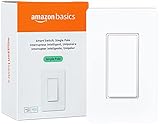
This is the cheapest credible path to a voice-controlled outdoor light, and it is honest about what it is: a single-pole, neutral-required, 2.4 GHz Wi-Fi switch that speaks Alexa and nothing else. For a household that has already standardized on Alexa, it does the job with no meaningful compromise. For anyone else, it is a lock-in you will notice later.
Who it suits
You have an Echo device within voice range of the location you care about, you have a neutral wire, you are switching a single fixture, and you want the lowest total cost of entry. You do not plan to add Google Assistant or Apple Home. You are comfortable doing app-based scheduling inside the Alexa app rather than a dedicated lighting app.
Key specs
- Single-pole; neutral wire required.
- 2.4 GHz Wi-Fi, no hub.
- Voice control via Alexa; scheduling and routines through the Alexa app.
- Standard wall-box form factor.
- No dimming, no multi-way support.
Strengths
The value proposition is concentration, not features. Everything lives in one app you already open, and routines can be built alongside your other Alexa devices — a porch light that comes on when a doorbell camera detects motion, for example, is a two-minute routine inside Alexa rather than an integration project. That cross-device choreography is where a single-ecosystem budget switch actually outperforms a more open budget switch.
Physically it installs like a standard switch. The wiring pattern is the same three-conductor arrangement you would find on any neutral-required smart switch, so if you have watched one install video you have watched this one. For someone replacing an existing outdoor switch for the first time, that familiarity is worth real money in avoided mistakes.
It also pairs quickly. There is no account-linking dance between two platforms, no hub discovery step, and no separate manufacturer cloud account beyond the Alexa sign-in you already have.
Pros
- Lowest-cost entry to voice-controlled outdoor switching.
- Routines integrate directly with cameras, doorbells, and other Alexa devices.
- Simple, familiar three-wire install.
- No hub, no bridge, no extra power brick.
- Fast pairing with an existing Alexa account.
Cons
- Alexa only — no Google Assistant, no Apple Home.
- Neutral required.
- Single-pole only.
- No dimming capability.
- App experience is Alexa’s, which is good at routines and less good as a dedicated lighting control panel.
How it compares
Against the Kasa Smart HS200, this is a straight ecosystem trade. Same wiring requirement, same radio band, same single-pole limitation — the only meaningful difference is which assistant answers. If your house is all Alexa, this is the cheaper correct answer. If there is any chance a Google speaker or a non-Alexa app ends up mattering, take the HS200 instead and pay the small premium.
Against the Leviton D315S-1RW, the gap is not small. The Leviton belongs to a different design class entirely — no-neutral-capable, premium-tier, backed by a brand with a long history in residential wiring devices. The Basics switch is what you buy when the wiring is already in your favor and the budget is not.
3. SURAIELEC 15 AMP WiFi Smart Timer Switch – Best for Exposed Outdoor Boxes

This is the only product in this roundup that starts from the assumption that the switch itself lives outside. It is designed around outdoor electrical boxes and a timer-first control model, with a 15 A rating that comfortably covers typical residential outdoor lighting circuits. If your enclosure is exposed to weather rather than tucked under an eave, this is the pick that matches the environment.
Who it suits
You are mounting into a genuine outdoor electrical box — a pool equipment enclosure, a post-mounted yard box, a wall box on an exposed exterior wall — rather than an indoor box pressed into service. You want reliable scheduled on/off behavior more than voice control. You may be switching something heavier than a single decorative fixture: a landscape transformer, a set of floodlights, or a pump-adjacent load within the rating.
Key specs
- 15 A switching rating — the highest in this roundup’s hardwired group.
- Designed for outdoor electrical boxes rather than indoor wall boxes.
- 2.4 GHz Wi-Fi with app-based control and scheduling.
- Timer-first control model: schedules and countdown behavior are the primary interface, not voice.
- No neutral-wire dependency in the same form as a standard indoor smart switch, because the form factor and circuit assumptions differ.
Strengths
The 15 A rating is the headline for anyone with a real load. A pair of 150 W floodlights is trivial. A landscape lighting transformer feeding a long run of path lights can pull a genuine, sustained current, and a switch rated at the top of the residential range gives you margin where a decorative-grade switch gives you a warm box and a shortened life. Margin is not a luxury on an outdoor circuit that may also run a fountain pump or a heater on a shared leg.
The timer-first design is also better suited to outdoor work than a voice-first design. Nobody wants to talk to a pool enclosure. What they want is a schedule that turns the lights on at dusk, off at a set hour, and repeats without intervention — and a device whose primary interface is a schedule screen gets that right more often than a device whose primary interface is a microphone.
Because it is built for outdoor boxes, the install assumptions are honest: box depth, gasketing, and mounting geometry are the ones an electrician would expect to find outside. That reduces the chances of a forced fit that compromises the gasket and lets water in.
Pros
- 15 A rating with real headroom for heavier outdoor loads.
- Purpose-built for outdoor electrical boxes rather than adapted from an indoor device.
- Timer and schedule behavior is the core feature, not an afterthought.
- Wi-Fi control with no hub requirement.
- Practical for landscape transformers and multi-fixture runs.
Cons
- Higher cost than the budget Wi-Fi switches.
- Timer-first interface is less natural if you mainly want voice control.
- Form factor is not a drop-in for a standard interior Decora opening.
- No dimming.
- Overkill if you are switching one 60 W porch light from a covered box.
How it compares
Against the Kasa Smart HS200, the difference is environmental and electrical rather than smart-home related. Both are hub-free 2.4 GHz Wi-Fi devices. But the HS200 expects a covered indoor-style box and a light single-pole load, while this expects an outdoor box and tolerates a heavier one. Choose based on the box you actually have, not the app you prefer.
Against the Leviton D315S-1RW, the split is price versus wiring flexibility. The Leviton is the premium, no-neutral-capable indoor-style option with a broad brand footprint. The SURAIELEC is the outdoor-box-specific option with the higher current rating. If the box is genuinely outdoors and the load is more than a single lamp, this is the safer answer; if the box is indoors-adjacent and the problem is a missing neutral, the Leviton is.
4. Leviton Decora Smart Switch D315S-1RW – Best Premium / Best Without a Neutral

Leviton is one of the oldest names in North American residential wiring devices, and the D315S-1RW sits at the premium end of the Decora Smart line. Its most important characteristic for outdoor work is the design class it belongs to: a no-neutral-capable switch. In older exterior boxes where the neutral bundle simply is not there, that single fact converts an impossible install into a possible one.
Who it suits
You have opened the box and found no neutral wire — a common situation in houses wired before the practice became standard for switch legs. You want a name-brand device from a company that also makes the breakers, receptacles, and plates in the rest of the house. You are willing to pay premium-tier pricing for the flexibility and for the fit and finish of a Decora device that matches existing plates exactly.
Key specs
- Decora form factor — matches standard Decora wall plates and multi-gang openings.
- No-neutral-capable design class, which is the defining feature versus the budget switches here.
- 2.4 GHz Wi-Fi with no hub required.
- Single-pole residential lighting loads.
- Premium-tier build and finish relative to the budget and mid-range entries.
Strengths
The no-neutral capability is the whole story. In a box without a neutral, the alternative is running new cable from the fixture or the panel, which is electrician work and often drywall work. A no-neutral-capable switch sidesteps both. It achieves this by drawing its operating current through the connected load, which is why these devices are commonly used with a minimum connected load and why some of them require a bypass component with very low-wattage fixtures such as a single LED lamp.
Premium pricing also buys physical quality. The Decora rocker feel, the plate fit, and the terminal design are what you would expect from a company whose non-smart switches are already the standard in a large share of North American homes. For a visible outdoor location, matching the rest of the house matters more than it sounds.
Brand continuity has a practical side too. If the rest of the home uses Leviton devices, one app or one account covers a growing number of switches, and the automation story can extend from the porch light to the hallway without introducing a second ecosystem.
Pros
- No-neutral-capable, which is decisive in older wiring.
- Premium fit and finish that matches standard Decora plates.
- Hub-free 2.4 GHz Wi-Fi.
- Strong brand support and documentation for a wiring category where clarity matters.
- Scales cleanly if you later add more Leviton smart devices.
Cons
- Premium price tier — the most expensive hardwired option here.
- No-neutral operation can require a minimum load or a bypass with very low-wattage fixtures.
- No dimming in this single-pole switch model.
- Still not marketed as an exposed-weather device; use a covered enclosure.
- Single-pole only.
How it compares
Against the Kasa Smart HS200 and the Amazon Basics Smart Light Switch, the Leviton wins on exactly one axis and loses on price: it can work where they cannot. If a neutral is present, the budget switches deliver most of the same everyday experience for far less, and there is no reason to pay premium-tier pricing for a porch light. If a neutral is absent, the Leviton is not a luxury — it is the only one of the three that solves the actual problem.
Against the SURAIELEC 15 AMP WiFi Smart Timer Switch, the Leviton trades current rating for wiring flexibility. The SURAIELEC is the outdoor-box, heavy-load device. The Leviton is the indoor-style, no-neutral device. Pick the one whose constraint matches yours.
5. Kasa Outdoor Smart Dimmer Plug – Best for String Lights and Plug-In Fixtures

The only wireless, no-wiring entry in this list, and for a large share of outdoor lighting situations it is the honest answer. If your outdoor light plugs in — string lights over a patio, a plug-in security floodlight, a seasonal display — you do not need a switch at all. You need a dimmer you can plug into.
Who it suits
You rent, or you do not want to touch a breaker. Your outdoor lighting is plug-in rather than hardwired. You want dimming, which none of the hardwired switches here offer. You have an outdoor receptacle that is already protected from direct water exposure, or a covered location where an IP64-rated plug is appropriate.
Key specs
- IP64 rating — protected against dust ingress and splashing water. Not submersible, and not intended for standing water or direct hose spray.
- Plug-in dimmer, so no wiring, no neutral requirement, and no breaker work.
- 2.4 GHz Wi-Fi; compatible with Alexa and Google Assistant.
- Designed for outdoor string lights and similar plug-in dimmable loads.
- App-based scheduling, scenes, and dimming levels.
Strengths
The IP64 rating is the correct rating for the job, and it is worth understanding why. IP64 means dust-protected and splash-resistant. That covers rain blown onto a patio outlet, condensation on a summer night, and the general dampness of an outdoor receptacle — the conditions that actually kill a cheap indoor plug. It does not mean you can leave it in a puddle or spray it with a hose, and knowing that boundary is the difference between a device that lasts several seasons and one that fails in the first storm.
Dimming is the feature that no other product in this roundup provides. String lights at full brightness are harsh; at 40 percent they are the reason people install them. Because this is a plug, dimming is built into the device itself rather than requiring a dimmer-rated switch and dimmable bulbs, which is a compatibility headache the hardwired route forces you to solve.
The zero-wiring install is genuinely zero. No breaker, no neutral check, no box depth measurement, no electrician. For renters and for anyone whose outdoor receptacle is on a shared or inconveniently labeled circuit, that is not a convenience — it is the only practical option.
It also moves with you. If you move house or rearrange the patio, the dimmer plug goes in a box and comes out at the new place.
Pros
- No wiring, no neutral requirement, no breaker work.
- IP64 rated for outdoor use.
- Dimming, which the hardwired switches here do not offer.
- Works with both Alexa and Google Assistant.
- Portable — take it with you if you move.
Cons
- Only controls plug-in devices; useless for hardwired fixtures.
- IP64 is splash-resistant, not submersible or hose-proof.
- Occupies an outdoor receptacle.
- Load capacity is limited to what a plug-in dimmer is rated for — not a substitute for a 15 A hardwired switch on a heavy circuit.
- 2.4 GHz Wi-Fi only.
How it compares
Against the SURAIELEC 15 AMP WiFi Smart Timer Switch, this is a fundamentally different product solving a neighboring problem. The SURAIELEC handles a hardwired, potentially heavy outdoor load. The Kasa plug handles a light, plug-in, dimmable one without any electrical work. If your lights came with a plug on the end, no hardwired switch in this list is relevant to you. If they are hardwired and pull real current, the plug is not an option.
Against the Kasa Smart HS200, both are hub-free Kasa Wi-Fi devices on the same app, so the automation experience is nearly identical. The split is purely physical: hardwired fixture and a neutral wire, or plug-in fixture and an outdoor receptacle. Choose by what is on the end of the cable.
How to Choose
Outdoor smart switching has one dominant variable that indoor smart switching does not: the enclosure. Everything else — app, voice assistant, price — is secondary to whether the device you buy can legally and safely live where the box is, and whether the box contains the wires the device needs.
Start with the enclosure, not the app
Stand at the box and answer three questions. Is it under an eave, inside a gasketed weatherproof cover, or fully exposed to rain and sun? Is it an indoor-style wall box or a purpose-made outdoor electrical box? How deep is it behind the device, in inches?
An indoor-style smart switch behind a proper weatherproof cover in a sheltered location is a normal, widely used arrangement. The same switch in an exposed box with a loose cover is a slow failure — corrosion on the terminals, a fogged display, and eventually a nuisance trip. If the box is exposed and purpose-built, a device designed for that environment is worth the premium-tier or mid-range spend. Box depth matters because smart switches are physically deeper than mechanical switches; a shallow box can leave you unable to fold the wires back without stressing a connection, which is a genuine fire risk and not just an inconvenience.
Neutral wire: the single most common blocker
A neutral wire is the return path that lets a smart switch power its radio while the light is off. Mechanical switches do not need it because they do not need power when open. Smart switches generally do, and older switch legs frequently lack it.
Here is how to check safely. Turn the breaker off, remove the switch plate and the switch, and look at the conductors in the box. You are looking for a bundle of white or gray wires joined together with a wire nut, separate from the switch’s own terminals. If you see that bundle, you almost certainly have a neutral. If you see only two conductors plus a bare ground, you do not.
If there is no neutral, you have three options, in ascending order of cost:
- Buy a no-neutral-capable switch, which powers itself through the connected load. This is the least invasive option and the reason the Leviton entry above exists.
- Run a new cable from the fixture or the panel to bring a neutral to the box. This is electrician work and often involves opening the wall.
- Convert to a plug-in solution if the fixture can be plugged rather than hardwired, which sidesteps the box entirely.
One caveat on no-neutral switches: because they draw operating current through the load, they can misbehave with very low-wattage fixtures, such as a single modern LED lamp. Many such devices specify a minimum connected load and may include or require a bypass component to be wired across the fixture. If your outdoor light is one small LED bulb, read the manufacturer’s minimum-load note before buying.
Load: calculate before you assume
Do not guess at the load. Read the fixture labels and add them up. Amps equal watts divided by volts, so on a 120 V circuit, 1 A is 120 W.
Worked example: a landscape lighting transformer labeled 300 W, plus two 150 W floodlights, on the same switched leg.
- Transformer: 300 W ÷ 120 V = 2.5 A
- Floodlights: 300 W ÷ 120 V = 2.5 A
- Total: 5.0 A steady-state
Five amps sits comfortably under a 15 A device — roughly one-third of rating. That is the margin you want, because inrush current on startup is higher than steady-state draw, and because a device run near its rating outdoors runs hotter and ages faster. As a rule of thumb, keep continuous load at or below about 80 percent of the device rating: 12 A on a 15 A switch, which is 1,440 W at 120 V.
Now the same math with a heavier load: a 1,500 W heater or a large pump on the same circuit would be 12.5 A. That still nominally fits a 15 A switch but leaves almost no margin, and a motor load introduces additional inrush. In that case, step up to a device rated above the load or, better, keep the smart switch on the lighting leg and leave heavy motor loads on a dedicated circuit with its own control. A smart switch is not the right place to save money on a high-current circuit.
Connectivity: Wi-Fi versus hub, and why 2.4 GHz matters outdoors
Every product in this roundup is 2.4 GHz Wi-Fi with no hub. That is the simplest architecture, and outdoors it has an underappreciated advantage: 2.4 GHz penetrates exterior walls, stucco, brick, and foil-backed sheathing far better than 5 GHz. A porch light outside the house is often a longer effective hop than a bedroom inside it, and 2.4 GHz is the band that makes that hop work.
The tradeoff is congestion. In a dense neighborhood, dozens of networks share the 2.4 GHz band, and every one of them competes with your switch. Practical mitigations:
- Place the router or a mesh node within one exterior wall of the switch, not at the opposite end of the house.
- If your router offers a separate 2.4 GHz SSID, connect the switch to that SSID explicitly. Some devices fail to join a combined SSID whose 5 GHz side answers first.
- Keep the switch’s firmware updated. Vendor fixes for reconnect behavior are common.
- Do not rely on a single cloud round trip for schedules that matter for security. Prefer devices that store schedules on-device, which the Kasa devices in this list do.
A hub-based system would sidestep some of this by using a lower-bandwidth mesh protocol, but it adds a bridge, a power brick, and a second ecosystem to maintain. For one or two outdoor switches, hub-free Wi-Fi is the right call. Above roughly eight to ten devices, hub-based meshes start to pay off in reliability.
IP ratings, decoded for outdoor boxes
IP ratings are two digits: solids first, liquids second. The first digit runs 0–6, the second 0–8. The relevant levels for outdoor lighting:
| Rating | Meaning | Where it is appropriate |
|---|---|---|
| IP44 | Splash-resistant from any direction, limited dust protection | Sheltered patio outlet under a deep overhang |
| IP54 | Dust-protected, splash-resistant | Covered outdoor receptacle, seasonal use |
| IP64 | Dust-tight, splash-resistant from any direction | Exposed outdoor plug-in device, patio string lights |
| IP65 | Dust-tight, protected against water jets | Exposed mounting where rain is driven sideways; hose-washable area |
| IP67 | Dust-tight, protected against temporary immersion | Ground-level or flood-prone mounting, low-lying landscape boxes |
The mistake to avoid is treating IP64 as waterproof. It is splash-resistant. A device rated IP64 sitting in a low spot that fills with two inches of water during a storm will fail, and the failure will not be covered by warranty. If your mounting point can pool water, you need IP67, or you need to move the device.
Dimmer versus switch, and the dimmer-compatibility trap
If you want to dim hardwired outdoor lights, you need both a dimmer-rated smart switch and dimmable bulbs. That combination is more fragile than it sounds. LED drivers vary in how they respond to phase-cut dimming, and the failure modes are ugly: flicker at low levels, a buzzing fixture, dead travel at the bottom of the slider, or a light that will not fully turn off. Worse, a smart dimmer that requires a neutral and a fixture that cannot take one is a dead end.
By contrast, a plug-in dimmer sidesteps all of it. The dimmer is the device, the load is whatever you plug in, and if the string lights behave badly you swap the lights rather than rewiring the box. That is why the Kasa Outdoor Smart Dimmer Plug occupies an outsized share of this roundup’s recommendation for decorative lighting: it moves the compatibility problem from the wall to the cable, where it is trivially solvable.
Also note that dimming and no-neutral do not mix. No-neutral smart switches draw their operating current through the load, and a dimmed load complicates that. If you need both dimming and no-neutral capability, the practical answer is usually a plug-in dimmer, not a wall device.
Multi-way circuits
Outdoor lighting is frequently switched from two locations — for example, a porch light with a switch by the front door and another in the garage. None of the hardwired switches in this roundup is a multi-way replacement in its standard form. Some manufacturers offer companion or remote devices for the far end of a three-way circuit, which is the correct way to handle it, but you must buy the companion explicitly. Installing a standard single-pole smart switch on a three-way circuit is a common and costly mistake: the switch will either not power up or will behave erratically depending on the traveler position.
If you want to avoid the multi-way problem entirely, put the smart device on the load side and treat the other location as a dumb switch, or use a plug-in device. For a garage-to-porch arrangement, moving to a plug-in dimmer on a plug-in fixture is often the cheapest fix.
Decision matrix
| Your situation | Best fit | Why |
|---|---|---|
| Covered outdoor box, neutral present, single fixture, Alexa or Google | Kasa Smart HS200 | Hub-free, budget tier, on-device schedules, broad ecosystem |
| Covered outdoor box, neutral present, Alexa-only household | Amazon Basics Smart Light Switch | Cheapest correct answer if you never need Google or Apple |
| Exposed outdoor electrical box, heavier load up to 15 A | SURAIELEC 15 AMP WiFi Smart Timer Switch | Purpose-built for outdoor boxes, highest current rating here |
| No neutral wire in the box | Leviton Decora Smart D315S-1RW | No-neutral-capable design class; premium tier |
| Plug-in string lights, wants dimming, no wiring allowed | Kasa Outdoor Smart Dimmer Plug | IP64, plug-in, dimmable, portable |
| Renter, cannot modify wiring | Kasa Outdoor Smart Dimmer Plug | Zero electrical work |
| Landscape transformer plus floodlights, ~5 A total | SURAIELEC 15 AMP WiFi Smart Timer Switch | Comfortable margin under a 15 A rating |
| Multi-way switching from two locations | None as a drop-in | Use a manufacturer companion device or move to a plug-in solution |
Frequently Asked Questions
Can I use an indoor smart switch outside?
Yes, if it is installed inside a proper weatherproof enclosure and the location is sheltered — under an eave or behind a gasketed outdoor cover. What you should not do is mount an indoor-rated switch in an exposed box with a loose or missing cover. The failure mode is not dramatic; it is gradual corrosion on the terminals and intermittent behavior after the first wet season.
How do I know if my outdoor box has a neutral wire?
Turn the breaker off, remove the switch, and look for a bundle of white or gray conductors joined with a wire nut, separate from the switch terminals. If you see that bundle you have a neutral. If you see only the two switch conductors plus a bare ground, you do not, and you need a no-neutral-capable device or new cable.
Do I need a hub for any of these?
No. Every device covered here is a 2.4 GHz Wi-Fi device that works without a hub or bridge. That keeps the install simple and the cost lower, at the price of putting more devices on your Wi-Fi network. Above roughly eight to ten smart devices, a hub-based system usually becomes more reliable.
How do I calculate whether my outdoor load is safe for a smart switch?
Add up the wattage on the switched leg and divide by 120 V to get amps. Then keep the continuous total at or below about 80 percent of the device rating — 12 A, or 1,440 W, on a 15 A switch. A 300 W landscape transformer plus two 150 W floodlights comes to 600 W, or 5 A, which leaves ample margin on a 15 A device.
What does IP64 actually protect against?
IP64 means dust-tight and splash-resistant from any direction. It handles rain blown onto a patio outlet and general outdoor dampness. It does not mean submersible or hose-proof. If your mounting location can pool water during a storm, you need IP67 or a different mounting point.
Can I dim hardwired outdoor lights with a smart switch?
Only with a dimmer-rated smart switch and dimmable bulbs, and the combination is less reliable than it sounds — flicker, buzz, and dead travel at the bottom of the range are common with LED loads. If dimming is the goal and the fixture can plug in, a plug-in dimmer is a far easier path. None of the hardwired switches in this roundup dims.
Why does my smart switch keep dropping off Wi-Fi?
Outdoor locations are often farther from the router than indoor ones, and 2.4 GHz congestion in dense neighborhoods does the rest. Practical fixes: place a mesh node within one exterior wall of the switch, connect to a dedicated 2.4 GHz SSID if your router offers one, and keep firmware current. Devices that store schedules on-board will keep switching correctly even when the cloud connection is momentarily lost.
What if my outdoor light is switched from two locations?
None of the hardwired switches here is a drop-in multi-way replacement. You need the manufacturer’s companion or remote device for the second location, which must be bought separately and explicitly. Installing a standard single-pole smart switch on a three-way circuit typically results in a device that will not power up or that behaves unpredictably as the travelers change position.
Which One to Buy
If your outdoor box is covered, has a neutral, and you just want a hardwired porch or garage light answering to voice and a schedule, buy the Kasa Smart HS200 — it is the best overall pick and the one that fits the most common situation. If your household is all-Alexa and you want the lowest spend, the Amazon Basics Smart Light Switch does the same job for less, with ecosystem lock-in as the price. If the box itself lives outdoors and the load is heavier than a single fixture, step up to the SURAIELEC 15 AMP WiFi Smart Timer Switch — the 15 A rating and outdoor-box design are worth the mid-range spend. If you opened the box and found no neutral, the premium-tier Leviton Decora Smart D315S-1RW is the only hardwired device here that solves that problem, and it is worth the money for exactly that reason. Finally, if your lighting plugs in, you rent, or you want dimming without touching a breaker, the Kasa Outdoor Smart Dimmer Plug is the one to get — IP64-rated, hub-free, and movable when you move.
Whichever you choose, confirm three things before buying: the enclosure type, the presence or absence of a neutral, and the total load in amps. Those three answers will point to one product on this list, and everything else is preference.
Ready to decide? Our #1 pick for 2026 is the Kasa Smart HS200.
Live price & availability on Amazon.