Our Short List of 3

All 4 Picks at a Glance
| Product | Specs | Action |
|---|---|---|
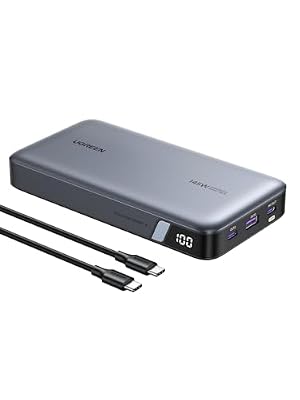 Best power bank for Steam Deck: the four picks compared | Check price on Amazon | |
| Anker 737 Power Bank (PowerCore 24K): fastest turnaround, best display | Check price on Amazon | |
 Baseus Blade 100W: the slim one that slides into a case sleeve | Check price on Amazon | |
 Anker Prime 27,650mAh (250W): maximum capacity under the flight limit | Check price on Amazon |
As an Amazon Associate we earn from qualifying purchases
Best Power Bank for Steam Deck
The Steam Deck is a gaming PC, and it drains its battery like one. Valve’s published specs rate the handheld for a 45W USB-C Power Delivery 3.0 supply, so the best power bank for Steam Deck is not simply the biggest battery on the shelf. It has to hold the 15V/3A (45W) PD profile while you play, carry enough watt-hours to add real game time, and stay under the 100Wh airline carry-on limit. The four banks below all clear that bar, and each one suits a different kind of trip. If you want an even wider shortlist before deciding, our full roundup of the best Steam Deck power bank options covers smaller and larger models as well.
What the Steam Deck actually needs
Output: 45W over USB-C PD is the floor. Valve ships the Deck with a 45W USB-C PD 3.0 adapter, and the console negotiates up to 15V/3A from a power source. A bank that tops out at 18W or 30W can still charge a sleeping Deck, but during a demanding game the console can draw power faster than a weak bank replaces it, so the battery keeps falling while plugged in. Every pick here delivers at least 100W from its main USB-C port, which leaves generous headroom above the Deck’s 45W ceiling.
Capacity: think in watt-hours, not mAh. The LCD Steam Deck carries a 40Wh battery and the Steam Deck OLED a 50Wh battery, per Valve’s specifications. Conversion losses in the bank and the Deck typically eat 10 to 15 percent of the stored energy, so a 74Wh bank delivers roughly 60 to 65 usable watt-hours: about one and a half charges of an LCD Deck, or one full charge of an OLED Deck plus a useful top-up. Banks in the 86 to 100Wh range push closer to two full LCD charges.
Cable: 60W-rated is enough for the Deck alone. Because the Deck never pulls more than 45W, any USB-C to USB-C cable rated for 60W or higher carries its full charging speed. Higher-rated 100W and 240W cables only matter if the same bank also has to fast-charge a laptop. All four banks below include a USB-C cable in the box, so there is nothing extra to buy for Deck use.
Travel: all four are carry-on legal. Airlines generally allow spare lithium batteries up to 100Wh in cabin baggage without approval. The largest bank here is rated at 99.54Wh, so every pick can fly in a carry-on.
Best power bank for Steam Deck: the four picks compared
UGREEN Nexode 145W (PB205): the balanced pick for most Deck owners
UGREEN’s Nexode pairs the joint-largest practical capacity class here with a port layout that maps neatly onto a Deck plus accessories. The main USB-C port (C1) delivers up to 140W over PD 3.1 and offers the full fixed-voltage ladder, including the 15V/3A step the Deck asks for. The second USB-C port provides up to 65W, and the USB-A port up to 22.5W, with 145W available in total; plug a phone into C2 alongside the Deck and the split still leaves C1 far above 45W. UGREEN lists the Steam Deck by name in this model’s compatibility notes.
At 25,000mAh (90Wh), it holds enough energy for roughly two charges of an LCD Deck after losses, or one and a half OLED charges. A small display shows the remaining percentage, and the bank itself recharges at up to 65W, which UGREEN rates at about two hours from empty with a suitable wall charger. The included USB-C to USB-C cable is rated at 100W, comfortably above the Deck’s needs.
Anker 737 Power Bank (PowerCore 24K): fastest turnaround, best display
The Anker 737 matches the UGREEN on headline output, up to 140W from its USB-C ports over PD 3.1 with the same 15V/3A profile the Deck uses, but its party trick is two-way speed: it also accepts up to 140W of input, so with a high-wattage wall charger it refills far faster than most banks of this size. Anker’s published spec table lists 24,000mAh (86.4Wh) of capacity, two USB-C ports, and an 18W USB-A port.
The smart display is the most informative in this group, showing remaining capacity, live input and output wattage, and estimated time to full or empty, which makes it easy to confirm the Deck is really drawing its full rate. At around 630g it is not light, but the box includes a 140W-rated USB-C to USB-C cable and a travel pouch. For players who drain a bank during the day and need it full again over a short hotel stop, this is the strongest option here.
Baseus Blade 100W: the slim one that slides into a case sleeve
The Blade takes a different trade-off: less capacity in exchange for a flat body roughly 0.7 inches thick that slips into a laptop sleeve or the flat pocket of a Deck carrying case where brick-shaped banks will not fit. Capacity is 20,000mAh (74Wh), still enough for about one and a half LCD Deck charges after conversion losses, and each of its two USB-C ports can output up to 100W over PD, including the 15V/3A profile. Two additional USB-A ports bring the total to four outputs, handy for earbuds and a phone.
A digital display shows the remaining percentage, and the included 100W USB-C to USB-C cable is a short 50cm length, which suits handheld use because there is less slack to tangle while the bank sits in a bag or coat pocket. Choose the Blade if your Deck travels in a slim case and the bigger banks above simply would not come along.
Anker Prime 27,650mAh (250W): maximum capacity under the flight limit
If the same bank has to serve a Steam Deck and a gaming laptop, the Anker Prime is built for that job. Its 27,650mAh (99.54Wh) battery is the largest here while staying just under the 100Wh carry-on threshold, and its three ports, two USB-C and one USB-A, can deliver 250W in total, with up to 140W from a single USB-C port over PD 3.1. The Deck’s 45W requirement barely registers against that budget, so a laptop can fast-charge on the second USB-C port at the same time.
The trade-offs are size and weight: at roughly 667g it is the heaviest pick in this guide, and the optional charging base shown in some bundles is not included with this listing. The box does include a 0.6m USB-C to USB-C cable and a travel pouch, and a smart display plus app support report charge status. Pick it for long-haul travel where one bank has to cover every device you carry.
Which one should you buy?
- Most Steam Deck owners: the UGREEN Nexode 145W. It has the best balance of capacity, ports, and size, and UGREEN explicitly lists Deck compatibility.
- Fastest refills and the clearest readout: the Anker 737, whose 140W input and detailed display suit daily drain-and-refill routines.
- Tightest bag space: the Baseus Blade, the only flat design here, at the cost of the smallest battery.
- Deck plus laptop on long trips: the Anker Prime 27,650mAh, with the most watt-hours that can still board a plane without approval.
FAQ
Can these power banks charge the Steam Deck while I am playing?
Yes. The Deck draws up to 45W, and every bank here sustains well over that from its main USB-C port, so the battery charges, or at minimum holds level, during play instead of draining.
How many extra hours does a 90Wh bank add?
Runtime depends on the game, but on capacity alone a 90Wh bank delivers roughly 75 to 80 usable watt-hours after losses. Against the LCD Deck’s 40Wh battery that is close to two full recharges; the 50Wh OLED battery gets about one and a half.
Do I need a special cable for full-speed Deck charging?
No. Any USB-C to USB-C cable rated for 60W or more carries the Deck’s 45W maximum, and all four banks include a cable rated at or above that level in the box.