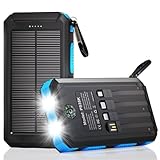
- Top Pick: SOARAISE Solar Power Bank 48000mAh Wireless Portable Charger with 4 Cables | Solar Charger with 4 Solar Panels, 48000mAh High Capacity, PD QC 3.0 Fast Charging Battery Pack, Flashlights for Camping
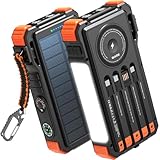
- Best Value: Durecopow Solar Charger Power Bank 20,000mAh, Portable Charger, 4 Cables 3 Ports Fast Charging External Battery Pack with USB C for Cell Phones, Solar Panel Charger with Dual Flashlight for Camping
- Premium Choice: BigBlue 28W High-Efficiency Solar Panel Charger with Dual USB-C and USB-A | Solar Phone Charger for Camping, Backpacking, Folding Solar Panels for iPhone, iPad, Samsung Galaxy, Power Bank, GPS etc
Searching for a portable solar panel charger turns up two very different products wearing the same label. One is a foldable panel that you spread out in the sun and plug your phone, tablet or battery into. The other is a power bank with tiny solar cells on its face, built mostly as a battery that you top up from the wall and keep around in case the grid or the trail runs out on you. Mixing them up is the most common way people end up disappointed, so the first decision is which of the two matches your trip.
This guide sorts nine listings into those camps for campers, hikers, road-trippers and anyone building an outage kit for 2026. Three are real folding panels with output ports and weather protection. Six are solar power banks with built-in cables, flashlights and in some cases wireless pads. Everything below comes from the specifications written into each product title, so use it as a shortlist and confirm connector details on the product page.
Quick Picks
As an Amazon Associate we earn from qualifying purchases at no extra cost to you.





| Product | Best for | Key spec from the title |
|---|---|---|
| SOARAISE Solar Power Bank | Extended trips with many devices | 48000mAh, 4 cables, PD and QC 3.0, wireless |
| Durecopow Solar Charger | Camping with USB-C devices | 20,000mAh, 4 cables, 3 ports, dual flashlight |
| BigBlue 28W Solar Panel | Backpackers charging phones in daylight | 28W, dual USB-C and USB-A, foldable |
| 20000mAh Solar Charger (4 panels) | Light-duty emergency kit | 4 built-in cables, 15W fast charging |
| BLAVOR Solar Power Bank | Phone and Apple Watch users | 20W USB-C, wireless, IPX5 waterproof |
| Nuynix Solar Power Bank | Simple everyday carry | 20000mAh, built-in cable, 15W, wireless |
| FlexSolar 100W | Powering a portable power station | 100W, IP67, PD3.0, QC3.0 and DC ports |
| Griplier 30W | Ultralight hiking | 30W ETFE panel, IP65, USB-C, USB-A and DC |
| 49800mAh Solar Charger | Group trips and long outages | 49800mAh, 22.5W, 4 cables, 3 ports |
How to Choose
Panel or power bank?
A folding panel generates electricity only while it faces strong sun, and its wattage tells you the upper limit of what it can deliver in perfect conditions. Real output is lower under haze, at an angle or in shade. A solar power bank stores energy, so it can charge a phone at night, but its small built-in cells add very little charge over a day. Treat the solar feature on a power bank as a bonus, and plan to recharge it from a wall or USB-C source before every trip.
Capacity and carry-on limits
Capacity in mAh tells you how much a bank can store, though conversion losses mean you never get the full figure back into a phone. A 20000mAh bank is a comfortable multi-day phone reserve. The two largest here, around 48000 and 49800mAh, hold far more but are heavier, take longer to refill and may exceed the roughly 100 watt-hour limit that airlines generally apply to carry-on batteries. If you fly, check your airline policy before packing them.
Output ports and charging speed
Match the charger to your devices. Look for USB-C with PD (Power Delivery) if you own a recent phone or tablet, and QC 3.0 for compatible Android devices. A DC port matters only if you plan to feed a portable power station. Fast-charging numbers such as 15W, 20W or 22.5W are maximums that apply to compatible devices on suitable cables. Built-in cables are convenient but they are shorter and can fail, so a bank that also accepts your own cable is a safer long-term buy.
Weather protection and build
Camping gear faces rain and dust. IPX5 means water jets are resisted, IP65 adds dust tightness, and IP67 allows brief immersion. These codes are checkable, unlike the phrase rugged. ETFE is a laminate used on some foldable panels for durability, and folding designs with eyelets can be hung from a pack or a tent. Wireless charging pads are handy but charge more slowly than cables, so use them for convenience instead of speed.
The 9 Best Options
SOARAISE Solar Power Bank 48000mAh
The SOARAISE leans on size. Its title lists 48000mAh, four cables, four solar panels, PD and QC 3.0 fast charging, wireless charging and flashlights for camping. It is the pick for someone who needs a large reserve for several people or devices, such as a family sharing one bank at a cabin or a tailgate.
- Strength: the capacity is among the highest in this lineup, so it can power a group over a long weekend.
- Strength: four cables and wireless charging reduce the need to carry extras.
- Trade-off: a battery this large is heavy and slow to refill, and airline limits may apply.
Skip it if you hike far or fly with carry-on only. It suits car camping and outage kits.
Durecopow Solar Charger 20,000mAh
The Durecopow offers 20,000mAh with four cables, three ports and USB-C, plus a dual flashlight aimed at campsite use. That spread of connections lets one bank serve a phone, a headlamp and a small gadget at the same time. At the 20,000mAh class it is also a sensible middle size, easier to carry than the giant banks and still generous for a long weekend away from outlets.
- Strength: three ports and four cables allow several devices to share the bank.
- Strength: the dual flashlight handles tent and trail lighting chores.
- Trade-off: the title gives no waterproof standard or wireless pad.
Skip it if you need documented splash protection or wireless charging. It fits weekend campers with USB-C phones who want a flashlight on the same device and a straightforward port layout.
BigBlue 28W Solar Panel Charger
This is a true folding panel rather than a power bank. The title lists 28W output, dual USB-C and USB-A ports, and a design for camping and backpacking, with iPhone, iPad, Samsung Galaxy, power bank and GPS charging named as targets.
- Strength: it generates power in the sun and can feed a power bank, which solves the problem of bank reserves running dry.
- Strength: USB-C plus USB-A cover modern and older cables.
- Trade-off: it only works while facing sunlight, and the title does not state a weatherproof standard.
Skip it if you want overnight charging. It suits backpackers who are outdoors by day.
20000mAh Solar Charger with Four Panels
This unbranded bank pairs 20000mAh with four built-in cables, micro, USB-C and iOS outputs and a USB-A input, plus four solar panels, 15W fast charging and a flashlight. The mix of outputs suggests it is meant as a grab-and-go backup rather than a main power source, with the USB-A input giving you a conventional way to refill it.
- Strength: the cable set covers older and newer phones without extras.
- Strength: 15W fast charging is a useful boost for a bank at this capacity.
- Trade-off: no brand or weather standard appears in the title, so rely on the product page for support terms.
Skip it if durability or a named brand matters most to you. It suits an emergency drawer or glove compartment, where it can sit ready until someone needs a phone charge.
BLAVOR Solar Power Bank 20000mAh
BLAVOR pitches itself at people with both a phone and an Apple Watch, since the title lists wireless charging for phones and watches, four built-in cables, 20W USB-C fast charging, IPX5 waterproofing and a camping flashlight. The title also mentions outdoor emergencies, so storm-kit use is as relevant as camping.
- Strength: IPX5 is the only water-resistance standard listed among the solar banks in this guide, so it is easy to verify.
- Strength: 20W USB-C is quicker than the 15W figures given on the other 20000mAh banks that list a wattage.
- Trade-off: wireless charging works slowly, so cables are better when time is short.
Skip it if you carry only Android devices and never use wireless charging. It suits hikers and commuters who wear a watch and want a single bank that handles both without a separate dock.
Nuynix Solar Power Bank 20000mAh
The Nuynix keeps things simple: 20000mAh, a built-in cable, 15W fast charging, wireless charging and an LED flashlight in an outdoor-ready design.
- Strength: a single built-in cable keeps the design uncluttered.
- Strength: wireless charging plus a flashlight cover basic needs.
- Trade-off: only one built-in cable limits how many devices can charge at once without your own wiring.
Skip it if several people share the bank or if you want a named weather standard. It suits one traveler who wants a light daily carry for commutes, flights within airline limits and weekend trips.
FlexSolar 100W Foldable Solar Panel
The FlexSolar is built for bigger jobs. The title lists 100W output, IP67 waterproofing and PD3.0 USB-C, QC3.0 USB-A and DC ports, with power stations, phones and power banks as targets. The title frames it as emergency power for camping and outdoor use.
- Strength: 100W is the highest output here and the DC port can feed a portable power station.
- Strength: IP67 is the strongest weather standard in the group.
- Trade-off: it is larger and heavier than the small folding panels, so it suits camp rather than ultralight hiking.
Skip it if you only charge a phone or need the lightest possible load. It suits extended camping, van stays or outage preparation with a power station that has a matching DC input.
Griplier 30W Portable Solar Panels
The Griplier is a small, foldable panel with an ETFE surface, USB-C, USB-A and DC ports, IP65 protection and a focus on hiking and backpacking. It charges phones, tablets and power banks. As a small folding charger it targets weight-conscious walkers who still want a weather-protected panel to strap to a pack during the day.
- Strength: the small folding size and IP65 protection fit a backpack.
- Strength: three port types cover phones, tablets and DC devices.
- Trade-off: 30W sits well below the 100W model, so larger batteries will fill more slowly.
Skip it if you need to fill a large battery or power station quickly. It suits solo hikers on multi-day routes who top up a phone or small bank during breaks.
49800mAh Solar Charger Power Bank
This unbranded giant lists 49800mAh, 22.5W fast charging, four cables, three ports, wireless charging and dual flashlights for camping, hiking and emergencies. Of the six solar banks, it states the highest capacity and the highest fast-charging wattage.
- Strength: the highest stated capacity and 22.5W fast charging suit group use.
- Strength: dual flashlights and three ports make it a complete outage kit.
- Trade-off: its size means long refills and likely airline restrictions.
Skip it if weight matters or if you plan to carry it on a plane. It suits home emergency kits, vehicle storage and group trips where one large bank serves everyone.
Which One Fits Your Situation
You hike with a pack and want daylight charging
Take the Griplier 30W or the BigBlue 28W. Both fold small, offer USB output and let you charge a phone or a bank while you walk or rest.
You camp in a car with a power station
The FlexSolar 100W, with its DC port and IP67 standard, is the obvious fit. Add a mid-range power bank such as the Durecopow for in-tent device charging.
You want an emergency kit for outages
The 49800mAh bank or the SOARAISE 48000mAh gives the most stored energy, with flashlights built in. Keep either charged from the wall every few months.
You carry a phone and a watch
BLAVOR combines wireless charging for both, a 20W USB-C port and IPX5 protection in a package suited to light travel.
Common Mistakes
- Expecting built-in solar cells to refill a big bank: the cells are tiny, so charge the bank at home before leaving.
- Reading capacity as phone charges: conversion losses mean you get less than the label suggests.
- Ignoring airline rules: very large banks may not be allowed in carry-on luggage.
- Buying watts you cannot use: a 100W panel is wasted if you only plug in a phone, and a 28W panel is slow for a power station.
- Leaving panels in shade or at a poor angle: output drops sharply, so face the panel toward the sun and reposition as it moves.
Related guides
- Battery Operated Smoke And Carbon Monoxide Detectors
- Combination Smoke And Carbon Monoxide Detectors
- Aio Liquid Coolers For High Performance Gaming
Frequently Asked Questions
Can a solar power bank charge itself fully from its panels?
Not realistically. The built-in cells are small, so the solar feature is an emergency top-up. For a full charge, use a wall adapter or a USB-C source.
What does a folding panel need to charge a phone?
Direct sunlight and a USB port. Face the panel toward the sun, avoid shade and keep the cable short. Output varies through the day, so a bank in the circuit smooths the supply.
Are IP65 and IP67 the same?
No. IP65 resists water jets and keeps dust out, while IP67 also survives brief immersion. For camping in rain, either is a sensible standard, but IP67 gives extra margin.
Is wireless charging worth having?
It is convenient for quick top-ups and for watches, but slower than a cable. Treat it as a bonus and rely on the wired ports when speed matters.