As an Amazon Associate we earn from qualifying purchases
Best PC Cases for Custom Water Cooling Loops
A custom water cooling loop makes demands that an air-cooled or AIO build never does. You need radiator mounts in more than one position, physical room for a pump and reservoir or a distribution plate, clearance for tubing runs and fittings, and enough working space behind the motherboard tray to route cables and drain lines. A case that only fits a single slim radiator will bottleneck an ambitious loop no matter how good it looks.
This guide compares four cases that manufacturers explicitly spec for multi-radiator custom loops. Every radiator size, position and clearance below comes from the manufacturer’s published specifications, so you can plan your loop layout before you buy. If you are still deciding between a full custom loop and a simpler sealed setup, our overview of the best PC cases for water cooling covers the wider category first.
How to Choose a Case for a Custom Loop
Radiator support is the headline spec. Look at both the maximum radiator length per position and which positions can be populated at the same time. A case that lists a 420 mm mount at the top, side and bottom is a very different platform from one that fits a single 360 mm radiator. Also check radiator thickness clearance where the manufacturer publishes it, especially on side mounts where a thick radiator plus fans can crowd the GPU.
Plan the pump and reservoir location. Dual-chamber cases move the power supply behind the motherboard tray, freeing the main chamber for a tube reservoir or a flat distribution plate mounted against the side or front. Before committing, confirm the case has a flat mounting surface where you want the distro plate and check the plate maker’s fitment list, because distro plates are usually designed for specific case models.
Motherboard and GPU clearance matter more in a loop. E-ATX boards can overhang radiator mounts in smaller chassis, and long graphics cards with a water block and terminal fittings need more length than the bare card spec suggests. Compare the manufacturer’s stated E-ATX width limit and GPU clearance against your parts.
Glass panels are for showing the loop off. Tempered glass front and side panels are standard on showcase loop cases. Decide whether you want a pillarless panoramic view or a framed panel, and remember that glass front panels restrict intake, so radiator positions behind mesh or perforated sections are preferable for exhaust-heavy layouts.
Working room saves frustration. Removable radiator brackets, adjustable motherboard trays and generous rear cable channels all make a loop easier to build, leak-test and drain. These details are in the manufacturer’s spec sheet and manual, and they matter more than styling once the tubing goes in.
Quick Comparison
| Case | Radiator support (manufacturer spec) | Motherboard support | GPU clearance | Panels |
|---|---|---|---|---|
| Lian Li O11 Dynamic EVO XL | Top, side and bottom: 240 / 280 / 360 / 420 mm each | E-ATX up to 280 mm wide, ATX, mATX, Mini-ITX | 460 mm | Tempered glass front and side |
| Phanteks NV7 | Top 360 mm, side 360 mm, bottom 360 / 280 mm, rear 240 mm | E-ATX up to 277 mm wide, ATX, mATX, Mini-ITX, SSI-CEB | 450 mm | Tempered glass front and side |
| Corsair 7000D AIRFLOW | Front 480 / 420 mm, top 420 / 360 mm, side 480 / 420 mm, rear 140 / 120 mm | E-ATX (305 x 277 mm), ATX, mATX, Mini-ITX | 450 mm | Tempered glass side, perforated steel front |
| HYTE Y70 | Side up to 360 mm (125 mm thick), top up to 360 mm (68 mm thick), rear 120 / 140 mm | E-ATX, ATX, mATX, Mini-ITX | 422 mm | Panoramic tempered glass |
The Best PC Cases for Custom Water Cooling Loops
1. Lian Li O11 Dynamic EVO XL — Best for Triple-Radiator Loops

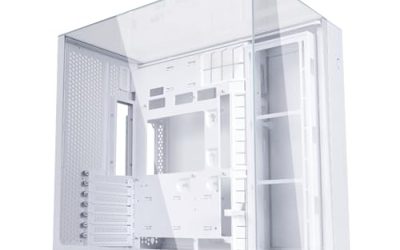
The O11 Dynamic EVO XL is the enlarged version of the dual-chamber design that made distribution-plate builds mainstream. Lian Li publishes radiator support of 240, 280, 360 and 420 mm at the top, side and bottom positions alike, so up to three 420 mm radiators can be installed simultaneously, alongside support for up to 11 fans. That is the most radiator volume on this list.
The chassis is reversible, the motherboard tray adjusts between three height levels to trade clearance between the top and bottom radiator positions, and the dual-chamber layout leaves the main chamber open for a tube reservoir or distro plate while the power supply and drives sit behind the tray. Lian Li rates motherboard support at E-ATX up to 280 mm wide and GPU clearance at 460 mm. Tempered glass front and side panels give the loop an unobstructed display, and the case measures 522 x 304 x 531.9 mm.
- View on Amazon: https://www.amazon.com/dp/B0CHM7L2V7
2. Phanteks NV7 — Best Showcase Case for Clean Loop Layouts

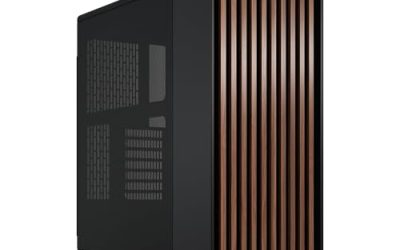
The Phanteks NV7 is a full-tower showcase chassis built around a near-seamless tempered glass front and side. Phanteks lists radiator support of up to 360 mm at the top, up to 360 mm at the side, up to 360 mm or 280 mm at the bottom, and up to 240 mm at the rear, with 12 fan positions in total. Three 360 mm radiators is enough surface for a high-end CPU and GPU loop with quiet fan speeds.
Phanteks rates motherboard support at ATX, micro-ATX, Mini-ITX and SSI-CEB, plus E-ATX up to 277 mm wide when the LED cover is fitted, and GPU clearance at 450 mm. The integrated D-RGB lighting frame and the included cable covers and airflow covers are designed to keep tubing and wiring visually tidy, which suits rigid-tube display builds. Note that Phanteks includes no fans with the NV7, so budget for the full fan set your radiators need. The case measures 253 x 532 x 586 mm.
- View on Amazon: https://www.amazon.com/dp/B0BYQXVG4M
3. Corsair 7000D AIRFLOW — Best Full Tower for Maximum Radiator Length

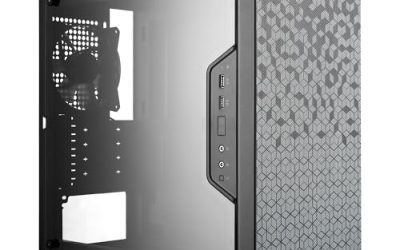
The Corsair 7000D AIRFLOW is a steel full tower aimed at builders who prioritise radiator length and airflow over an all-glass look. Corsair’s published radiator compatibility is 480 mm or 420 mm at the front, 420 mm or 360 mm at the top, 480 mm or 420 mm on the motherboard-tray side mount, and 140 mm or 120 mm at the rear. Corsair states the case can run three 360 mm radiators simultaneously, or two 420 mm radiators, and the side mount alone takes up to four 120 mm fans once the cable cover is removed.
Motherboard support runs to E-ATX at 305 x 277 mm, maximum GPU length is 450 mm, and the hinged tempered glass side panel still shows the finished loop. Corsair includes three 140 mm AirGuide fans and a PWM repeater, and its RapidRoute cable management system gives the rear chamber defined channels, which helps when you are also routing pump power and fan cables for three radiators. The case measures 550 x 248 x 600 mm.
- View on Amazon: https://www.amazon.com/dp/B094442NL5
4. HYTE Y70 — Best Dual-Chamber Case for a Compact Dual-Radiator Loop

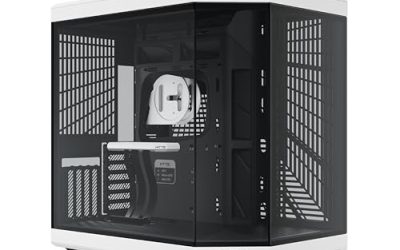
The HYTE Y70 is a dual-chamber mid-tower with panoramic tempered glass that wraps the front corner, designed around a vertically mounted graphics card using the included PCIe 4.0 riser cable. HYTE publishes unusually specific radiator limits: the side mount accepts a radiator up to 360 mm long and 125 mm thick, the adjustable top bracket takes up to 360 mm at 68 mm thick, and the rear takes a 120 mm or 140 mm radiator. The floor is reserved for fans up to 32 mm thick feeding the GPU area, and the chassis holds up to 10 fans in total.
That thickness headroom on the side mount makes the Y70 a genuine custom loop case rather than an AIO-only showcase: a thick 360 mm side radiator plus a top 360 mm is a proven layout for a CPU and GPU loop. HYTE rates motherboard support up to E-ATX, maximum GPU length at 422 mm and CPU cooler height at 180 mm. The second chamber hides the power supply and cabling, leaving the main chamber clean for a reservoir mounted beside the motherboard.
- ASIN: B0CX58ZF9G (White)
- View on Amazon: https://www.amazon.com/dp/B0CX58ZF9G
Who Should Choose Which Case
Choose the Lian Li O11 Dynamic EVO XL if your loop plan calls for three radiators or 420 mm units, or you want a distro-plate build with the largest mounting canvas. Choose the Phanteks NV7 if the build is a visual centrepiece and three 360 mm radiators cover your cooling needs. Choose the Corsair 7000D AIRFLOW if you want the longest radiators on this list, an airflow front panel, and a traditional full-tower interior with strong cable management. Choose the HYTE Y70 if desk space is limited but you still want a real dual-radiator loop and a panoramic glass presentation with a vertical GPU.
Whichever case you pick, cross-check the radiator thickness and motherboard width limits in the manufacturer’s manual against your exact blocks, fittings and board before ordering parts.
FAQ
How many radiators does a custom loop actually need?
A common starting point is one 360 mm radiator for a CPU-only loop and two 360 mm radiators once a graphics card joins the loop. Cases like the O11 Dynamic EVO XL that accept three large radiators give you headroom for quieter fan speeds rather than being a requirement.
Can I mount a distribution plate in any of these cases?
Distro plates are model-specific. Plate makers publish fitment lists per case, and the O11 family in particular has plates designed around its side mounting area. Always confirm your exact case model appears on the plate manufacturer’s compatibility list before buying.
Does E-ATX support mean any E-ATX board fits with radiators installed?
Not always. Manufacturers state a maximum E-ATX width, such as 280 mm on the O11 Dynamic EVO XL and 277 mm on the NV7, because wider boards can foul side radiator mounts. Check the width limit as well as the form factor name.
Is a glass front panel a problem for a radiator intake?
It can restrict airflow compared with a perforated front, which is why the Corsair 7000D AIRFLOW uses a steel airflow front panel and the glass showcase cases place their main radiator mounts at the top, side and bottom instead of behind the glass.