

- Top Pick: NOCO GEN5X2 12V 10A 2-Bank OnBoard Marine Battery Charger & Maintainer | Charges 2 Batteries at Once, IP68 Waterproof, Overcharge Protection, Temperature Compensation, For Lead-Acid & Lithium
- Best Value: 2 Bank Marine Battery Charger 5X2 10A (5A/Bank) – 12V Boat Charger | Charges 2 Batteries at Once, IP68 Waterproof, Charged 24/7, Overcharge & Temperature Protection, For Lead-Acid & Lithium
- Premium Choice: 3 Bank Marine Battery Charger 10X3 30A (10A/Bank) – 12V Boat Charger | Charges 3 Batteries at Once, IP68 Waterproof, Charged 24/7, Overcharge & Temperature Protection, For Lead-Acid & Lithium
A boat battery spends most of its life sitting still, and that is exactly when it quietly loses health. Between trips, the starting battery, the trolling-motor bank, and the house battery all drift downward, and a plug-in charger that stays wired in on the dock is what keeps them from ending the season half dead. A marine charger differs from an automotive one in a few specific ways: it is sealed against spray, it can feed several batteries independently, and it is built to stay connected for months.
This shortlist covers nine onboard chargers, from a single-bank unit to three-bank models that handle a starting battery plus a pair of deep-cycle banks. Most are 12V designs that list protection features and support for both lead-acid and lithium chemistries, while one targets 12V and 24V systems. Everything is judged from what each title states as of 2026, so check your battery chemistry and bank count against the details before you buy.
Quick Picks
As an Amazon Associate we earn from qualifying purchases at no extra cost to you.



| Product | Best for | Key spec from the title |
|---|---|---|
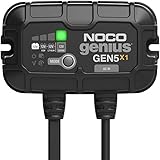
| NOCO GEN5X1 | One-battery skiffs | 5A, 1 bank, IP68 |
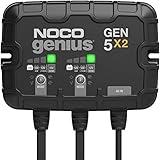
| NOCO GEN5X2 | Two-battery boats | 10A, 2 banks, lead-acid and lithium |
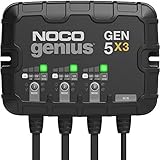
| NOCO GEN5X3 | Three-battery setups | 15A, 3 banks, temperature compensation |
| NOCO GENPRO10X2 | Larger two-bank systems | 20A, 2 banks, IP68 |
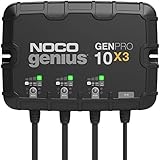
| NOCO GENPRO10X3 | Big three-bank rigs | 30A, 3 banks, lead-acid and lithium |
| 5X2 Two-Bank Charger | Two-bank boats on a lighter budget | 10A total, 5A per bank, IP68 |
| 10X3 Three-Bank Charger | High-output three-bank boats | 30A total, 10A per bank, IP68 |
| Smart 2-Bank Charger with Desulfator | AGM and deep-cycle upkeep | 10A, LiFePO4 support, desulfator |
| Guest ChargePro 8A | 12V or 24V systems | 4A per bank, IP67, flooded and AGM |
How to Choose
Count your banks first
The number of banks equals the number of separate batteries or battery groups the charger can feed at once. A fishing boat with a cranking battery and a trolling-motor battery needs two; add a house or livewell battery and you want three. Buying fewer banks than you have batteries means switching leads by hand, which defeats the purpose of a permanent installation. Count honestly, including any separate battery for a bow thruster, windlass, or electronics.
Match amperage to battery size
A common guideline is a charge rate between roughly 10 and 20 percent of a battery’s amp-hour capacity. A 100 amp-hour deep-cycle battery is comfortable with about 10 to 20 amps, while a small starting battery needs far less. Higher output refills big banks faster after a day on the water, but oversized chargers add nothing for tiny batteries, and pushing too much current into a small battery shortens its life. Wiring matters as well: heavier output means thicker cable and proper fuses.
Chemistry and system voltage
Check that the listing names your chemistry: flooded, AGM, gel, or lithium (LiFePO4). A charger without a lithium profile can undercharge or damage a lithium battery, so never assume. Several titles here state both lead-acid and lithium support, while the Guest unit focuses on flooded and AGM only. If your boat uses a 24V trolling system, only a unit that names 24V works for that bank; most others are 12V only.
Waterproofing and protective features
IP67 and IP68 are ingress protection codes: IP68 usually implies tolerance for continuous submersion, while IP67 handles temporary immersion. Temperature compensation adjusts the charge to heat or cold, and overcharge protection ends the cycle. Generic chargers often cut corners on certifications and support, so prefer listings that spell out each protection. Also look at the lead length: a charger that cannot reach the batteries without extensions invites loose, corroded connections.
The 9 Best Options
NOCO GEN5X1
The simplest charger in the set, with one bank and 5A of output. The title lists IP68 waterproofing, overcharge protection, temperature compensation, and support for lead-acid and lithium batteries. It fits a small boat with a single starting battery that needs looking after between weekends, such as a jon boat or a small outboard runabout kept on a trailer.
- Strength: IP68 waterproof housing in a straightforward single-bank package.
- Strength: lead-acid and lithium support are both named.
- Trade-off: only one battery can be charged at a time.
Skip it if you carry a second battery for a trolling motor or accessories, because you would be left switching leads by hand.
NOCO GEN5X2
A 10A, two-bank design, which makes it a natural fit for a boat with a starting battery and one deep-cycle bank. The title lists IP68, overcharge protection, temperature compensation, and both lead-acid and lithium chemistries. For many owners of mid-sized fishing boats, this is the baseline configuration that covers the usual two-battery layout.
- Strength: two independent banks in one sealed unit.
- Strength: temperature compensation and overcharge protection are spelled out.
- Trade-off: 10A total may feel slow when refilling large deep-cycle batteries.
Skip it if your batteries are big or you run three banks.
NOCO GEN5X3
Fifteen amps across three banks makes this the pick for a boat that carries a starting battery plus two deep-cycle batteries, perhaps one for the trolling motor and one for electronics. The title repeats the family features, including IP68 sealing and support for lithium alongside lead-acid, so moving up from the two-bank model adds capacity rather than changing the protection story.
- Strength: three banks cover a full battery layout.
- Strength: IP68 and temperature compensation are named.
- Trade-off: the 15A total is shared, so recovery on all three can be slower.
Skip it if you only have two batteries; you would carry an unused bank.
NOCO GENPRO10X2
The stronger two-bank NOCO, listed at 20A. It suits owners whose deep-cycle batteries are large enough that a 10A unit would take too long, such as a pair running a bow-mount trolling motor. The title keeps the IP68, overcharge, temperature, and chemistry language of its siblings, so the main change is raw output.
- Strength: 20A output for faster top-ups on larger batteries.
- Strength: lead-acid and lithium compatibility is stated.
- Trade-off: more output than a small boat needs.
Skip it if your batteries are small or you have three banks to feed, because the extra capacity would sit unused.
NOCO GENPRO10X3
The largest NOCO in this set, listed at 30A across three banks. It is aimed at bigger boats with several heavy batteries and plenty of onboard electronics that drain them. As with the other NOCO entries, the title mentions IP68 sealing, overcharge protection, and temperature compensation, making it the headroom choice for a serious rig.
- Strength: the highest output among the NOCO models, spread over three banks.
- Strength: lead-acid and lithium support are named.
- Trade-off: it is more charger than a small starter-only setup needs.
Skip it if you are looking after one or two small batteries.
5X2 Two-Bank 10A Marine Charger
A generic-brand alternative to the NOCO two-bank, giving 10A total at 5A per bank. The title lists IP68 sealing, an always-connected mode, overcharge and temperature protection, and support for lead-acid and lithium. It fits shoppers who want the same layout as the NOCO model but are comfortable with a lesser-known name.
- Strength: the 5A-per-bank split is clearly stated.
- Strength: IP68 with lead-acid and lithium support.
- Trade-off: brand background and support terms are less clear than with an established name.
Skip it if a recognized marine brand matters to you.
10X3 Three-Bank 30A Marine Charger
Another generic-brand listing, this one with three banks and 10A per bank for 30A total. It suits larger boats that need serious output and a tidy installation. The same IP68 sealing, overcharge protection, and temperature protection appear in the title, along with lead-acid and lithium support.
- Strength: 10A per bank is stated outright, which makes sizing simple.
- Strength: a full three-bank layout with IP68 sealing.
- Trade-off: less brand context than the NOCO GENPRO10X3 offers.
Skip it if your boat has only one or two batteries.
Smart 2-Bank Marine Charger with Desulfator
A 10A, two-bank charger that adds a desulfator mode, with LiFePO4 and AGM both named. It is aimed at owners with older or heavily cycled deep-cycle batteries who like having a maintenance mode built into the charger rather than bought as an add-on.
- Strength: desulfator and maintainer functions named in the title.
- Strength: LiFePO4, AGM, and deep-cycle support are all listed.
- Trade-off: only the word waterproof appears; no IP code is spelled out.
Skip it if you want a stated IP code on the label before you mount it, or if you prefer a charger from an established marine brand.
Guest ChargePro 8A 2-Bank
Built for systems that might run 12V or 24V, this 8A charger delivers 4A per bank inside an IP67 housing. It lists flooded and AGM lead-acid support only, which suits traditional boat batteries and an older electrical layout.
- Strength: both 12V and 24V systems are named.
- Strength: IP67 housing for a damp compartment.
- Trade-off: no lithium support is listed.
Skip it if you have lithium batteries on board or need high output, since 4A per bank refills big batteries slowly. It makes the most sense as a steady maintainer for a boat with older-style flooded or AGM batteries, particularly one with a 24V trolling motor circuit.
Which One Fits Your Situation
A small skiff with one battery
The NOCO GEN5X1 covers it with a single bank and sealed housing, and the compact size suits a boat that lives on a trailer between outings.
A bass boat with a trolling-motor bank
The NOCO GEN5X2 or the NOCO GENPRO10X2 fits, with the stronger unit suited to big deep-cycle batteries. If you would rather try a lesser-known brand, the 5X2 two-bank listing mirrors the same 5A-per-bank layout.
A cruiser with starting, house, and accessory batteries
The NOCO GEN5X3 or the NOCO GENPRO10X3 handles three banks, the latter with more headroom. The generic 10X3 listing offers the same 30A layout for those open to an unfamiliar name.
A 24V trolling system or AGM-only bank
The Guest ChargePro 8A is the only listing here that names 24V compatibility, and its flooded and AGM support matches an older battery setup.
Common Mistakes
- Buying fewer banks than you have batteries.
- Ignoring chemistry, then pairing a lead-acid-only charger with lithium.
- Choosing output far above what the battery size calls for, then leaving wiring and fuses undersized.
- Assuming IP67 and IP68 are identical, when the two codes describe different levels of water exposure.
- Mounting a charger in a spot that stays wet and unventilated, which strains even a sealed housing.
Related guides
- Battery Operated Smoke And Carbon Monoxide Detectors
- Combination Smoke And Carbon Monoxide Detectors
- Aio Liquid Coolers For High Performance Gaming
Frequently Asked Questions
What is a bank on a marine charger?
A bank is one independent charging output for a battery or group of batteries. Two banks let you charge two separate batteries without them interacting.
Can I leave a marine charger connected all season?
That is what they are designed for, provided they have overcharge protection and a maintenance mode. Check the listing for those features, and inspect the connections each spring for corrosion.
Do I need temperature compensation?
It helps when the boat sits in a hot or cold storage area, since battery charge needs shift with temperature.
Is a desulfator worth having?
It can help with older lead-acid batteries, but it is no substitute for replacing a failed one. It matters most for batteries that have sat discharged for long periods.







