- Top Pick: BLAVOR Solar Power Bank 20000mAh, Wireless Charger for Phones & Apple Watch | Portable battery pack, 4 built-in cables, 20W USB-C fast charging, IPX5 waterproof, camping flashlight, outdoor emergencies
- Best Value: BLAVOR Solar Power Bank 10,000mAh Portable Wireless Charger for Cell Phones | 20W USB-C battery pack, battery bank, IPX5 waterproof, 2 flashlights, camping essentials, hiking gear, emergency solar backup
- Premium Choice: SOARAISE Solar Power Bank 48000mAh Wireless Portable Charger with 4 Cables | Solar Charger with 4 Solar Panels, 48000mAh High Capacity, PD QC 3.0 Fast Charging Battery Pack, Flashlights for Camping
When the grid goes down after a storm, the phone in your pocket becomes your flashlight, radio, map and link to family, and it drains faster than anyone expects. An emergency solar charger is meant to be the item in the go-bag that keeps working when wall outlets do not. The catch is that “solar” on a product page can mean very different things: a power bank with a small panel on its back, or a proper folding panel that feeds whatever you plug in.
This guide is for households building a storm kit, hikers who want a safety margin, and anyone who needs a charger that survives a power cut, not just a weekend picnic. The ten listings below cover big-capacity power banks, wireless-capable models and one dedicated foldable panel. Each is judged only on its title, because capacity and cable counts are stated plainly while real-world solar recharge speed is not. In 2026 shopping, the smart move is to treat the built-in panel as a trickle top-up and rely on stored capacity.
Quick Picks
As an Amazon Associate we earn from qualifying purchases at no extra cost to you.
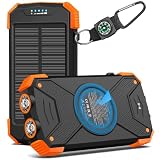

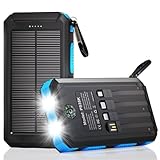


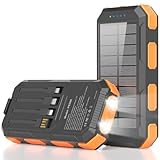

| Product | Best for | Key spec from the title |
|---|---|---|
| BLAVOR 20000mAh | Phone plus watch | 20W USB-C, 4 cables, IPX5 |
| BLAVOR 10,000mAh | Light go-bag | 10,000mAh, 20W USB-C, 2 flashlights |
| SOARAISE 48000mAh | Longest outage | 48000mAh, 4 solar panels, PD QC 3.0 |
| Durecopow 20,000mAh | Multi-device sharing | 3 ports, 4 cables, dual flashlight |
| 49800mAh hand crank | No-sun backup | Hand crank, compass, 25W |
| ERRBBIC 49800mAh | Big reserve | 22.5W, 4 cables, 3 ports |
| Nuynix 20000mAh | Simple carry | Built-in cable, 15W, wireless |
| ERRBBIC 20000mAh | Air travel kits | 15W, 3 cables, flight-safe |
| YELOMIN 38800mAh | Mid-size family kit | 22.5W USB-C, 4 cables |
| BigBlue 28W | Real solar input | 28W foldable panel, USB-C and USB-A |
How to Choose
Capacity first, solar second
A 10,000mAh bank refills a typical phone roughly once or twice after conversion losses, and a 20,000mAh bank roughly doubles that. Banks above about 27,000mAh generally exceed airline carry-on limits, so a 48000mAh unit is for car and home kits, not flights. The small panels built into power banks usually add only a trickle, so see them as a rescue option rather than a daily charging method.
Output and port count
Look for USB-C output of at least 20W for modern phones and 22.5W or more if you also charge tablets. Three ports let a family share one bank during an outage. Built-in cables are convenient but fragile, so keep one spare cable in the kit. Wireless pads are handy but slower and wasteful, so reserve them for situations where cables are missing.
Durability and emergency features
IPX5 means resistance to water jets, which covers rain but not submersion. Flashlights with an SOS mode matter more than they sound, because light is the second thing people need after power. Hand cranks and compasses, as on one model here, add backup when there is no sun. A bright flashlight can drain a bank quickly, so treat it as a short-burst tool. Before storm season, run a full cycle: charge the bank, drain it on a phone, and recharge it, so you know how long a refill really takes in your home.
Where budget models cut corners
Capacity numbers on low-tier banks are often optimistic, and the stated figure is the cell capacity, not the usable output. Panels are tiny, plastic housings can crack, and few listings mention certifications or safe-charging protections. Choose a unit that explains its output in watts and ports, and keep the bank partly charged year-round. Also label the kit with the date of the last top-up, since lithium cells slowly lose charge on a shelf and a bank forgotten for a year may arrive in the emergency nearly flat.
The 10 Best Options
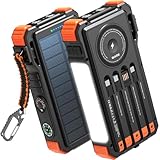
BLAVOR Solar Power Bank 20000mAh
This one targets phone and Apple Watch owners, with a wireless charger, four built-in cables, 20W USB-C fast charging, IPX5 waterproofing and a camping flashlight. It is a tidy single-unit kit for a household that wants fewer loose cables. The phone-and-watch wording matters if you own an Apple Watch, since many banks leave out that charging puck entirely, and a flashlight on the same body removes another item from the bag.
- Strength: four built-in cables plus wireless charging.
- Strength: 20W USB-C and IPX5 are both stated.
- Trade-off: built-in cables can limit repairs if one fails.
Skip it if you need capacity above 20000mAh for a multi-day outage.
BLAVOR Solar Power Bank 10,000mAh
The smaller sibling keeps 20W USB-C, IPX5 waterproofing and two flashlights, and the title mentions camping, hiking and emergency solar backup. At 10,000mAh it suits a day pack more than a family kit. It is the sort of bank you toss into a hiking pack or a bike bag, where weight counts and a second flashlight can double as a signal.
- Strength: two flashlights in a small unit.
- Strength: 20W USB-C and IPX5 both listed.
- Trade-off: only 10,000mAh of stored capacity.
Skip it if you plan to run several devices for days.
SOARAISE Solar Power Bank 48000mAh
The headline is 48000mAh with four cables and four solar panels, plus PD and QC 3.0 fast charging and flashlights for camping. It is built for the longest outage in this list, with the four panels adding a modest top-up. Realistically, you would treat it as a family hub: plug in several phones, a tablet and a radio, and ration the stored energy across the whole outage.
- Strength: very large stored capacity for sharing.
- Strength: PD and QC 3.0 support are named.
- Trade-off: capacity is above typical airline limits.
Skip it if you want a pocketable bank or need to fly with it.
Durecopow Solar Charger Power Bank 20,000mAh
Durecopow offers 20,000mAh, four cables, three ports, USB-C fast charging and a dual flashlight with a solar panel. The three-port layout suits households where more than one phone needs power at the same moment. With four cables included, parents can hand cords to everyone and still keep a spare port for a radio or lantern.
- Strength: three ports for simultaneous charging.
- Strength: four cables in the listing.
- Trade-off: no water-resistance claim is stated.
Skip it if you expect wet-weather exposure.
49800mAh Solar Power Bank with Hand Crank
The only model with a hand crank, billed as a 3-in-1 wireless portable charger with a camping light, compass, four cables and 25W fast USB-C charging. The crank gives a path to power when clouds persist, even if it is slow. Cranking is a last resort for a message or a map check, not a method for refilling a full battery, so keep expectations modest.
- Strength: hand crank adds a no-sun fallback.
- Strength: 25W USB-C is the highest output in the power banks here.
- Trade-off: large capacity makes it bulky for hiking.
Skip it if you want a slim carry or airline-friendly size.
ERRBBIC Solar Charger Power Bank 49800mAh
A big reserve with 22.5W fast charging, four cables, three ports and a dual flashlight, aimed at camping, hiking and emergencies. The listing names iPhone compatibility and wireless charging. With nearly fifty thousand mAh stored, it is aimed at users who would rather carry weight than worry about running dry in a long blackout.
- Strength: three ports and four cables.
- Strength: 22.5W output with a large reserve.
- Trade-off: heavy compared with 20000mAh units.
Skip it if you only need one or two phone refills.
Nuynix Solar Power Bank 20000mAh
This one offers a built-in cable, 15W fast charging, wireless charging, an LED flashlight and an outdoor-ready design. Its title is the simplest in the group, which suits users who want few moving parts. The outdoor-ready wording suggests a rugged shell, though the title gives no water-resistance claim, so keep it in a pouch during storms.
- Strength: built-in cable keeps the kit simple.
- Strength: wireless charging is included.
- Trade-off: 15W is slower than the 20W-plus models.
Skip it if you need multiple built-in cables.
ERRBBIC Solar Charger Power Bank 20000mAh
With 15W fast charging, three built-in cables, dual SOS flashlights and a “flight-safe” note, it fits travelers who also want a storm-kit item. The SOS flashlights add practical emergency signaling. The flight-safe note makes it one of the few listings that speaks directly to travelers who want the same unit in a carry-on and a storm closet.
- Strength: dual SOS flashlights.
- Strength: flight-safe wording on the listing.
- Trade-off: 15W output is on the modest side.
Skip it if you want output of 20W or more.
YELOMIN Solar Charger Power Bank 38800mAh
YELOMIN pairs 38800mAh with 22.5W USB-C fast charging, four built-in cables and dual LED emergency flashlights for camping and hiking. It lands between the mid and big-reserve groups. For a family of three or four, that capacity covers phones for a long weekend without the bulk of the largest banks.
- Strength: 22.5W USB-C with four cables.
- Strength: dual emergency flashlights.
- Trade-off: capacity is above typical airline limits.
Skip it if you plan to fly with your emergency kit.
BigBlue 28W Solar Panel Charger
Not a power bank: a folding solar panel with 28W high-efficiency output and dual USB-C plus USB-A ports, built for camping and backpacking. It charges phones, tablets, GPS units and power banks directly. Because the title names backpacking and camping, it folds small enough for a pack, and it pairs naturally with any of the stored-power banks above.
- Strength: dedicated panel gives meaningful solar input.
- Strength: three ports, including USB-C.
- Trade-off: stores no power, so it needs sun and a battery to be useful.
Skip it if your outage kit has to work at night.
Which One Fits Your Situation
You are building a household storm kit
The SOARAISE 48000mAh or the ERRBBIC 49800mAh gives the biggest reserve, with enough ports for several family members. Pair either with a backup cable.
You want a weekend hiking safety net
The BLAVOR 10,000mAh keeps weight down and still gives IPX5 water resistance and two flashlights for a night on the trail.
You need to fly with the kit
Pick the ERRBBIC 20000mAh, whose title says flight-safe, and confirm airline rules before traveling.
You want real solar input with panel flexibility
Pair the BigBlue 28W panel with any power bank above, since it can feed a bank directly while you wait for sun.
Common Mistakes
- Counting on a small built-in panel to fully refill a large bank, when it is intended only as a slow top-up.
- Buying maximum mAh without confirming output in watts, which determines how quickly a phone actually fills.
- Leaving the bank empty in a drawer for months, then discovering it holds almost no charge during the storm.
- Ignoring airline capacity limits and finding out at security.
- Skipping a spare cable, which matters when a built-in cable fails.
Related guides
- Battery Operated Smoke And Carbon Monoxide Detectors
- Combination Smoke And Carbon Monoxide Detectors
- Aio Liquid Coolers For High Performance Gaming
Frequently Asked Questions
Can a solar power bank charge from its panel alone?
Technically yes, but the panel is small, so recharging is very slow. Plan on wall or car charging for the bulk, and use sun only for a slow top-up.
How many phone charges does 20000mAh give?
Roughly two to four for many phones, depending on battery size and conversion losses. Real figures vary with temperature and the cable used.
Is IPX5 good enough for emergencies?
It handles rain and splashes but not submersion. Store the bank in a dry bag if flood risk is part of your plan.
Do I need a separate foldable panel?
Only if you want faster solar recharging. A dedicated panel like the BigBlue can feed any compatible bank, which beats relying on a small onboard panel.