
A dual fuel system pairs an electric heat pump with a gas or oil furnace, and the thermostat is the part that decides which one warms the house on a given morning. Pick a model that only understands a single heating source and the furnace never gets its cue, or the heat pump keeps struggling on a freezing night. This guide looks at six White-Rodgers and Venstar models and what each one’s listing actually says, so you can narrow the field before opening a manual.
It is written for homeowners replacing a worn-out wall control and for handy buyers who plan to hand the final wiring check to an HVAC pro. One honest caveat up front: none of the six listing titles uses the phrase “dual fuel,” so every pick below needs a confirmation against the manufacturer’s wiring guide before you buy. In 2026 that single check still saves more headaches than any feature on the box.
Quick Picks
As an Amazon Associate we earn from qualifying purchases at no extra cost to you.


| Product | Best for | Key spec from the title |
|---|---|---|
| White-Rodgers 1F83H-21NP | Simple fixed-temperature control | 80 Series, non-programmable, heat pump |
| White-Rodgers 1F85U-42PR | Schedules on unfamiliar wiring | 80 Series, programmable, universal |
| White-Rodgers 1F83C-11PR | One-stage systems with schedules | 80 Series, programmable, single stage |
| White-Rodgers 1F75H-21NP | Basic heat pump swap | 70 Series, non-programmable, heat pump |
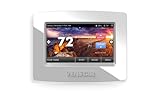
| Venstar T7900 Colortouch | App control and humidity | Built-in WiFi, humidity control |
| Venstar T8800 Colortouch | Light commercial spaces | Programmable, commercial |
How to Choose
Read the terminals before the screen
A heat pump thermostat needs a reversing valve terminal (usually labeled O or B), a compressor call (Y), and a way to call a second heat source (W2 or AUX). A dual fuel setup uses that second call to bring the furnace in. Open your current thermostat and photograph the wire labels. If you see Y, O/B, and a W wire, you have the raw ingredients; if the old unit only had R, W, G, and Y, you may be looking at a plain furnace-plus-air-conditioner system that never needed these features.
Switchover logic is the whole point
In a true dual fuel install, something has to decide when the heat pump is no longer worth running. Some controls watch outdoor temperature, others rely on how far the house is from its setpoint. Many installers aim for a changeover somewhere in the neighborhood of 25 to 40 degrees Fahrenheit, depending on local energy rates and equipment. Ask whether the thermostat you want handles that lockout itself or whether the furnace control board does it. A model that cannot take an outdoor sensor or an auxiliary heat lockout is a weaker fit.
Programmable or not
Schedules save energy on a furnace but can backfire on a heat pump. Large overnight setbacks make the system claw its way back by leaning on auxiliary heat, which wastes the efficiency a heat pump is supposed to deliver. If you choose a programmable model, keep setbacks to two or three degrees and confirm there is a recovery setting. Non-programmable models avoid that trap, and they suit households that are home most of the day. Check that the schedule has separate weekday and weekend periods if your routine splits that way.
Power, connectivity, and where budget models cut corners
Wi-Fi models and color screens usually want a common wire (C) for constant 24-volt power. If your wall has no C wire, look for a power-stealing option or plan on running new cable. Budget controls tend to drop remote access, humidity handling, and detailed configuration menus. Ignore screen size and color themes; the setup menu depth is what lets you set stage counts, cycle rates, and changeover temperatures correctly. Also confirm the voltage marking on the label matches a 24-volt low-voltage system, because a line-voltage baseboard setup needs a completely different control.
The 6 Best Options
White-Rodgers 80 Series 1F83H-21NP
This is the plain, no-schedule choice for people who want to set a temperature and forget it. The title names it a heat pump thermostat, which is the right first category for any dual fuel project, and the non-programmable design keeps the setup menus short. A household where someone is home most of the day, or a second property used in steady stretches, is the natural audience, since there is no weekly program to build or babysit.
- Strength: listed as a heat pump model, so the category matches the equipment you are pairing.
- Strength: no scheduling means no accidental deep setbacks that trigger auxiliary heat.
- Trade-off: no program periods, and the title does not state furnace changeover support, so verify it in the manual.
Skip it if you want weekday and weekend schedules or remote access from a phone.
White-Rodgers 80 Series 1F85U-42PR
The word “universal” in this title signals a control meant to cover several system types rather than one narrow configuration. Paired with programmable operation, it fits a home where the previous wiring is a puzzle and you want flexibility while you sort it out. It is also a sensible shortlist entry when a contractor will be on site and can decide on the spot how the terminals should be mapped.
- Strength: universal positioning gives it the broadest system coverage of the White-Rodgers group.
- Strength: programmable, so a household with set work hours can automate comfort.
- Trade-off: broad compatibility often means a longer installer setup sequence.
Skip it if you want something you can mount in ten minutes with no menu work, or if you need built-in Wi-Fi.
White-Rodgers 80 Series 1F83C-11PR
The title calls this a programmable, single stage thermostat. That wording describes a basic one-stage heating and cooling system, not a heat pump with a furnace backup, so it sits at the edge of this guide. Include it on a shortlist only if you already know your equipment can be driven by a one-stage control, such as a furnace paired with a separate air conditioner, and you simply want scheduling from a familiar product line.
- Strength: programmable scheduling in the same 80 Series family as the heat pump models.
- Strength: straightforward single-stage design keeps configuration light.
- Trade-off: nothing in the title says heat pump or auxiliary heat, so it is the riskiest dual fuel pick here.
Skip it unless the manual confirms support for a heat pump and a second heat source; otherwise choose one of the heat pump models above.
White-Rodgers 70 Series 1F75H-21NP
Another non-programmable heat pump control, this one from the 70 Series line instead of the 80 Series. It targets the buyer who wants the same simple operating style as the first model and prefers a different product family. The model number follows the same naming pattern as the 80 Series heat pump entry, which makes side-by-side comparison of the two manuals straightforward before you commit to either.
- Strength: heat pump designation in the title, matching the core equipment type.
- Strength: no schedule logic to manage, which suits a rental or a vacation home with steady use.
- Trade-off: no programming and no connected features listed.
Skip it if you want app access, schedules, or a humidity readout.
Venstar T7900 Colortouch
This is the connected pick of the group. The title lists built-in WiFi and humidity control, and it states that the unit replaces the T5900 and ACC0454, which helps if you already own one of those Venstar parts. For a household that wants to nudge the temperature from the couch or the road, and that cares about indoor humidity as well as temperature, it is the most feature-rich entry on the list.
- Strength: built-in WiFi means remote adjustments without an add-on module.
- Strength: humidity control is named in the title, handy in damp climates.
- Trade-off: the title never mentions heat pump or auxiliary heat, and a color touchscreen model usually needs a common wire.
Skip it if your wall has no C wire and you do not want to run one, or if you prefer physical buttons.
Venstar T8800 Colortouch
Labeled a programmable commercial thermostat, the T8800 is built around business spaces such as small offices or shops. It brings the same Colortouch interface family as the T7900 with scheduling emphasis. Think of it as the option for a landlord or a small business owner who wants the display and program structure of a commercial control, and who has an installer who can read the commercial wiring documents.
- Strength: programmable design suits buildings with predictable occupied hours.
- Strength: commercial positioning implies a configuration depth beyond a basic residential dial.
- Trade-off: no WiFi or humidity feature appears in the title, and it may be more control than a house needs.
Skip it for a typical home install where simplicity matters more than commercial-style options.
Which One Fits Your Situation
You want a no-fuss swap on a heat pump system
The White-Rodgers 1F83H-21NP is the cleanest match: it is named a heat pump thermostat and carries no schedules to misconfigure. If you prefer the 70 Series family, the 1F75H-21NP follows the same logic.
You want phone control and humidity management
The Venstar T7900 is the only model in the group with built-in WiFi and humidity control in its title. Make sure your wall has a C wire, and confirm heat pump and auxiliary support with the manufacturer.
You are staring at confusing old wiring
The White-Rodgers 1F85U-42PR is a universal programmable design, which gives you the most room to adapt while an installer works out the terminals.
You manage a small shop or office
The Venstar T8800 is the commercial pick, and its programmable focus suits spaces with fixed business hours.
Common Mistakes
- Buying on the phrase “heat pump” alone and never confirming that the model can call a second heat source for a furnace.
- Ignoring the common wire requirement on a Wi-Fi or color-screen model, then discovering the wall has only four conductors.
- Programming deep overnight setbacks on a heat pump, which pushes the system into auxiliary heat every morning.
- Choosing a single stage model for a two-source system because the series name looked familiar.
- Skipping a photo of the old wiring before disconnecting anything, which makes a wrong terminal mapping hard to undo.
Related guides
- Combination Smoke And Carbon Monoxide Detectors
- Aio Liquid Coolers For High Performance Gaming
- Graphics Cards For Low Wattage Power Supplies
Frequently Asked Questions
What makes a thermostat dual fuel?
It can run a heat pump as the main heat source and call a furnace for backup, with logic that decides when to switch. Look for heat pump terminals, an auxiliary heat output, and a configurable changeover or lockout setting.
Do any of these listings say dual fuel?
No. The titles describe heat pump, universal, single stage, or commercial control, so the dual fuel suitability of each one has to be confirmed from the manual or the manufacturer’s support line.
Can I install one myself?
If you are comfortable labeling wires and turning off power at the breaker, many buyers handle it. A dual fuel system adds the furnace changeover wiring, so an HVAC technician is worth involving for the final setup.
Is a smart thermostat worth it for dual fuel?
Remote access helps if you travel or manage a second home, but the changeover settings matter far more than the app. Put configuration depth ahead of connected features.