As an Amazon Associate we earn from qualifying purchases.
A desktop pick and place machine automates the slowest part of small-batch electronics assembly: taking surface-mount components from tape, tray, or bulk feeders and placing them on a printed circuit board at the coordinates in your placement file. For a prototyping lab, makerspace, or small production bench, it turns a run of boards that would take a full day of tweezers and rework into a supervised, repeatable job.
This guide compares five desktop machines currently listed on Amazon US using only the specifications their sellers publish: listed placement speed, feeders supported, vision and camera system, nozzle arrangement, and intended board work. Where a seller publishes few hard numbers, this guide says so rather than filling the gap — an unpublished specification tells you what to confirm with the seller before ordering.
How to Choose a Desktop Pick and Place Machine
Listed placement speed (CPH). Sellers quote speed in components or points per hour. Treat that figure as a ceiling for simple parts on an optimized job, not a sustained rate: feeder changes, vision checks on fine-pitch parts, and board handling all slow a real run. Speed matters most when you repeat the same board; for one-off prototypes, setup time dominates.
Feeders. Feeder capacity decides how many part values one job can hold without a mid-run swap. Tape feeders suit production parts, tray feeders suit ICs, and bulk or loose-component handling suits prototyping, where parts arrive in bags rather than on reels. Electric feeders advance tape automatically; manual and strip feeders are simpler but need more attention.
Vision and cameras. A top camera finds board fiducials and feeder positions. A bottom, upward-facing camera checks the part on the nozzle and corrects offset and rotation before placement, which matters for polarized and fine-pitch parts. More cameras generally mean faster correction, with less travel to one inspection position.
Nozzles and heads. Multiple heads place more parts per gantry pass. An automatic nozzle changer lets one job mix tiny passives and large ICs without a manual tip swap, and a published nozzle library size shows how many tip types the machine holds ready.
Board size, fit, and power. Confirm the maximum PCB size against the largest board you build, and check footprint and weight against your bench — several desktop units need a permanent bench position. Some machines are built around 220V supply, so check the listing’s voltage statement against your workshop wiring before ordering.
The Picks
1. AiXunTech Desktop SMT Pick and Place Machine — Best Documented Desktop Listing

This AiXunTech unit is the most concretely documented machine in this roundup. Its Amazon listing identifies the manufacturer as AiXun, gives part number AX202412002, and publishes physical dimensions of 19.69 x 21.65 x 14.96 inches at 61.6 pounds — a genuinely benchtop footprint, but heavy enough to plan a permanent bench position for. The listing title describes a high-speed, fully automatic machine with dual vision, a built-in vacuum pump, three cameras, and three three-position electric feeders included.
That combination suits a lab that wants to start placing boards without first sourcing a separate vacuum supply or powered feeders. Dual vision with three cameras covers board registration and on-nozzle inspection, and electric feeders advance tape without the operator nudging strips. Because the included feeder count is small, treat this as a focused workstation for jobs built around a limited set of high-use part values, supplemented by trays or strips for the rest.
Specs
- Brand: AiXunTech (manufacturer listed as AiXun)
- Part number: AX202412002
- Vision: Dual vision, 3 cameras (per listing title)
- Feeders: 3 three-position electric feeders included (per listing title)
- Vacuum: Built-in vacuum pump (per listing title)
- Dimensions: 19.69 x 21.65 x 14.96 inches
- Weight: 61.6 pounds
2. Fully Automatic SMT Desktop Pick and Place Machine with Triple Vision — Best Listed Speed in This Class
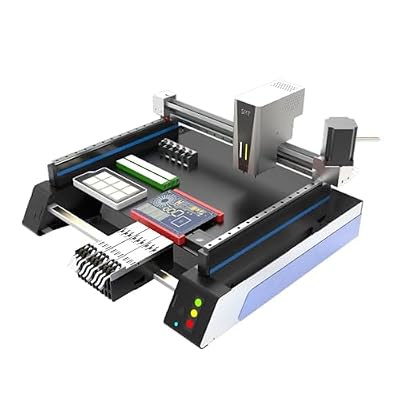
This unbranded fully automatic desktop machine is built around a triple vision camera system with dual bottom cameras, and its listing claims a maximum speed of 3,000 points per hour using S-curve motion control. Dual mounting heads support passive automatic head change with up to six nozzle libraries, so one job can mix diverse component sizes without manual tip swaps. Its feeder support is the broadest in this guide: visual bulk, automatic, manual, and tray feeders, covering everything from bagged prototype parts to taped production stock.
The listing also describes a sheet-metal integrated welded body rather than a bolted aluminum-profile frame, an all-metal-gear suction nozzle motor, and 220V dual-voltage support. This is the pick for a workshop wanting one machine for prototyping and short production runs, provided the 220V requirement fits the building. Confirm feeder count and maximum PCB size with the seller, because the listing emphasizes cameras and speed over a full feeder and board-size table.
Specs
- Type: Fully automatic desktop SMT pick and place machine
- Vision: Triple vision cameras, including dual bottom cameras
- Listed maximum speed: 3,000 points per hour (seller-listed)
- Heads: Dual mounting heads, passive automatic head change
- Nozzle libraries: Up to 6
- Feeders supported: Bulk (visual), automatic, manual, and tray
- Voltage: 220V dual voltage (per listing)
3. BC-4Y SMT Pick and Place Machine — Best for Loose Components and Prototyping Flexibility

The BC-4Y is a four-head machine aimed at prototyping and small-volume production. Its defining features are an automatic nozzle changer and support for loose components, with tape, tray, stick, and loose-component feeding all listed. Loose-component placement is rare at desktop scale and genuinely useful in research and development work, where parts often arrive as cut tape or loose samples rather than full reels.
Four independent heads raise throughput on repetitive boards, and the high-precision vision system handles alignment. The trade-off is setup complexity: this machine rewards an operator who invests time in feeder setup and job preparation, and returns that investment on varied, changing work. If your bench handles a rotating mix of prototype designs, this is the most flexible option here. Confirm listed speed, feeder count, and maximum PCB size with the seller, since those figures are not in the summary specifications available for this listing.
Specs
- Model: BC-4Y
- Heads: 4 independent heads
- Nozzle change: Automatic nozzle changer
- Feeding options: Tape, tray, stick, and loose components
- Vision: High-precision vision system
4. SMT 550 4-Head SMD Pick and Place Machine — Best for Precision-Focused Assembly

The SMT 550 is a four-head SMD pick and place machine built around a servo motor drive, positioned for precision and durability in professional electronics manufacturing. Servo drive is the headline specification: it is the arrangement sellers offer when consistent, repeatable placement on detailed assemblies matters more than headline speed, and four heads keep placement moving while that precision is maintained.
This is the pick for a professional bench assembling detailed boards where placement quality is the priority and the operator is experienced with SMT setup. It is less suitable as a first machine, and the published summary specifications are limited — the seller lists head count, model, machine type, and servo motor, but no full speed, feeder, or board-size table. Ask the seller for listed CPH, feeder capacity, and maximum PCB size in writing before committing.
Specs
- Model: SMT 550
- Heads: 4
- Drive: Servo motor
- Type: SMD pick and place machine
5. SMT802A-S Automatic Pick and Place Machine — Best Compact Entry Point for LED and Simple SMD Work

The SMT802A-S is a compact desktop machine positioned for LED production and small-scale assembly. Its published positioning is deliberately narrow: a compact design supporting LEDs and simple SMD components, automated placement for small runs, and a simpler operating model than the multi-head machines above. For a workshop whose work is LED boards and straightforward SMD assemblies, that focus is a virtue — you are not maintaining capability your boards never use.
It is not the machine for complex, high-mix assemblies or large boards, and the listing’s specifications are brief, so confirm feeder count, listed speed, and maximum PCB size with the seller. Within its intended scope, it is the most approachable entry point in this guide.
Specs
- Model: SMT802A-S
- Design: Compact desktop
- Supported components: LEDs and simple SMDs (per listing)
- Operation: Automatic placement
Which Machine Fits Your Bench?
Choose the AiXunTech unit for the most completely documented listing, with published dimensions, weight, cameras, and included electric feeders. Choose the triple-vision fully automatic machine if listed speed and feeder variety matter most and your workshop supports 220V. Choose the BC-4Y if your prototyping involves loose or sample components. Choose the SMT 550 if servo-driven precision on detailed assemblies is the priority. Choose the SMT802A-S if your work is LED boards and simple SMD runs and bench space is tight.
The same discipline applies as when you pick between a gaming laptop and a desktop for a build: match the machine to the work you actually do, confirm the published specifications that matter for that work, and do not decide on a headline number alone.
Before You Order
These are freight-class purchases, so verify four things with the seller before ordering: listed placement speed for your component mix, the exact feeder count and types included, maximum PCB size, and the supply voltage your unit ships configured for. Also plan the rest of the SMT process — paste printing, reflow, and inspection are separate steps this equipment does not perform. The machine is only the middle of that line.