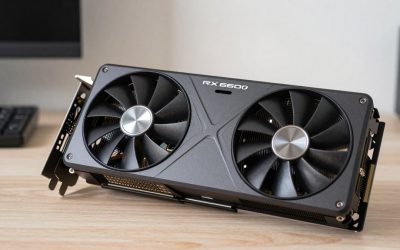
Pairing the right processor with your RX 9060 XT determines whether you extract every frame that GPU has to offer or leave performance stranded behind a weak CPU. The RX 9060 XT sits firmly in the 1440p sweet spot, which means resolution alone masks a lot of processor limitations at higher settings. At 1080p, however, CPU choice becomes critical because the GPU finishes its work faster and waits on the processor to feed it draw calls. Beyond raw frame rates, your platform decision affects motherboard cost, memory compatibility, and how far you can upgrade before the socket itself becomes a dead end. This guide covers the CPUs that pair well with the RX 9060 XT across budgets, with notes on where each one shines and where it falls short.
Verdict at a Glance
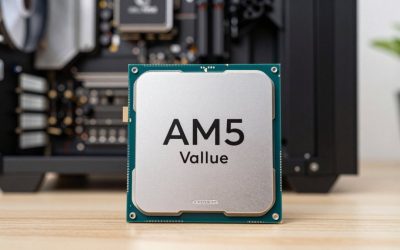
- Best value for most RX 9060 XT builds: AMD Ryzen 5 9600X or Ryzen 5 7600 – six-core AM5 chips that keep the 9060 XT fed at 1080p and 1440p on a budget platform.
- Best drop-in upgrade for an older AM4 PC: AMD Ryzen 7 5700X3D or 5800X3D – 3D V-Cache gaming performance on your existing board and DDR4 memory.
- Best Intel: Intel Core Ultra 5 250K Plus (new LGA 1851 build) or Core i5-14600K (LGA 1700, DDR4 or DDR5).
- Future-proof pick: AMD Ryzen 7 9800X3D – overkill for this GPU today, but it will not hold back a future GPU upgrade. The newer 9850X3D is even faster and makes even less sense here.
Short answer: the RX 9060 XT is a mid-range GPU, so a mid-range CPU is the right match. Spend on the 16GB version of the card before spending on an X3D processor.
Quick Picks
| Pick | Tier | Why |
|---|---|---|
| AMD Ryzen 5 7600X 6-Core, 12-Thread Unlocked Desktop Processor | Best Value | Handles 1440p gaming without holding back the RX 9060 XT at a fraction of the cost |
| AMD Ryzen™ 5 9600X 6-Core, 12-Thread Unlocked Desktop Processor | Best Overall | Extra IPC headroom keeps 1080p framerates competitive while staying affordable |
| AMD Ryzen 7 7700X 8-Core, 16-Thread Unlocked Desktop Processor | Best for Multitasking | Eight cores smooth out streaming, recording, and background workloads alongside gaming |
| AMD Ryzen™ 7 9700X 8-Core, 16-Thread Unlocked Desktop Processor | Best for 1080p High Refresh | Stronger single-thread performance tightens 1% lows in competitive titles |
| AMD RYZEN 7 9800X3D 8-Core, 16-Thread Desktop Processor | Best Future-Proof | 3D V-Cache dramatically reduces CPU bottlenecks, making it the safest future-proof pairing |
How We Chose
These processors were compared using gaming benchmarks from launch and follow-up reviews published by TechPowerUp, Tom’s Hardware, Gamers Nexus, Hardware Unboxed, and TechSpot. Our selection criteria prioritized price-to-performance within the RX 9060 XT’s natural target range, platform longevity on AM5, and real-world frame consistency rather than peak numbers in synthetic tests. CPUs that bottleneck the GPU noticeably at 1440p were excluded.
As an Amazon Associate we earn from qualifying purchases at no extra cost to you.


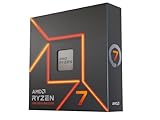


AMD Ryzen 5 7600X 6-Core, 12-Thread Unlocked Desktop Processor
This is the floor for a responsible RX 9060 XT pairing. At 1440p, the 7600X rarely introduces measurable bottlenecks in GPU-bound titles, and even demanding open-world games run within a few percent of faster chips. TechPowerUp’s CPU reviews consistently placed the 7600X within single-digit percentage differences of the 7700X at 1440p, and Gamers Nexus found similar parity in 1% low performance. At 1080p you will see a small gap versus higher-tier options in CPU-bound esports titles, but it remains well within acceptable range for most players. The one drawback is thermals under sustained all-core loads; without a decent tower cooler, the chip can hit temperature limits during productivity bursts. For pure gaming builds on a tight budget, this remains hard to beat.
AMD Ryzen™ 5 9600X 6-Core, 12-Thread Unlocked Desktop Processor
The 9600X delivers the Zen 5 architecture’s IPC gains at only a small premium over its predecessor. Tom’s Hardware’s launch review found the 9600X ahead of Zen 4 in single-core throughput, though the eight-core 7700X keeps the lead in multi-threaded workloads. For the RX 9060 XT, that translates to slightly tighter minimums in 1080p competitive play and a touch more headroom when the GPU is not the limiting factor. At 1440p and 4K the difference is negligible. It runs cooler than the 7600X at stock settings due to its 65W TDP default. The tradeoff is that six cores remain six cores—if you stream or run heavy background tasks regularly, the extra threads of an eight-core option are worth the jump. Otherwise, this is the best price-per-frame pick on the list.
AMD Ryzen 7 7700X 8-Core, 16-Thread Unlocked Desktop Processor
When your gaming sessions double as content creation or streaming, the 7700X earns its place. Hardware Unboxed demonstrated that eight cores smooth out frame-time variance in newer titles that lean heavily on background thread scheduling, and TechSpot observed comparable gains when OBS encoding runs simultaneously. At 1440p with the RX 9060 XT, the 7700X never bottlenecks the GPU and leaves thermal and headroom surplus for future upgrades. At 1080p, it maintains 1% lows in demanding open-world titles better than six-core options. The downside is its 105W TDP and the need for a quality cooler under sustained loads; without one, boost clocks taper during long sessions. For a dedicated gaming rig this is slightly overkill, but for hybrid workloads it is the most logical mid-tier step.
AMD Ryzen™ 7 9700X 8-Core, 16-Thread Unlocked Desktop Processor
The 9700X pairs Zen 5’s higher IPC with eight full cores, and Tom’s Hardware highlighted its advantage in games where single-thread speed directly drives frame pacing. Gamers Nexus testing showed it narrowing the gap to the 9800X3D in certain engines, particularly those that do not heavily exploit the 3D cache layer. At 1080p with the RX 9060 XT, this is the six-core-plus option that tightens minimums without resorting to the X3D’s premium. At 1440p it operates well below any bottleneck threshold. The notable tradeoff is price: it sits significantly above the 7700X while offering a performance uplift that feels modest in pure GPU-bound scenarios. If you plan to game at 1080p high refresh specifically, the value proposition makes sense. For 1440p or above, the 7700X delivers nearly the same experience at less cost.
AMD RYZEN 7 9800X3D 8-Core, 16-Thread Desktop Processor
No other processor on this list pairs more completely with the RX 9060 XT across every resolution. The 3D V-Cache adds 64 MB of stacked L3 beneath its single eight-core complex, for 96 MB in total, and TechPowerUp’s review found it eliminating the CPU bottleneck that even the 9700X introduces in cache-sensitive titles at 1080p. Hardware Unboxed echoed this, showing 1% lows that stay remarkably consistent in open-world and strategy-heavy games. At 1440p and 4K the GPU sets the pace, so the CPU is effectively out of the equation. The drawback is obvious: it often costs more than the RX 9060 XT itself, making it an unusual spend for a mid-range GPU owner. If you plan to upgrade the GPU later and want the CPU to never be the problem, the X3D design justifies the premium better than anything else here.
AMD Ryzen 7 5800X3D — Best AM4 Upgrade (and the 5700X3D Alternative)

Many RX 9060 XT buyers are upgrading an older AM4 system rather than building from scratch. For them, the Ryzen 7 5800X3D is the strongest CPU that drops into an existing B450, X470, B550 or X570 board (after a BIOS update) and keeps using DDR4 memory. It has eight Zen 3 cores, 16 threads, 96MB of L3 cache with AMD’s first-generation 3D V-Cache, a 4.5GHz boost and a 105W TDP.
The closely related Ryzen 7 5700X3D uses the same eight cores and 96MB cache at lower clocks (4.1GHz boost). It usually sells for less and lands only a few percent behind the 5800X3D in games, so take whichever is cheaper where you shop. Both chips are older AM4 parts, and stock is thinning.
Who it is for: owners of Ryzen 3000 or 5000 systems who are adding an RX 9060 XT and want to remove the CPU bottleneck without buying a new board and RAM.
Strengths: the extra cache gives it gaming performance in the range of newer six-core Zen 4 chips in many titles, according to long-running comparisons from Hardware Unboxed and TechSpot. It is a far bigger 1080p upgrade than a non-X3D AM4 chip, and you keep your existing platform.
Drawbacks: AM4 is a dead-end socket, with no PCIe 5.0 and no DDR5. The cache chip cannot be overclocked in the usual way, and it needs a capable cooler. The RX 9060 XT’s PCIe 5.0 x16 link runs at PCIe 4.0 on B550/X570 and at PCIe 3.0 on B450/X470. That costs little on the 16GB card but more on the 8GB card.
Compared with the existing picks: for a brand-new build, the AM5 Ryzen 5 9600X is better value. For an AM4 upgrade, this is the chip to get.
AMD Ryzen 5 7600 — Lowest-Cost AM5 Entry
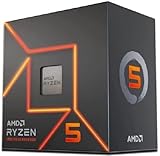
The non-X Ryzen 5 7600 is the 7600X’s quieter sibling: six Zen 4 cores, 12 threads, 32MB of L3 cache, a 5.1GHz boost and a 65W TDP, with AMD’s Wraith Stealth cooler in the box. In games it typically runs within a few percent of the 7600X.
Who it is for: budget RX 9060 XT builds that want to move to AM5 and DDR5 at the lowest possible cost, with room to drop in an X3D chip later.
Strengths: the included cooler saves money, it has low power and heat, works on any B650 or B850 board, and it is capable enough for the RX 9060 XT at 1440p, where the GPU sets the pace.
Drawbacks: the stock cooler is basic and noisy under sustained load. At 1080p in CPU-heavy games, it trails the Zen 5 9600X and the X3D chips.
Compared with the existing picks: it is essentially a cheaper 7600X. Buy whichever is lower-priced, and use the savings to step up to the 16GB RX 9060 XT if you have not already.
Intel Core i5-14600K — Best Intel for DDR4 Reuse

The Core i5-14600K is Intel’s 14th-generation midrange chip, with 14 cores (6 P-cores and 8 E-cores), 20 threads, a 5.3GHz boost and 24MB of L3 cache on LGA 1700. Unlike AM5 or Arrow Lake, LGA 1700 boards come in both DDR4 and DDR5 versions, so you can reuse DDR4 memory from an older build.
Who it is for: Intel 12th- or 13th-generation owners upgrading on their existing board, or builders who want to keep a DDR4 kit and still get strong gaming and multi-threaded performance.
Strengths: gaming performance competitive with the Ryzen 5 9600X and Ryzen 7 7700X in most outlet roundups, plus strong multi-threaded output from the extra E-cores.
Drawbacks: install the latest BIOS before use. Intel released microcode fixes (0x12B and later) for the instability issue affecting 13th- and 14th-generation chips, and running old firmware is a risk. It draws more power and runs hotter than the AMD chips here, and LGA 1700 has no further upgrade path.
Compared with the existing picks: it is the Intel answer to the 7700X. Choose it mainly if you already own an LGA 1700 board or DDR4 memory.
Intel Core Ultra 5 250K Plus — Best New Intel Build

Launched in March 2026, the Core Ultra 5 250K Plus has 18 cores (6 P-cores and 12 E-cores), a 5.3GHz boost, 30MB of L3 cache and a 159W maximum turbo power on LGA 1851 with DDR5.
Who it is for: new Intel builds where the RX 9060 XT shares the system with streaming, video editing or other multi-threaded work.
Strengths: TechPowerUp found it has closed the gaming gap with the Ryzen 5 9600X that the earlier 245K had, and its 18 cores give it a big multi-threaded advantage over six-core Ryzen chips.
Drawbacks: LGA 1851 boards cost more than entry AM5 boards, the platform has no announced future CPUs, and older boards may need a BIOS update for the Plus chips.
Compared with the existing picks: it is a closer rival to the 9600X than any earlier Intel chip. Pick it for multi-threaded work, or the 9600X for the cheaper platform with an upgrade path.
Platform Costs to Budget For
The five original picks use the AM5 socket, which AMD has committed to supporting through 2027 and beyond. A budget B650 motherboard handles the 7600X and 9600X without VRM concerns. The 7700X and 9700X benefit from a mid-range board with robust power delivery, while the 9800X3D is happy on any mid-range B650 or X670. All AM5 chips require DDR5 memory; a 32 GB kit of 6000 MT/s CL30 remains the sweet spot. Cooling needs scale with TDP: a budget tower cooler suffices for the 65W chips, while 105W and 120W parts perform better with a mid-range dual-tower unit or a 240mm AIO.
Bottleneck Check by Resolution
At 1080p, the RX 9060 XT becomes CPU-sensitive in esports and poorly optimized titles. The 7600X and 9600X are adequate but will trail the 9700X and 9800X3D in minimums depending on the game, according to TechSpot and Gamers Nexus coverage. At 1440p, the gap compresses sharply across these CPUs because the GPU takes longer per frame and the CPU simply waits less. At 4K, every processor listed here is effectively invisible in the bottleneck equation; the RX 9060 XT’s compute throughput is the limiting factor at that resolution by a wide margin.
RX 9060 XT Bottleneck and Platform Cost by CPU Tier
This table pulls together the ranges reported by the outlets in our Sources section, with the total platform cost tier: CPU, motherboard, memory and cooler.
| CPU tier | Example chips | 1080p | 1440p | 4K | Platform cost tier |
|---|---|---|---|---|---|
| AM4 X3D upgrade | Ryzen 7 5700X3D / 5800X3D | Small limit | None in practice | None | Lowest if reusing board and DDR4 |
| Budget AM5 6-core | Ryzen 5 7600 / 7600X / 9600X | Small limit in CPU-heavy games | None in practice | None | Budget (B650/B850, 32GB DDR5) |
| Intel mid-range | Core i5-14600K, Core Ultra 5 250K Plus | Small limit | None in practice | None | Budget to mid-range (DDR4 reuse possible on LGA 1700) |
| AM5 8-core | Ryzen 7 7700X / 9700X | Minimal | None | None | Mid-range |
| Top X3D | Ryzen 7 9800X3D / 9850X3D | None (GPU-limited) | None | None | Mid-range to premium; overkill for this GPU |
For an RX 9060 XT, the CPU decision matters most at 1080p in esports and CPU-heavy games. At 1440p and above, every chip in this table is limited by the GPU, so spend the budget where it shows: a 16GB card, a better monitor or a faster SSD.
Setup Tips for an RX 9060 XT Build
- Enable Smart Access Memory (Resizable BAR). It is supported on AM5, on most AM4 boards with recent firmware, and on Intel 12th-generation and newer platforms. It gives RDNA 4 cards a free performance boost in many games.
- Update the BIOS before swapping CPUs. This matters for 5700X3D/5800X3D upgrades on older B450 and X470 boards, for Intel’s Core Ultra 200 Plus chips, and for the latest firmware fixes on 14th-generation Intel.
- Turn on EXPO or XMP so your memory runs at its rated speed. A 32GB DDR5-6000 kit suits AM5. On AM4, DDR4-3600 CL16 or CL18 is the usual sweet spot.
- Use FSR 4 and Anti-Lag 2 where available. FSR 4 is exclusive to RDNA 4 cards like the RX 9060 XT and looks far better than older FSR versions. Anti-Lag 2 reduces input latency in supported competitive games.
- Power supply: the RX 9060 XT has a modest power draw, so a quality 550-650W unit is plenty with any CPU in this guide. Spend on reliability rather than extra wattage.
Our Verdict
For most RX 9060 XT owners building in 2026, the Ryzen 5 9600X hits the best balance of price, performance, and platform headroom. If you want absolute certainty that the CPU never limits your GPU at any resolution, the 9800X3D is the definitive answer but carries a significant cost premium that some builders may not justify for a mid-range card. The 7600X remains the budget anchor that does not embarrass itself at 1440p, and the 7700X is the smart pick if your build also handles work or streaming. The 9700X occupies a narrower niche: it rewards 1080p competitive players but asks for a premium that may be hard to defend over the 7700X or 9600X.
FAQ
Can I pair an Intel CPU with the RX 9060 XT?
Yes, the RX 9060 XT works fine with Intel processors. This guide includes the Intel Core i5-14600K and Core Ultra 5 250K Plus, which deliver gaming results similar to the AMD six- and eight-core picks.
Does the RX 9060 XT need more than 32 GB of RAM?
Not for gaming. 32 GB of memory (DDR5-6000 on AM5) covers current titles and leaves margin for background applications. Running 64 GB brings little to no gain in games, though it helps if you edit video or run virtual machines concurrently.
Will any of these CPUs limit the RX 9060 XT in future game releases?
Games that increasingly demand more CPU threads could eventually push six-core parts into bottleneck territory at 1080p. The 7700X, 9700X, and 9800X3D with their eight cores offer more longevity in that regard. At 1440p and above, the RX 9060 XT itself will likely become the limiting factor before any of these CPUs do.
Is the 9800X3D overkill for an RX 9060 XT?
In a strict performance-matching sense, yes—the 9800X3D’s advantages become most visible when paired with faster GPUs. However, it is not wasted money if you plan a GPU upgrade within one to two years or if you play at 1080p with a high refresh rate monitor. The X3D simply ensures the CPU never becomes the conversation.
Is the Ryzen 7 5700X3D good with the RX 9060 XT?
Yes, especially as an upgrade for an existing AM4 system. Its 96MB of 3D V-Cache gives strong gaming performance on your current board and DDR4 memory. On B450 or X470 boards the GPU runs at PCIe 3.0, which costs little on the 16GB RX 9060 XT but more on the 8GB model.
Does the RX 9060 XT run at full speed on a PCIe 4.0 or 3.0 board?
The RX 9060 XT uses a full x16 link, so even at PCIe 4.0 it has plenty of bandwidth, and the 16GB model is barely affected at PCIe 3.0. The 8GB model is more sensitive when it runs out of memory, because overflow data travels over the slower bus.
Should I pair a Ryzen 7 9850X3D with an RX 9060 XT?
Not unless you plan a GPU upgrade soon. The 9850X3D is the fastest gaming CPU available, but the RX 9060 XT is the limiting factor at 1440p and above. A Ryzen 5 9600X or 7600 delivers nearly the same experience with this card for much less money.
Sources and Methodology
Performance ranges cited in this guide are approximations drawn from CPU and GPU launch reviews and follow-up testing published by TechPowerUp, Tom’s Hardware, Gamers Nexus, Hardware Unboxed, and TechSpot. No benchmarks in this article were conducted on this site. Individual game results vary by title, driver version, system configuration, and ambient temperature, so treat all figures as directional rather than absolute.