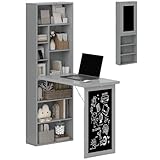
- Top Pick: HOMCOM Foldable Desk Wall Mounted Convertible Table for Small Spaces, Gray
- Best Value: Aibiju Expandable 3-in-1 Convertible Bookcase with Adjustable Width, 4-Tier Modern Storage Organizer, Space-Saving Wooden Bookshelf Rustic Brown YD-BC005H
- Premium Choice: Trygoal 3 in 1 Convertible Sofa Bed, Velvet Fabric Loveseat Sleeper Sofa with Side Pockets, Pull Out Couch with Adjustable Backrest for Small Spaces, Living Room, Bedroom, Apartment, Green
The best convertible furniture for small spaces is usually a wall bed for maximum floor recovery, a compact sleeper sofa for everyday seating, or a lift-top desk for combining work and gaming; choose by the furniture’s folded footprint rather than its advertised open size.
- Best convertible furniture at a glance
- 1. Wall beds: the best choice when floor space matters most
- 2. Sleeper sofas: the best balance of seating and occasional sleeping
- 3. Convertible chair beds: compact, but only for one person
- 4. Convertible desks for gaming and work
- 5. Decision matrix for a small room
- Comfort, durability, and assembly: what specifications miss
- Final recommendation
As an Amazon Associate we earn from qualifying purchases at no extra cost to you.


Best convertible furniture at a glance
| Furniture type | Typical folded footprint | Open footprint | Best for | Main compromise |
|---|---|---|---|---|
| Vertical wall bed | Approximately 65–75 in wide × 16–25 in deep | Approximately 80–90 in deep | Studios, guest rooms, gaming rooms used for more than gaming | Higher price and wall installation |
| Compact sleeper sofa | Approximately 70–85 in wide × 35–40 in deep | Approximately 75–85 in deep | Living rooms needing daily seating and occasional sleeping | Most sofa beds have thinner mattresses |
| Convertible chair bed | Approximately 30–40 in wide × 35–45 in deep | Approximately 75–85 in long | One-person guest sleeping or very small rooms | Narrow sleep surface |
| Lift-top or folding desk | Approximately 36–60 in wide × 18–30 in deep | Approximately 24–30 in deep at working height | Gaming and home-office setups | Less room for multiple monitors and accessories |
| Storage ottoman or bench | Approximately 24–48 in wide × 16–20 in deep | Usually unchanged | Extra seating, bedding storage, and foot support | Not a full sleeping solution |
1. Wall beds: the best choice when floor space matters most
A vertical wall bed gives the largest transformation: a full or queen sleeping surface disappears into a cabinet during the day. Models from companies such as Bestar and Resource Furniture use counterbalanced or assisted lift mechanisms, while Clei systems combine the bed with shelving, sofas, or desks.
For a small room, compare the closed depth first. A cabinet around 20 inches deep can replace a bed, but the mattress still needs roughly 80 inches of clear floor when opened. Leave at least 24 inches of walking space beside the bed where possible; 30–36 inches is more comfortable.
What to check
- Mattress compatibility: many wall beds accept a standard mattress, but some mechanisms specify a maximum thickness and weight. Confirm both before buying a premium mattress.
- Weight limits: distinguish the mattress limit from the total occupant limit. A queen bed rated for 1,000 pounds may still require a mattress below a specified weight.
- Mechanism type: piston-assisted systems are quieter and easier to operate than basic spring systems, but replacement parts may be more specialized.
- Wall attachment: secure installation into suitable studs or structural masonry is essential. Do not rely on drywall anchors alone.
- Clearance: measure ceiling height, nearby light fixtures, baseboards, outlets, and monitor arms before ordering.
A wall bed is the strongest choice if you need a real mattress every night but want the room available for a desk, exercise area, or gaming chair during the day. It is less attractive for renters unless the lease permits anchoring and the unit can be removed without major wall repair.
2. Sleeper sofas: the best balance of seating and occasional sleeping
A sleeper sofa is more practical than a wall bed when the room functions primarily as a lounge. The IKEA FRIHETEN sectional sleeper, for example, combines a chaise with a pull-out sleeping surface and built-in storage; the IKEA NYHAMN is a more compact sofa-bed format. Dimensions and mattress construction vary by region, so use the current product sheet for the exact configuration.
There are three common conversion mechanisms:
- Pull-out platform: the seat or a hidden platform extends forward. It is familiar and usually quick to operate, but requires clear floor space in front.
- Click-clack back: the backrest folds flat. This is simple and often inexpensive, although the center hinge can affect sleeping comfort.
- Folding foam seat: cushions unfold into a mattress. It stores efficiently and avoids a metal bar, but cushion seams may be noticeable.
For nightly sleeping, prioritize a continuous sleeping surface, a mattress at least 4–5 inches thick, and a support system that does not create a hard bar beneath the hips. For occasional guests, a thinner foam mattress may be acceptable. Sit on the sofa in its normal position and check that the seat depth supports your thighs without forcing your knees upward.
Also measure the open depth, not just the sofa depth. A sofa that is 38 inches deep may need 80 inches or more when converted. A useful rule is to keep a 30-inch route from the room entrance to the remaining furniture after the bed is opened.
3. Convertible chair beds: compact, but only for one person
A chair bed is the best fit for a home office, nursery, or gaming room that occasionally needs a guest bed. It usually folds from an armchair into a narrow single sleeping surface around 30–40 inches wide.
Choose one with a steel or reinforced wood frame, removable washable upholstery, and a mattress or cushion thickness that does not depend entirely on the floor for support. Check the unfolded length: some compact models are closer to 72 inches, which may be uncomfortable for taller adults.
Chair beds are also useful beside a wall bed. The wall bed handles regular sleeping, while the chair provides a second guest position without permanently consuming sofa-sized floor space.
4. Convertible desks for gaming and work
A folding desk or lift-top desk can be more valuable than a convertible sofa in a small gaming room. It lets you switch between a shallow storage footprint and a usable workstation, but the mechanism must support the actual equipment load.
Use this calculation before buying: a 27-inch monitor typically weighs about 12–20 pounds with its stand, a small desktop computer may weigh 20–35 pounds, and speakers, keyboard, mouse, and accessories can add 10–20 pounds. That creates a likely load of 42–75 pounds before leaning on the desk. A desk rated for only 40 pounds is therefore unsuitable, even if its surface is large enough.
For a dual-monitor gaming setup, allow at least 48 inches of width and 24 inches of depth. A 32-inch monitor plus a second display can fit on a 48-inch desk, but monitor arms need rear clearance and may not work with a thin folding panel. A single 27-inch display, laptop, and console fit more comfortably on a 36–42-inch surface.
Mechanisms worth comparing
- Drop-leaf desk: the simplest option. It folds flat against the wall or sides, but its hinges and wall brackets carry the working load.
- Lift-top desk: raises a work surface while retaining hidden storage. It is convenient for seated work but heavier and more complex to assemble.
- Desk concealed in a wall bed: preserves the desk when the bed is lowered on some designs. Check whether monitors, cables, or speakers must be removed during conversion.
- Folding console desk: excellent for laptops and controllers, but usually too shallow for a desktop tower or large monitor arm.
5. Decision matrix for a small room
| Your situation | Best choice | Minimum useful specification | Avoid if |
|---|---|---|---|
| You sleep there every night and need the floor during the day | Vertical wall bed | Full or queen size, assisted lift, suitable mattress support | You cannot anchor safely to the wall |
| You host guests once or twice a month | Sleeper sofa | At least 4-inch mattress, continuous support, storage for bedding | The open bed blocks the only doorway |
| You need one guest bed in a home office | Convertible chair bed | At least 30 inches wide and roughly 75 inches long | The guest is tall or will sleep there regularly |
| You need a gaming and work station | Lift-top or folding desk | 48 × 24 inches for dual monitors; load rating above actual equipment weight | The frame wobbles at full height |
| You need extra seating and hidden storage | Storage ottoman or bench | Hinges with a safety stop and a stated weight rating | Children could access an unsecured lid |
Comfort, durability, and assembly: what specifications miss
Conversion furniture experiences more movement than ordinary furniture, so inspect the joints rather than focusing only on upholstery. Look for metal hinges with replaceable hardware, reinforced corner blocks, smooth drawer runners, and legs that contact the floor evenly. A sofa that rocks when someone sits on one edge will usually become more unstable after repeated conversions.
Assembly time also changes the value calculation. A simple ottoman may take less than an hour, while a wall bed can require several hours and two or more adults, followed by professional anchoring. For heavy pieces, confirm that the package fits through stairwells, elevators, and doorways. A folded cabinet can be taller than the room’s doorway even when its final installation will fit.
Before finalizing a purchase, tape the folded and open dimensions on the floor. Mark the swing of cabinet doors, the pull-out path of a sofa bed, and the chair clearance beneath a desk. This catches the most common failure: furniture that technically fits but prevents drawers, doors, or walkways from working.
Final recommendation
Choose a wall bed when nightly mattress comfort and maximum daytime floor space are the priorities. Choose a sleeper sofa when seating is more important and sleeping is occasional. Choose a chair bed for a genuinely tiny room, and choose a properly load-rated lift-top or folding desk when the room must support both gaming and work. The best convertible furniture for small spaces is not the piece with the smallest folded dimensions; it is the one whose conversion path, comfort, load rating, and installation requirements match how you use the room every day.
Ready to decide? Our #1 pick for 2026 is the Vertical wall bed.
Live price & availability on Amazon.