Traditional astrophotography used to mean buying a telescope, a mount, a camera, cables and software separately, then spending several nights learning how it fits together. A beginner combo removes most of that friction. Here, a combo means a smart telescope with the camera, tracking mount and processing software built into one unit, sold as a complete package.
That convenience comes with honest limits. Small smart telescopes are superb at wide and mid-sized deep-sky targets such as the Orion Nebula, the Andromeda Galaxy and bright star clusters. They are not planetary instruments: their short focal lengths make Jupiter and Saturn small in the frame. If planets are your main interest, read our guide to the best cameras for astrophotography alongside this one, because a dedicated planetary camera is a different tool.
As an Amazon Associate we earn from qualifying purchases.
How these combos work, in plain terms
Each system below plate-solves the sky: the camera takes a short image, software matches the star pattern to a built-in catalogue, and the mount then knows where it is pointing. GoTo slewing moves to a target chosen in the app, tracking follows it as the Earth rotates, and live stacking combines many short exposures into one image that improves on your phone screen over minutes. Because exposures are short, most work on alt-azimuth mounts. Field rotation limits how long an alt-azimuth session can run before the corners smear, which is why two picks below add an equatorial mode for longer sessions.
Three published numbers predict most of what a combo can do. Aperture is the diameter of the light-gathering optic: more aperture collects more light and resolves finer detail. Focal length and sensor size together set the field of view. Focal ratio, written as f/5 or f/4, describes how fast the optics deliver light; lower numbers build an image faster per exposure.
ZWO Seestar S30 Pro
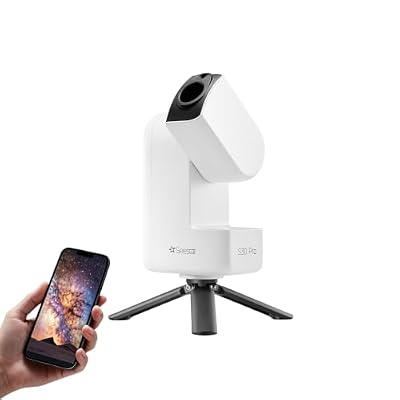
The Seestar S30 Pro is the most rounded starting point here: one box, a tripod included, and a wide view of the sky. ZWO builds it around a 30 mm telephoto aperture with a 160 mm focal length at f/5.3, as published in ZWO and retailer listings. That short focal length frames large targets whole, so the Andromeda Galaxy, the Orion Nebula, the Pleiades and Milky Way star fields fit without mosaics.
The camera side is dual: a Sony IMX585 telephoto sensor and a Sony IMX586 wide-angle sensor, each listed at 2160 by 3840 resolution, or 8.3 megapixels. The telephoto field of view is listed at 4.6 degrees; the wide camera covers 63 degrees. Storage is 128 GB, the mount is a motorized alt-azimuth GoTo unit, and the 6000 mAh battery is rated by ZWO laboratory data at about six hours. The listing includes the tripod, a filter and a Type-C cable in the box.
Who it suits, and who should skip it. Choose the S30 Pro for the widest framing here, a tripod in the box, and the simplest path to large nebulae, galaxies and clusters. Skip it if planets are your priority: at 160 mm the planets stay small, and 30 mm of aperture cannot resolve fine lunar detail like a larger optic. Never point any telescope at the Sun without the proper front filter fitted.
DWARFLAB Dwarf Mini

The Dwarf Mini is the travel pick. DWARFLAB lists it at 840 grams, about 1.85 pounds, the lightest complete system here by a wide margin. Its telephoto side uses a 30 mm aperture and a 150 mm focal length at f/5, paired with a Sony IMX662 sensor at 1920 by 1080 resolution. A wide-angle camera uses an OmniVision OS02K10 sensor, also at 1920 by 1080, for orientation and wide nightscapes.
What lifts the Mini above a novelty is mount flexibility. The listing describes Auto GoTo with alt-azimuth and equatorial tracking modes, and published material cites exposures of up to 90 seconds, long for this class and helpful in equatorial mode, where field rotation is controlled. Built-in filters, a solar filter in the box, and 64 GB of storage round out the package; the 7000 mAh battery is cited at roughly four hours of use.
Who it suits, and who should skip it. Choose the Mini if you hike, travel, or have limited storage, and want real deep-sky stacking from something that fits in a small daypack. Note that a tripod is not in the listed box contents, so budget for a photo tripod, and that the 2.1 megapixel class resolution is the lowest here. Skip it if detail matters more than portability.
DWARFLAB Dwarf 3
The Dwarf 3 keeps the Mini’s pocketable idea but spends more on camera and optics. Its telephoto aperture grows to 35 mm with a 150 mm focal length at f/4.3, and the main sensor becomes a Sony IMX678 Starvis 2 unit at 3840 by 2160, or 8.3 megapixels. A wide-angle camera with a Sony IMX307 sensor supports target finding and panoramas.
DWARFLAB lists 128 GB of storage, double the Mini, and a 10,000 mAh battery charged over USB-C. The mount offers alt-azimuth tracking and an equatorial mode, with built-in filters and cloud processing through the app. At about 1.35 kilograms it remains a travel instrument, though like the Mini it needs a tripod, sold separately.
Who it suits, and who should skip it. Choose the Dwarf 3 for the sharpest results in the smallest class here, plus daytime wildlife flexibility. Its telephoto field, about 2.93 by 1.65 degrees in published calculations, frames mid-sized nebulae and clusters comfortably. Skip it if you want an eyepiece or a big mirror’s light grasp: 35 mm gathers far less light than the 114 mm reflectors below, so faint galaxies take longer to build.
Unistellar eQuinox 2

The eQuinox 2 is the step up to a real telescope aperture in a fully automated package. Its Newtonian reflector mirror measures 114 mm with a 450 mm focal length at f/4, and it collects far more light than the small refractors above. The Amazon listing describes a digital, computerized system with a motorized alt-azimuth mount, app control, raw and FITS export, and 64 GB of storage, and rates the battery at up to 11 hours, the longest endurance figure here.
Published sources list a Sony IMX347 sensor with image output of 6.2 megapixels, a field of view of about 45.6 by 34.2 arcminutes, and a weight of about nine kilograms including the tripod. That narrower field is the trade for the bigger mirror: the core of Andromeda fits rather than the whole galaxy, while smaller targets such as the Ring Nebula, globular clusters and distant galaxies fill the frame far better. Unistellar rates it to a limiting magnitude of 18.2. There is no eyepiece; everything is viewed on a phone or tablet.
Who it suits, and who should skip it. Choose the eQuinox 2 if deep-sky reach matters most: faint galaxies, small planetary nebulae and dense clusters are its home ground, and the long battery suits full nights at a dark site. Note the manual side the small smart scopes hide: specification sources mention manual focusing with the included Bahtinov mask cap and occasional user collimation. Skip it if you want the lightest kit or an eyepiece, and note that a solar filter is sold separately.
Unistellar eVscope 2

The eVscope 2 shares its optical foundation with the eQuinox 2: the same 114 mm mirror, 450 mm focal length and f/4 ratio, on a motorized alt-azimuth mount with app control. The difference is how you look. This model adds an electronic eyepiece developed with Nikon, an OLED display at the eyepiece position showing the live stacked image, so you can put your eye to the telescope in the traditional way while the sensor does the work. For many beginners, and for sharing the sky with family who expect to look through something, that is a meaningful difference.
Published sources list a Sony IMX347 sensor with image output of 7.7 megapixels, raw and FITS export, 64 GB of storage, a tripod in the package, and a battery rated at nine hours in the Amazon listing data. The field of view matches the eQuinox 2: excellent for clusters, planetary nebulae, galaxies and the Moon, and too narrow for the largest nebulae.
Who it suits, and who should skip it. Choose the eVscope 2 for the reflector’s deep-sky reach plus the eyepiece experience. Skip it if you will only ever view on a screen, because the eQuinox 2 delivers the same optics without the eyepiece hardware, or if weight matters: at about nine kilograms with its tripod it is a car-based system. Manual focus and periodic collimation apply here as well.
Side-by-side comparison
| Combo | Aperture | Focal length and ratio | Main sensor as published | Mount | Battery as published |
|---|---|---|---|---|---|
| ZWO Seestar S30 Pro | 30 mm | 160 mm, f/5.3 | Sony IMX585 | Alt-azimuth GoTo | 6000 mAh, about six hours |
| DWARFLAB Dwarf Mini | 30 mm | 150 mm, f/5 | Sony IMX662 | Alt-azimuth GoTo, equatorial mode | 7000 mAh, about four hours |
| DWARFLAB Dwarf 3 | 35 mm | 150 mm, f/4.3 | Sony IMX678 Starvis 2 | Alt-azimuth, equatorial mode | 10,000 mAh |
| Unistellar eQuinox 2 | 114 mm | 450 mm, f/4 | Sony IMX347 | Motorized alt-azimuth GoTo | Up to 11 hours |
| Unistellar eVscope 2 | 114 mm | 450 mm, f/4 | Sony IMX347 | Motorized alt-azimuth GoTo | Nine hours per listing |
Buying advice: matching a combo to your sky and your targets
Start with targets, not specifications. If your list is the Orion Nebula, Andromeda, the Pleiades, open clusters and Milky Way fields, field of view is king, and the short focal lengths of the S30 Pro, Dwarf Mini and Dwarf 3 frame those objects best. If your list runs to smaller, fainter objects, aperture wins, and the 114 mm reflectors reach deeper.
Next, be honest about where you will observe. Light pollution does not stop these systems, because stacking and built-in processing are designed for suburban skies, but it changes expectations: bright nebulae photograph well from a city, while faint galaxy arms reward a drive to darker sky. The Dwarf models and the S30 Pro travel in a small bag; the Unistellar systems travel in a car.
Then check the unglamorous details. Confirm what the box contains, especially tripods: the S30 Pro lists one included, the Dwarf models do not, and the Unistellar systems include theirs. Plan power for a full night, and budget for a solar filter for any solar work. Finally, remember what none of these combos do: none replaces a long focal length planetary rig, none matches a cooled dedicated camera on a full equatorial mount for hours-long narrowband projects, and none shows the sky through glass, because every view here is a camera view.
Frequently asked questions
Can a beginner smart telescope photograph planets?
It can, with limits to accept before buying. The short focal lengths here make Jupiter and Saturn appear small, so you will see Saturn’s ring shape and Jupiter’s largest bands and moons, but not the fine detail that long focal length telescopes with dedicated planetary cameras record. The Moon, large and bright, photographs well with every pick here.
Do I need an equatorial mount as a beginner?
No. Every combo here tracks automatically in alt-azimuth mode, enough for the short stacked exposures these systems are built around. Equatorial mode, offered by the two DWARFLAB models, reduces field rotation on longer sessions, but it is an option to grow into.
What else do I need to buy before the first night?
Check the box contents for your pick. A tripod is the common gap, since the Dwarf Mini and Dwarf 3 list none included. You also need a phone or tablet for the app and a way to charge the battery.
How long does it take to get a recognizable image?
These systems stack exposures live, so a bright target such as the Orion Nebula typically becomes recognizable within minutes and keeps improving the longer you let it run. Faint galaxies take longer and reward darker skies.
Verdict
For most beginners, the ZWO Seestar S30 Pro is the easiest recommendation: a tripod in the box, the widest framing here, and dual 8.3 megapixel cameras. The Dwarf Mini is the pick when weight rules everything, and the Dwarf 3 is the better imager of the two small DWARFLAB models. When you are ready to trade portability for reach, the eQuinox 2 brings a 114 mm mirror and the longest battery life here, while the eVscope 2 adds the eyepiece experience on the same optics.
Product and ASIN Reference
| Product | ASIN |
|---|---|
| ZWO Seestar S30 Pro Smart Telescope | B0GYX9GSVX |
| DWARFLAB Dwarf Mini Smart Telescope | B0GT3VFN84 |
| DWARFLAB Dwarf 3 Smart Telescope | B0FHP6K4BK |
| Unistellar eQuinox 2 Smart Telescope | B0BRNSWXLS |
| Unistellar eVscope 2 Smart Telescope | B0BGSXC56W |