- Top Pick: Celestron SkyMaster 15×70 Astronomy Binoculars for Stargazing and Deep-Sky | Ideal Balance of Power & Brightness, For Night Sky Long-Range Viewing, Multi-Coated BaK-4 Optics, Tripod Adapter & Carry Case
- Best Value: Celestron Cometron 7x50mm Astronomy Binoculars | Wide-Field Astronomy Binocular, Porro Prism, Multi-Coated Optics, Comfortable Handheld, Tripod Adaptable, Carrying Case
- Premium Choice: Celestron SkyMaster 25×70 Binoculars for Astronomy, Long-Range & Wildlife | Exceptional Long-Range Detail, Astronomy & Wildlife or Land Viewing, Multi-Coated BaK-4 Optics, Tripod Adapter Included
Binoculars are the gentlest way into the night sky. They show the Moon’s craters, the Pleiades, and the star-rich band of the Milky Way without a telescope’s setup ritual. The catch is that astronomy asks different things from a pair than daytime viewing does. Aperture, magnification, and how the pair is held matter far more than weatherproof styling or a trendy coating name.
This guide is for first-time stargazers choosing between a light handheld pair and a heavy tripod-mounted giant. It also helps anyone picking up a pair for their 2026 backyard sessions who does not want to guess what “20×80” means. Every pick below is judged only from what its listing states, so you can match the numbers to your own sky and your own arms.
Quick Picks
As an Amazon Associate we earn from qualifying purchases at no extra cost to you.


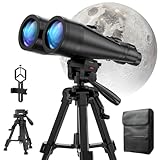


| Product | Best for | Key spec from the title |
|---|---|---|
| Celestron SkyMaster 15×70 | All-round starter | 15×70, BaK-4, tripod adapter and case |
| Celestron Cometron 7×50 | Handheld sweeping | 7×50, Porro prism, wide-field |
| Celestron SkyMaster 25×70 | Moon and planets | 25×70, tripod adapter included |
| Celestron SkyMaster 20×80 | Deep-sky targets | 80mm objectives, ultra-stable mounting |
| Generic 20×80 HD | Waterproof all-weather use | 20×80, BAK4, waterproof, tripod adapter |
| Celestron SkyMaster 25×100 | Dim nebulae and clusters | 100mm objectives |
| Aurosports 20×80 | Complete kit with strap | FMC coating, water-resistant, neck strap |
| Sogries 25×100 | Large-aperture alternative | 25×100, waterproof |
| Celestron SkyMaster 15-35×70 | Flexible magnification | 15-35x zoom, 70mm |
| Celestron SkyMaster 12×60 | Wide-field comfort | 12×60, handheld viewing |
How to Choose
Aperture beats magnification
The second number is the front lens diameter in millimeters, and it sets how much starlight the pair gathers. A 50mm lens is the practical floor for astronomy; 70mm to 100mm reveals clusters and faint patches that smaller glass misses. Ignore a big first number paired with a small lens, because it just magnifies a dim image.
Check the exit pupil
Divide the lens size by the magnification. A 7×50 gives about 7mm, a 15×70 gives about 4.7mm, and a 25×70 gives under 3mm. Dark-adapted eyes open to roughly 5 to 7mm, so lower-power pairs deliver relaxed, bright views while high-power pairs trade brightness for detail.
Plan for the tripod
Anything above roughly 10x shakes noticeably in bare hands, and 70mm-plus models are heavy to hold overhead. Look for a listing that mentions a tripod adapter or tripod mount, then budget separately for a sturdy tripod. Skipping this step is where most disappointing first nights begin.
Prisms, coatings, and weather
BaK-4 prisms and multi-coated or fully multi-coated optics are the sensible baseline for a bright, even image. Waterproof or water-resistant wording is welcome for damp, dewy evenings, but it matters less than aperture. Budget models usually cut corners on edge sharpness and focus smoothness, so keep realistic expectations at the edge of the view.
The 10 Best Options
Celestron SkyMaster 15×70
This is the sensible middle path for a newcomer who wants real astronomy performance without committing to a monster. The title lists multi-coated BaK-4 optics, a tripod adapter, and a carry case. It suits someone who expects to look at the Moon one night and the Orion region the next, and who is happy to mount the pair on a basic photo tripod for longer sessions.
- 70mm lenses give a roughly 4.7mm exit pupil, a good balance of brightness and power
- Ships with the adapter and case, so little else is needed to get started
- Trade-off: 15x is shaky without a tripod
Skip it if you want strictly handheld, grab-and-go viewing.
Celestron Cometron 7×50
The Cometron targets people who want to sweep across rich star fields by hand. The listing highlights a wide-field design, Porro prisms, multi-coated optics, and tripod adaptability. It is the pair a parent or a casual observer can hand around a backyard without a lecture on mounts, and it works well for finding your way around constellations before moving up in power.
- Low 7x power is forgiving of shaky hands
- 50mm lenses and a case make it an easy backyard companion
- Trade-off: the modest magnification will not pull in much planetary detail
Skip it if you mostly want close lunar craters.
Celestron SkyMaster 25×70
Aimed at buyers who care about the Moon, Jupiter’s neighborhood, and distant landscape targets, this model leans on magnification. The title notes multi-coated BaK-4 optics and an included tripod adapter. The astronomy-and-wildlife wording means one pair can double as a spotting tool for distant ridgelines during the day, which helps justify the extra weight to a household with mixed interests.
- 25x power brings long-range detail for both sky and land
- Adapter included, which this power level essentially demands
- Trade-off: a smaller exit pupil makes the image dimmer than lower-power pairs
Skip it if wide, sweeping star fields are your priority.
Celestron SkyMaster 20×80
Built around 80mm objectives, this one is for the person who has already enjoyed the Moon and now wants nebulae and clusters. The listing mentions multi-coated BaK-4 optics and ultra-stable mounting. Its 20x power with 80mm glass is a popular stepping stone for people stepping up from entry-level pairs, offering a clear jump in light grasp without the bulk of the 100mm class.
- 80mm aperture collects noticeably more light than 70mm models
- Tripod-adaptable design suits long observing sessions
- Trade-off: the larger body is heavy for casual carrying
Skip it if you do not own, or plan to buy, a tripod.
Generic 20×80 HD Astronomy Binoculars
This unbranded 20×80 is for buyers who want big-aperture views plus weather resistance in a single package. The title lists HD optics, a BAK4 prism, waterproofing, a tripod, an adapter, and a carrying case. The moon-observation and wildlife-watching wording also hints at flexible use, so it can serve a camper or a cabin owner who wants one pair for both the night sky and the tree line.
- Waterproof wording suits damp nights and outdoor storage
- Bundled tripod and adapter reduce extra shopping
- Trade-off: no recognizable brand, so support and quality consistency are harder to judge
Skip it if a known manufacturer’s backing matters to you.
Celestron SkyMaster 25×100
The giant of the lineup, with 100mm objectives intended for deep-sky observers. The listing stresses crisp views in low light and a build aimed at long-distance viewing. Think of it as the dedicated stargazer’s tool: something you set up on a fixed mount in the yard or at a dark-sky site, then sit behind for an hour while you drift through a cluster-rich region.
- 100mm lenses capture the most light of any option here
- Strong fit for dim clusters and nebulae under dark skies
- Trade-off: expect serious weight and a mandatory sturdy mount
Skip it if you want something light enough to carry on a hike.
Aurosports 20×80
A packaged option for newcomers who like an accessory-heavy kit. The listing names BAK4 prisms, FMC coating, 80mm lenses, a tripod mount, water resistance, a case, and a neck strap. For a buyer who wants everything in one box and does not mind an unfamiliar brand, the 80mm aperture still delivers the main attraction of the format: more light for faint objects than 70mm rivals can collect.
- FMC coating is aimed at low-light clarity
- Neck strap and case make transport simple
- Trade-off: water-resistant is a weaker promise than fully waterproof
Skip it if you plan to observe in wet climates.
Sogries 25×100
This one pairs 100mm glass with 25x power at a lesser-known brand, appealing to buyers who want maximum aperture. The listing mentions waterproofing and general stargazing use for planets and long-distance viewing. It targets adults who already know they want big glass and are comfortable assembling a mount, accepting that brand reputation is thinner than with long-established optics makers.
- 100mm objectives gather plenty of light for faint targets
- Waterproof claim supports use under unpredictable skies
- Trade-off: the title says little about prism or coating grade
Skip it if you want clearly stated optical specifications.
Celestron SkyMaster 15-35×70
For the buyer who cannot decide on a power level, the zoom lets you vary between 15x and 35x. The title lists multi-coated BaK-4 optics and an included tripod adapter. It fits families or clubs where one pair has to satisfy a beginner who wants a wide first look and an enthusiast who wants a closer view of the Moon, simply by turning the zoom ring.
- One pair covers wide scans and closer looks at the Moon
- Tripod adapter included for the higher settings
- Trade-off: zoom designs usually narrow the field and dim the image at the top end
Skip it if you prefer fixed-power simplicity.
Celestron SkyMaster 12×60
This is the comfortable compromise for people who want something they can actually hold. The listing describes wide-field viewing, multi-coated BaK-4 optics, and a soft carrying case. The wide field makes it easier to find targets such as the Andromeda Galaxy region or the Double Cluster, and it suits a viewer who observes from a lawn chair more often than from a tripod.
- 60mm lenses and 12x give a roughly 5mm exit pupil for bright views
- Designed for handheld viewing, with a case for storage
- Trade-off: it gathers less light than the 70mm and 80mm siblings
Skip it if faint deep-sky objects are the whole point.
Which One Fits Your Situation
You want one pair, no tripod, no fuss
The Celestron SkyMaster 12×60 or the Cometron 7×50 are the realistic handheld choices. Pick the 7×50 if steadiness is the priority and the 12×60 for a bit more reach.
You are drawn to nebulae and star clusters
Go to the Celestron SkyMaster 20×80 or the 25×100, and plan on a solid mount. Their larger objectives are the only route to those faint targets.
You need something weather-ready
The generic 20×80 lists waterproofing and bundles a tripod. If you prefer a branded body, the 15×70 is a calmer, lighter step down.
You like flexible magnification
The Celestron SkyMaster 15-35×70 lets you change power without swapping gear, which suits a household where several people share one pair.
Common Mistakes
- Chasing the highest magnification and ignoring lens diameter, which only enlarges a dim picture.
- Buying 20x or stronger without any plan for a tripod.
- Assuming “waterproof” replaces the need to wipe dew from the lenses after a session.
- Observing from a bright porch light zone, where even 100mm glass struggles.
- Ignoring eye relief and neck comfort when you wear glasses or plan long sessions.
Related guides
- Combination Smoke And Carbon Monoxide Detectors
- Aio Liquid Coolers For High Performance Gaming
- How To Lower Input Delay In Competitive Shooters
Frequently Asked Questions
Is 10×50 enough for astronomy?
It is a fair introduction, but pairs around 15×70 and above reveal noticeably more. The 50mm class is best for wide star fields and meteor watching.
Do I need a tripod?
For 15x and above, yes, or at least a solid brace against a wall or chair. A tripod adapter listed in the title makes this simple.
Can I use these for daytime viewing too?
Several listings mention wildlife or long-range land viewing. Larger models are heavy, so handheld daytime use is easier with the lower-power picks.
Which is better, 20×80 or 25×100?
The 25×100 gathers more light, while the 20×80 is lighter and easier to mount. Choose by how much weight your tripod can carry and how dark your skies are.