- Top Pick: TV Antenna Indoor, Digital Amplified Indoor HDTV Antenna, 1080p VHF UHF Television Local Channels Detachable Signal Amplifier and 16.5ft Long Coax Cable
- Best Value: TV Antenna for Smart TV Indoor, Digital TV Antenna for Local Channels | HD Digital Antenna with Amplifier Signal Booster for Local Channels Supports 4K 1080p-16.5 ft Long Cables
- Premium Choice: DAANT TV Antenna Indoor Long Range | Supports 4K 1080p Smart TV Signal Reception with 16ft HDTV Coax Cable
Cutting the cable bill sounds simple until the first channel scan comes back with half the local stations missing. An amplified indoor antenna is the usual fix: a thin panel or sheet on a window or wall, a coax run to the TV, and a small booster that lifts weak signals before they reach the tuner. The catch is that the amplifier is only one piece of the decision. Cable length, the bands the antenna covers, and how well it copes with your distance from the towers matter just as much, and the 2026 market is full of listings that promise far more than broadcast physics allows.
This guide is for renters, apartment dwellers, and anyone with a spare room or kitchen TV who wants free local channels without climbing onto a roof. We compare seven amplified or amplifier-ready indoor models using only what their listings state: cable length, supported bands, claimed range, and mounting style. Use the table to shortlist, then read the buying section to match an antenna to your own signal situation.
Quick Picks
As an Amazon Associate we earn from qualifying purchases at no extra cost to you.
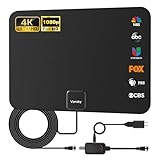


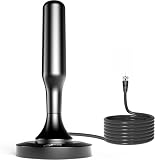


| Product | Best for | Key spec from the title |
|---|---|---|
| Vansky Amplified HDTV Antenna | Removable-booster flexibility | VHF/UHF, detachable amplifier, 16.5ft coax |
| Intelbras Indoor HD Antenna | Smart TV setups | Amplifier signal booster, 16.5ft cable, 4K/1080p |
| DAANT Long Range Indoor Antenna | Simple window mounting | 16ft HDTV coax, 4K/1080p support |
| NEOSIGN Indoor Antenna | Mid-room TV placement | Signal booster, 16.5ft cable, long-range claim |
| HIDB Magnetic Base Antenna | Quick, tidy setup | Magnetic base, 10ft cable, OTA digital HD |
| MVAFRUOY Long Cable Antenna | TV far from the window | 38ft coax, booster amplifier, 8K/4K/1080p |
| RCA ANT1360E Flat Antenna | Known-brand flat panel | Multi-directional VHF/UHF, 40 mile range |
How to Choose
Match the Range Claim to Your Real Distance
Every listing here makes a range claim, and they are not equal. The RCA lists a 40 mile range, a figure in line with how indoor antennas are normally described. Another listing advertises 6000-plus miles, which no indoor antenna can deliver, because broadcast signals fade with distance, terrain, and walls. Treat inflated numbers as marketing and look up how far your local stations transmit from. If the towers are within roughly 30 miles in open terrain, nearly any model can work; beyond that, favor the antenna with a real amplifier and the best window position.
Decide Whether You Need the Amplifier at All
An amplifier helps when the signal is weak or when a long cable and a splitter eat into it. It can hurt when you live close to the towers, because a strong signal can overload the tuner and cause pixelation. That is why a detachable booster, as on the Vansky, is a useful design: you can run the antenna bare first and add the amplifier only if channels are missing. Also note that two listings here, the DAANT and the HIDB, do not mention an amplifier in the title, so confirm what is in the box before you buy.
Check Cable Length Against Your Room Layout
The cables range from 10ft on the HIDB to 38ft on the MVAFRUOY, with most clustered around 16ft. Reception improves the closer the antenna sits to a window, so measure the run from the best window to the TV before choosing. A short cable that forces a poor position can lose you more channels than a modest amplifier gains back. Walls, metal blinds, and low-emissivity window glass all weaken the signal, so a spot near plain glass facing the towers is worth chasing before anything else. If the best window is across the room, the long coax saves you from adding a joint or extension, which is another point where signal leaks away.
Ignore Resolution Badges, Check Bands and Coverage
Labels such as 4K, 8K, and 1080p describe what the TV can display, not how the antenna performs; over-the-air broadcasts arrive in whatever format the station sends. A more meaningful spec is band coverage: look for both VHF and UHF, since some local networks still use VHF channels. Multi-directional designs help when stations sit in different compass directions, while a single-direction panel needs repositioning for each. Budget models usually cut corners on cable quality and shielding, so a thin cable is a reason to be careful.
The 7 Best Options
Vansky Amplified HDTV Antenna
The Vansky listing describes a digital amplified antenna covering VHF and UHF, with a detachable signal amplifier and a 16.5ft coax cable. It fits a buyer who is unsure whether a booster will help, since the amplifier can be removed if a strong signal gets overloaded.
- Strength: the detachable amplifier lets you compare reception with and without boost.
- Strength: both VHF and UHF are named in the listing, which covers the full range of local channels.
- Trade-off: the title gives no range figure, so you cannot gauge distance capability from the listing alone.
Skip it if you want a panel with a stated mile range to compare against your tower distance.
Intelbras Indoor HD Antenna
This model is worded for smart TV owners, listing a built-in amplifier signal booster, support for 4K and 1080p, and a 16.5ft cable. It suits a living room where the TV sits within a short walk of a window and you want a plug-in solution with no fuss.
- Strength: the amplifier is part of the design, so there is nothing extra to source.
- Strength: the 16.5ft cable gives reasonable placement freedom around a window.
- Trade-off: the listing does not separate VHF and UHF, so band coverage is less clear than on some rivals.
Skip it if your TV is far from any window, where a longer cable would serve you better.
DAANT Long Range Indoor Antenna
The DAANT title leans on a long-range label, support for 4K and 1080p, and a 16ft HDTV coax cable. It is a straightforward pick for a bedroom or spare-room TV where simplicity matters more than extras.
- Strength: a 16ft cable is long enough for most window-to-TV runs.
- Strength: the listing keeps its claims modest, with no mile figure to doubt.
- Trade-off: the title does not mention an amplifier, which is the defining feature of this category.
Skip it if you specifically need a booster for a weak-signal area; confirm the contents first.
NEOSIGN Indoor Antenna
The NEOSIGN listing combines a signal booster, a 16.5ft cable, 4K and 1080p support, and a long-range reception claim in a black finish. It is a sensible middle option for a TV in a den or kitchen where black blends with other gear.
- Strength: it lists an amplifier booster alongside a generous 16.5ft cable.
- Strength: the black finish is less conspicuous on a wall or window frame.
- Trade-off: the range claim has no number attached, so it is hard to compare with other models.
Skip it if you want a magnetic or adhesive-free mount, since the title mentions neither.
HIDB Magnetic Base Antenna
The HIDB takes a different approach, listing a magnetic base, a 10ft cable, and an OTA digital HD design built around easy setup. It is a fit for a small apartment or dorm where the TV is near a window and a metal surface, such as a radiator cover or window frame, is nearby.
- Strength: the magnetic base makes repositioning quick while you hunt for the best signal.
- Strength: the shorter cable keeps cable clutter down in tight spaces.
- Trade-off: no amplifier is named in the title, and the 10ft cable limits how far the TV can sit from the window.
Skip it if you live far from the towers or need a long cable run.
MVAFRUOY Long Cable Antenna
The MVAFRUOY stands out for its 38ft coax cable and a booster amplifier, with support for 8K, 4K, and 1080p. It targets rooms where the TV sits well away from the window, such as a basement den or a long living room.
- Strength: the 38ft cable solves awkward layouts without extra extensions.
- Strength: an amplifier is included to offset some of the loss over that long run.
- Trade-off: the 6000-plus mile claim is not believable for an indoor antenna and should not drive your decision.
Skip it if your TV is near a window; the extra cable would only coil up behind the set.
RCA ANT1360E Flat Antenna
The RCA is a flat, multi-directional antenna covering VHF and UHF, with a 40 mile range stated in the title and an amplified design. It suits households that prefer a familiar electronics brand and a number they can check against a tower map.
- Strength: the 40 mile figure is believable and easy to compare with your actual distance.
- Strength: multi-directional reception helps when stations come from different directions.
- Trade-off: the title does not list a cable length, so measure your run and confirm the included cord.
Skip it if you live well beyond 40 miles from the broadcast towers.
Which One Fits Your Situation
Small Apartment, TV Beside a Window
The HIDB Magnetic Base Antenna is the natural fit. Its 10ft cable is enough when the set is close to the glass, and the magnetic base lets you shift position during a channel scan without hardware.
TV on the Far Side of the Room
Go with the MVAFRUOY Long Cable Antenna. The 38ft coax lets you mount the antenna at the best window and still reach a distant TV, and the amplifier helps offset loss over the length.
Not Sure You Need a Booster
The Vansky Amplified HDTV Antenna lets you experiment. Try it with the amplifier detached, scan for channels, then reattach the booster only if stations drop out.
You Want a Checkable Range Number
The RCA ANT1360E gives you a 40 mile figure to compare against a tower map. If your stations are inside that radius, the multi-directional panel is a sensible, low-risk choice.
Common Mistakes
- Believing impossible range claims, such as thousands of miles, instead of checking the real tower distance.
- Adding an amplifier when living close to towers, which can overload the tuner and break up the picture.
- Mounting the antenna low or behind a wall rather than at a window, where reception is usually strongest.
- Skipping a full channel rescan after every move, so the TV never learns the stations that now come in.
- Buying on resolution badges like 4K and 8K when the real question is VHF and UHF coverage.
Related guides
- Combination Smoke And Carbon Monoxide Detectors
- Aio Liquid Coolers For High Performance Gaming
- Graphics Cards For Low Wattage Power Supplies
Frequently Asked Questions
Does an amplifier always improve reception?
No. It helps with weak signals and long cable runs, but it can overload the tuner when you are close to the towers. A detachable amplifier gives you the option to try both ways.
Do I need a special antenna for 4K TVs?
No. Broadcast channels arrive in the format the station sends, so any antenna that covers the right bands will work. The 4K label on a listing mainly signals compatibility with newer TVs.
Where should I place an indoor antenna?
Put it as high as practical and as close to a window as you can, ideally facing the direction of the towers. After each move, run a fresh channel scan on the TV.
How long a cable do I need?
Measure from the best window to the TV and add a little slack. Most listings here offer around 16ft, while one offers 38ft for large rooms and another only 10ft for tight setups.