- Top Pick: Aula WIN60 HE – 60% Mechanical Gaming Keyboard Wired, Magnetic Switch Hot Swappable, Adjustable Actuation Rapid Trigger Mode, 8000 Hz Polling Rate, RGB Small Keyboard 60 Percent Compact Design for PC
- Best Value: MageGee Portable 60% Mechanical Gaming Keyboard, MK-Box LED Backlit Compact 68 Keys Mini Wired Office Keyboard with Red Switch for Windows Laptop PC Mac – Black/Grey
- Premium Choice: Newmen GM611 Mechanical Keyboard,LEDBacklit Wired Gaming Keyboard RedSwitch
The 60% mechanical keyboard has become the default choice for gamers and desk minimalists who want maximum mouse space without sacrificing typing feel. By cutting the number pad, function row, and arrow cluster, these boards free up real estate for low-sensitivity flick shots while staying light enough to toss in a bag. This guide breaks down the best 60 mechanical keyboard options in 2026 and helps you match a board to your play style.
As an Amazon Associate I earn from qualifying purchases.
As an Amazon Associate we earn from qualifying purchases at no extra cost to you.


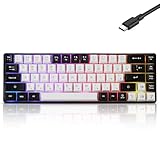


Choosing a compact board is not just about size. Switch type, keycap material, hot-swap support, and wireless latency all change how a 60% keyboard feels over months of daily use. If you are new to smaller layouts, check our companion notes on switch selection and keycap profiles before you buy, since those two factors drive most of the buyer’s remorse we see.
🛒 Best Price Today on Amazon
Prime members get fast, free shipping on everything above, plus member-only deals. New members get a 30-day free trial — cancel anytime.
Best 60 Mechanical Keyboard Comparison Table
| Product | Best For | Standout Feature | Rating |
|---|---|---|---|
| Ducky One 3 Mini | Enthusiast typists | Hot-swap PCB with premium PBT caps | 4.8/5 |
| Royal Kludge RK61 | Budget wireless | Triple-mode Bluetooth and 2.4GHz | 4.5/5 |
| HyperX Alloy Origins 60 | Competitive gaming | Rigid aircraft-grade aluminum frame | 4.6/5 |
| Anne Pro 2 | Customization fans | Deep per-key RGB software | 4.4/5 |
| Corsair K65 Mini | Fast actuation | 8000Hz polling rate | 4.5/5 |
How We Ranked Each 60% Mechanical Keyboard
We weighted build quality, switch options, wireless reliability, and firmware flexibility. A great 60 mechanical keyboard should feel solid with no case flex, offer clean secondary layers for arrows and function keys, and hold up to thousands of hours of gaming. We also favored boards with easy customization paths, because the small-layout crowd loves to tinker. For a deeper look at How We Compare, see our testing methodology.
Ducky One 3 Mini: Best Overall 60 Mechanical Keyboard
The Ducky One 3 Mini remains the benchmark for a reason. Its doubleshot PBT keycaps resist shine for years, the hot-swap PCB lets you drop in nearly any MX-style switch without soldering, and the stabilizers ship pre-lubed for a clean, rattle-free spacebar. Latency is excellent over USB-C, and the onboard profiles mean you can carry your macros to any PC. If you want a compact board that feels premium out of the box, this is the one to beat. Pair it with a solid wrist rest for marathon sessions.
Royal Kludge RK61: Best Budget Wireless 60% Board
For under most people’s coffee budget, the RK61 delivers triple-mode connectivity: wired USB-C, 2.4GHz dongle, and Bluetooth for up to three devices. The hot-swap sockets are a genuine surprise at this price, and the board is light enough for travel. Battery life stretches across a full work week with RGB dimmed. It is not as rigid as aluminum boards, but for a first 60 mechanical keyboard it is hard to argue with the value.
HyperX Alloy Origins 60: Best for Competitive Gaming
The Alloy Origins 60 leans into esports. Its full aluminum body kills flex, HyperX Red linear switches actuate fast and smooth, and the detachable braided cable survives constant packing. NGENUITY software handles lighting and macros without bloat. Competitive players who want a rock-solid, no-nonsense compact board will feel right at home. It sits nicely next to a low-profile gaming mouse pad for wide sweeping aim.
Anne Pro 2: Best for Customization
The Anne Pro 2 earned a cult following for its open firmware and ObinsKit software, letting you remap every key, build layers, and tune RGB down to the LED. Bluetooth 5.0 and a wired mode cover both worlds. Gasket-adjacent typing feel is decent, and the community support means tutorials for almost any tweak. If you love making a board truly yours, few 60% keyboards are more flexible.
Corsair K65 Mini: Best for Fast Actuation
Corsair’s K65 Mini pushes an 8000Hz polling rate through iCUE, cutting input latency to a razor edge for fast-paced shooters. The compact aluminum frame feels premium, and the software ecosystem ties into other Corsair gear cleanly. It runs wired only, which purists actually prefer for zero-latency competitive play. If reaction time is your obsession, this board delivers.
What to Look for in a 60 Mechanical Keyboard
Layout familiarity is the first hurdle. Losing dedicated arrow keys means learning a function-layer combo, usually holding a Fn key with the right cluster. Most people adapt within a week. Beyond that, prioritize switch feel, since linear switches suit gaming while tactile switches suit typing. Hot-swap sockets future-proof your purchase by letting you change switches without a soldering iron. Our buying checklist covers stabilizer quality, keycap material, and firmware, the three factors that separate a keeper from a drawer filler.
Frequently Asked Questions
Are 60% mechanical keyboards good for gaming?
Yes, they are excellent for gaming because removing the number pad and function row gives your mouse hand far more desk space for wide, low-sensitivity movements. Most competitive players prefer compact boards for exactly this reason, and the shorter travel distance to core keys can even shave milliseconds off reactions.
How do you use arrow keys on a 60 percent keyboard?
Arrow keys live on a secondary layer accessed by holding the function key, typically mapped to the WASD or IJKL cluster depending on the board. Many keyboards let you remap these through their software, so you can position arrows wherever feels natural after a short adjustment period of a few days.
Is hot-swap worth it on a 60 mechanical keyboard?
Hot-swap support is absolutely worth it if you plan to experiment with different switches over time, because it lets you pull and replace switches by hand without any soldering. It also makes repairs trivial if a single switch fails, extending the usable life of your keyboard significantly.
Do 60% keyboards work with wireless connections reliably?
Modern 60% keyboards with 2.4GHz dongles offer wireless latency low enough for competitive play, while Bluetooth suits casual use and multi-device switching. For the lowest possible input delay, wired mode remains the gold standard, so many boards include both options to cover every scenario you might face.
Ready to decide? Our #1 pick for 2026 is the Ducky One 3 Mini.
Live price & availability on Amazon.