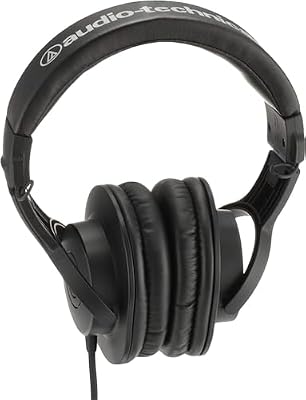
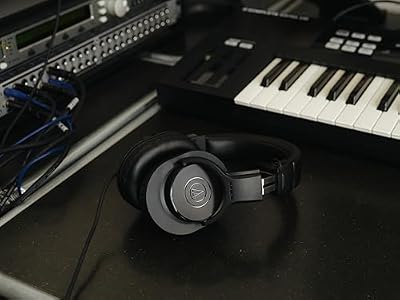
The Audio-Technica ATH-M20x is the entry point to Audio-Technica’s well-respected M-series of closed-back studio monitor headphones — the affordable starting rung of a ladder that climbs through the M30x, M40x and M50x. It pairs a 40mm dynamic driver with a closed-back chassis, a 47-ohm impedance and a fixed straight cable for around $49. This Audio-Technica ATH-M20x review covers the sound signature, comfort, the budget closed-back case, amp requirements, who they suit and a verdict.

Audio-Technica ATH-M20x Professional Studio Monitor Headphones, Black | Closed-back design with 40mm drivers and 3m cable for monitoring, tracking and mixing





As an Amazon Associate we earn from qualifying purchases. Product prices and availability are accurate as of the date/time indicated.
🛒 Best Price Today on Amazon
Prime members get fast, free shipping on everything above, plus member-only deals. New members get a 30-day free trial — cancel anytime.
As an Amazon Associate we earn from qualifying purchases.







Audio-Technica ATH-M20x at a Glance
| Specification | Detail |
|---|---|
| Type | Closed-back over-ear |
| Driver size | 40mm dynamic |
| Impedance | 47 ohm |
| Frequency response | 15 Hz – 20 kHz |
| Sensitivity | 96 dB SPL/mW |
| Wired / Wireless | Wired only |
| Connection | 3.5mm with screw-on 6.35mm adapter (fixed straight cable) |
| Weight | Approx. 190 g |
| Approx. price | Around $49 |
Sound Signature & Tonality
Before getting into the specifics of this set it is worth a short refresher on the realities that shape every studio-headphone review. The headline distinction is open-back versus closed-back. A closed-back design seals the ear cup with a solid outer shell, isolating the listener from external noise and stopping the music from leaking outward — that is what you want for a noisy office, a podcast booth or any environment where a microphone is open near your head. An open-back design replaces the solid shell with a grille or perforated cup; sound flows in both directions, you hear the room, the room hears you, but the trade-off is a far more spacious, three-dimensional presentation that audiophiles and mixing engineers prize. Semi-open designs split the difference and are less common.
The second reality is impedance, measured in ohms. Most consumer headphones sit between 16 and 50 ohms and run loud from a phone or laptop without help. Professional studio cans push higher — 80, 250, even 600 ohms — because higher-impedance drivers are easier for an amplifier to drive cleanly and are designed to be fed by a proper amp or audio interface, not a phone jack. The well-known Beyerdynamic DT 770 PRO at 250 ohms, for instance, sounds noticeably quiet and lifeless straight from a laptop; pair it with an entry-level USB DAC or headphone amp and the same set comes alive with authority. Lower-impedance 80- or 32-ohm versions of the same headphone are the right choice if you only have a phone or a basic laptop output.
Finally tonality and use case. Studio monitor headphones are tuned to be honest rather than flattering — the Sony MDR-7506, the Audio-Technica M-series and the Beyerdynamic DT 770 are all designed so that an engineer can hear exactly what is in a mix, including its flaws. That same honesty makes them excellent for gaming directional cues and dialogue intelligibility, less obviously thrilling for casual music listening compared to consumer cans with boosted bass. Audiophile open-back sets like the Sennheiser HD 599 or Beyerdynamic DT 990 PRO trade isolation for soundstage and air; they are wonderful at a quiet desk and frustrating on a train. Pick the set that matches your real environment, not the one with the prettiest graph.
The M20x delivers an honest, balanced presentation that punches well above its price tag — the family resemblance to the more expensive M-series is immediately audible. The 40mm driver gives a warm, slightly bass-leaning sound that suits podcasts, dialogue, casual gaming and most mainstream music without ever sounding bloated. Treble is gentler than the brighter Sony MDR-7506, so long sessions are less fatiguing for the casual listener, and the midrange is the clearest part of the response — voices, acoustic instruments and game dialogue all sit forward in the mix. Compared to the M50x the bass is a little less articulate and the soundstage is more confined, but for the price the M20x is a genuinely useful starter monitor. For the wider mixing-focused category see our best headphones for mixing guide.
Comfort & Weight Over Long Sessions
At around 190 grams the M20x is one of the lightest closed-back monitors in this guide, and that low weight pays dividends on long sessions — there is no head-top pressure, the cups sit comfortably around average ears and the clamp is modest. The synthetic-leather pads warm up after an hour or two as all closed-back pleather pads do, but the light weight more than compensates for the long-session friendliness. The headband is well padded for the price. The fixed cable is the comfort cost — it cannot be unplugged for transport — but for a budget set most buyers accept that trade-off. For multi-hour gaming, podcasting or remote-meeting sessions the M20x is genuinely friendly to wear.
Open vs Closed – Use Case
The M20x is closed-back, and that is the right design for its intended buyer. The closed cup isolates the listener from the room and stops sound leaking outward — essential if you share a desk, record voice with an open microphone or game in a busy household. The trade-off versus an open-back is a less expansive soundstage, but for podcasting, streaming, gaming in shared spaces and beginner mixing work, isolation is the priority. A first-time monitor buyer almost always wants closed-back for this practical reason, and the M20x delivers it at the lowest price tier in the M-series. Audiophiles chasing the largest soundstage should look at our best open-back headphones guide instead.
Amp Requirements & Impedance
At 47 ohms with 96 dB sensitivity the M20x is easy to drive from a phone, laptop, audio interface or basic on-board PC audio — it does not need an external amp, though it benefits modestly from one. The 96 dB sensitivity is a touch lower than the M50x or MDR-7506, so very weak laptop headphone outputs may need to push higher volume settings to reach comfortable listening levels, but in practical use the headphone is straightforward to power. A modest USB DAC or audio-interface headphone output is the natural upgrade if you graduate from a phone to a desktop setup. For relevant DAC options our best headphone DACs guide covers the entry tier.
Best For – Gaming / Mixing / Casual
The M20x is the right pick for the buyer who wants the family-trusted Audio-Technica sound at the lowest possible price — a first-time podcaster, an aspiring producer learning a DAW, a gamer who has outgrown a cheap headset, or a remote worker who wants a comfortable closed-back set for hours of meetings. It is not the right pick for the buyer who can stretch to the M40x or M50x and wants more refined bass, a detachable cable system and a slightly more spacious soundstage. The M20x is honest about what it is: a budget entry to a respected family, and a sensible first studio headphone purchase. The wider category is covered in our best studio headphones guide.
Verdict
At around $49 the Audio-Technica ATH-M20x is the best value entry point to the M-series, and one of the most honest budget closed-back monitors on the market. Buyers who can stretch should step up to the M30x or M40x for more refined sound and the M40x’s detachable cable; buyers on the strictest budget should consider the OneOdio Studio Monitor for an even cheaper closed-back. For the buyer who wants the trusted Audio-Technica name and a balanced, lightweight, honest closed-back set at entry-level cost, the M20x earns its place. See also our best headphones for gaming guide for gaming-focused alternatives and our best closed-back headphones guide for the wider category.
Frequently Asked Questions
Are the Audio-Technica ATH-M20x good for mixing?
Yes, for learning to mix at the entry tier. The balanced, slightly warm tuning is honest enough to develop ear training on, though more serious work benefits from stepping up to the M40x or M50x.
Do the ATH-M20x need an amp?
No. At 47 ohms with 96 dB sensitivity they run from a phone, laptop or audio interface without an external amplifier. A USB DAC is a sensible later upgrade.
Can the cable on the ATH-M20x be replaced?
No. Unlike the M40x and M50x, the M20x has a fixed straight cable. This is one of the budget compromises of the entry-level model.
How do the ATH-M20x compare to the M50x?
The M50x has a more refined and articulate bass, a slightly more spacious soundstage and a detachable cable system; the M20x is lighter, cheaper and shares the same broad family character. For most buyers the M50x is worth the extra spend if budget allows.
More Studio Headphone Reviews
- Beyerdynamic DT 990 PRO 250 Ohm Review: Open-Back Studio Classic
- Beyerdynamic DT 770 PRO 80 Ohm Review: Closed-Back Studio Standard
- Audio-Technica ATH-M40x Review: Mid-Tier Studio Monitor
- Sennheiser Momentum 4 Wireless Review: Consumer Audiophile ANC
- Audio-Technica ATH-M30x Review: Budget Studio Monitor
- AKG K240 STUDIO Review: Semi-Open Classic for Mixing
- Sennheiser HD 599 Special Edition Review: Open-Back Audiophile
- Beyerdynamic DT 770 PRO 250 Ohm Review: Closed-Back Studio Reference
Affiliate Disclosure: As an Amazon Associate, we earn from qualifying purchases. If you click a link and make a purchase, we may earn a small commission at no extra cost to you. Prices and availability are accurate as of publication and may change.